
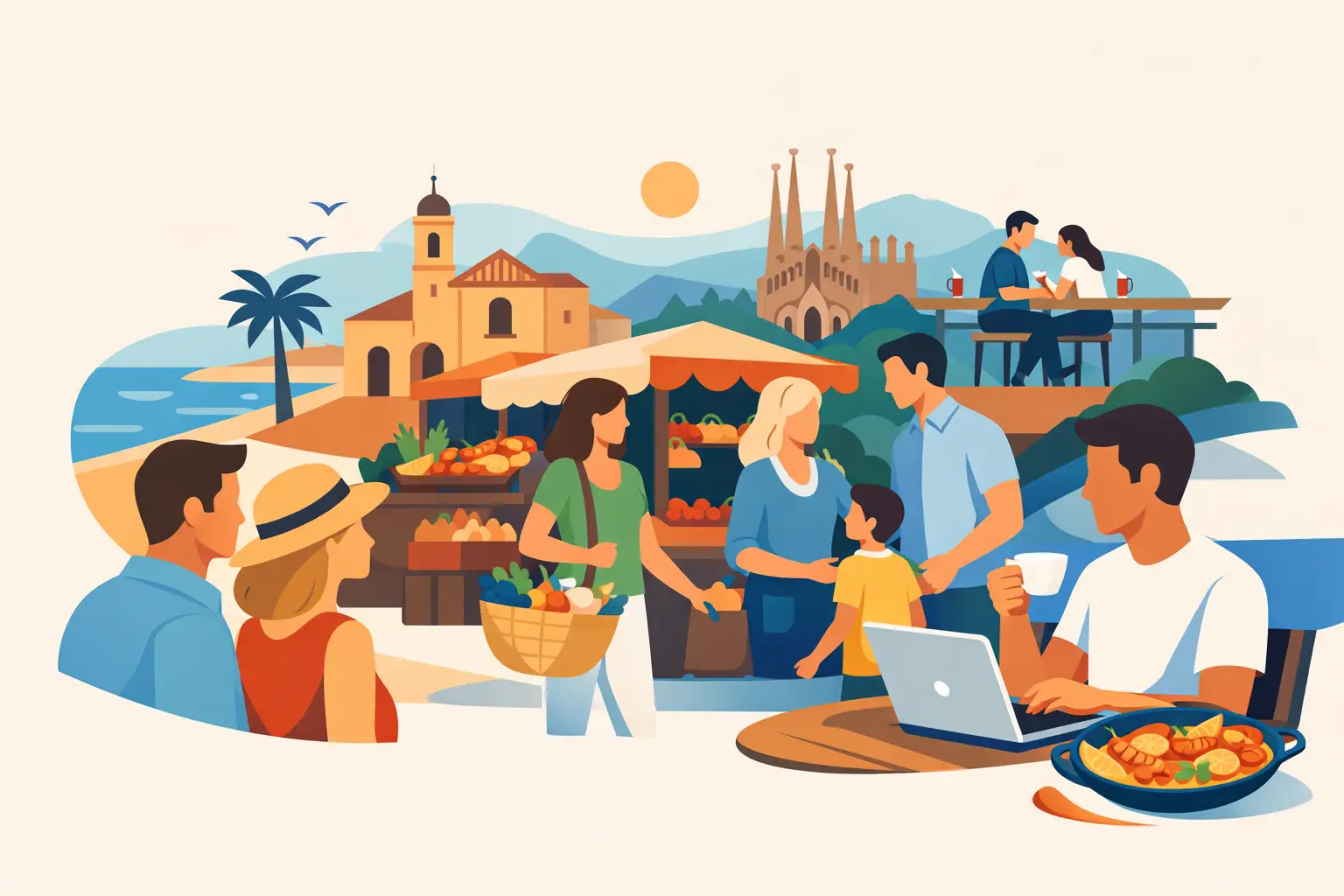
The first surprise for many expats in Spain is that life rarely runs on the schedule they expected. Shops may close in the afternoon, dinner starts late, paperwork can move slowly, and social warmth does not always mean immediate friendship. None of this makes Spain hard to live in, but it does mean that settling well depends less on a perfect relocation checklist and more on understanding how daily life actually works.
That gap between arriving and functioning is where many newcomers struggle. Spain is often marketed as easy, sunny, and relaxed, which is partly true. But the lived experience is more specific than that. Your quality of life can be excellent here, yet much depends on where you live, how much Spanish you speak, what kind of work you do, and how patient you are with systems that do not always operate with the speed or clarity you may be used to.
Why expats in Spain often adjust in stages
The early stage usually feels promising. You notice the walkable neighborhoods, outdoor cafes, and a daily rhythm that can feel less frantic than in many US cities. Public space is used well, many towns are social by design, and even ordinary errands can feel more human and less rushed.
Then comes the second stage, when the charm starts colliding with practical reality. You may discover that opening a bank account is not straightforward, landlords want extensive documentation, and official appointments can take time to secure. If you are working remotely for a non-Spanish employer, life may feel quite manageable. If you need to integrate into local employment or administrative systems quickly, the experience can be more demanding.
A third stage comes later, when the country starts making sense on its own terms. This is when many people stop comparing everything to home and begin adjusting expectations. Spain becomes easier once you understand its logic, even when you do not agree with it.
Daily life in Spain is local, not one-size-fits-all
One of the biggest mistakes newcomers make is treating Spain as a single lifestyle experience. Madrid, Barcelona, Valencia, Malaga, Seville, Bilbao, and smaller inland towns can feel like very different countries in practice. Cost, pace, climate, bureaucracy, housing pressure, and the expat presence all vary sharply.
Madrid tends to suit professionals who want energy, infrastructure, and career options, but it can feel expensive and fast by Spanish standards. Barcelona attracts international workers and creatives, though housing pressure and local political sensitivities can complicate the experience. Valencia often appeals to people who want a balance of affordability, services, and coastal living. Smaller cities and towns may offer lower costs and a stronger sense of local community, but they often require more language confidence and more flexibility.
This matters because the same person who feels isolated in one part of Spain may thrive in another. If you are choosing a destination, think beyond weather and scenery. Ask yourself how much structure you need, whether you rely on English, and what kind of social environment helps you feel grounded.
The social side of living abroad in Spain
Spain is widely seen as friendly, and in many ways it is. People are often more outwardly social in public than newcomers from the US or northern Europe expect. Conversation can be animated, public spaces are active, and social life often happens outside the home. That can make daily life feel more open and less private.
But friendliness is not the same as instant integration. Many expats in Spain find that it is easy to have pleasant interactions and much harder to build close local relationships. Established family networks and long-term friendships play a strong role in Spanish life. Social circles can be warm but not immediately permeable.
Language makes a real difference here. In highly international areas, you can function in English for many tasks. Still, basic Spanish changes the tone of your experience. It helps with practical matters, but just as importantly, it signals effort. In regions with strong local identity, such as Catalonia or the Basque Country, awareness of regional language and culture also matters. You do not need perfect fluency to be respected, but indifference can create distance.
Housing, cost, and the reality behind the lifestyle image
Spain can offer a good standard of living for less than many major US cities, but the low-cost dream is uneven. Rent has risen sharply in high-demand areas, especially in major cities and popular coastal zones. If your income comes from abroad in dollars or from a strong remote salary, you may feel comfortable. If you are earning locally, your budget may feel tighter than expected.
Housing searches can also be more competitive and document-heavy than newcomers assume. Landlords may request proof of income, work contracts, deposits, guarantors, or evidence that you can reliably pay. Temporary arrivals often find that the hardest part is not the monthly rent itself but proving stability in a system that prefers predictable paperwork.
Daily expenses depend heavily on lifestyle. Eating local food, using public transit, and living outside the most in-demand neighborhoods can keep costs reasonable. Imported goods, frequent travel, private international schooling, and premium housing can change the picture quickly. Spain can be affordable, but it is not automatically cheap.
Bureaucracy can shape your experience more than culture does
A lot of relocation stress in Spain comes from systems rather than social life. Administrative tasks may involve multiple steps, conflicting information, and long waits for appointments. Rules can be clear in theory and inconsistent in practice. What worked for one expat six months ago may not work the same way now or in another city.
This is where patience becomes a practical skill. Bureaucracy in Spain often rewards persistence, careful record-keeping, and the willingness to ask the same question more than once. It also helps to assume that paperwork will take longer than it should. Frustration is common, but it becomes easier to manage when you stop treating every delay as a sign that something has gone wrong.
For families, retirees, and long-term residents, these systems matter because they affect healthcare access, residency, taxes, schooling, and everyday legitimacy. For short-term remote workers, it may be tempting to focus only on lifestyle. That works until you need something official and realize your setup is less stable than it seemed.
Work and expectations for expats in Spain
Spain can be a great place to live while earning income from elsewhere. It is often less straightforward as a place to build a local career quickly, especially if you do not speak Spanish well. Salaries in many sectors are lower than US professionals expect, and job competition can be strong.
That does not mean professional life is poor. It means expectations need adjustment. If you arrive with a remote role, independent income, or a specialized skill set, Spain may offer an attractive quality-of-life trade-off. If you plan to enter the local labor market immediately, it helps to research salaries, hiring practices, and regional job conditions before assuming your professional profile will transfer smoothly.
The same applies to work culture. Depending on sector and city, workplace norms may feel more relationship-based, less direct, or slower-moving than in the US. Some people find that refreshing. Others find it inefficient. Usually, the best approach is to observe first and judge later.
What helps people settle well
The expats who tend to do best in Spain are not always the most adventurous. Often, they are the ones who can tolerate ambiguity without spiraling. They expect delays, build routines early, learn enough language to handle ordinary interactions, and choose location based on lifestyle fit rather than fantasy.
It also helps to resist building your entire life inside an expat bubble. Expat networks can be useful, especially at the beginning, because they reduce friction and provide practical information. But if they become your only point of contact, your experience can stay shallow and oddly fragile. A better balance is to use international networks for support while slowly learning how local life functions around you.
Spain can be deeply rewarding for people who want a life with more public social space, better everyday walkability, and a different relationship to time. It can also be frustrating if you need constant efficiency, immediate clarity, or rapid access to systems. Both things can be true at once.
If you are considering the move, focus less on whether Spain is “good for expats” in the abstract and more on whether your income, habits, expectations, and tolerance for uncertainty match the version of Spain you are actually likely to live in. That is usually the difference between a stressful experiment and a sustainable life.