
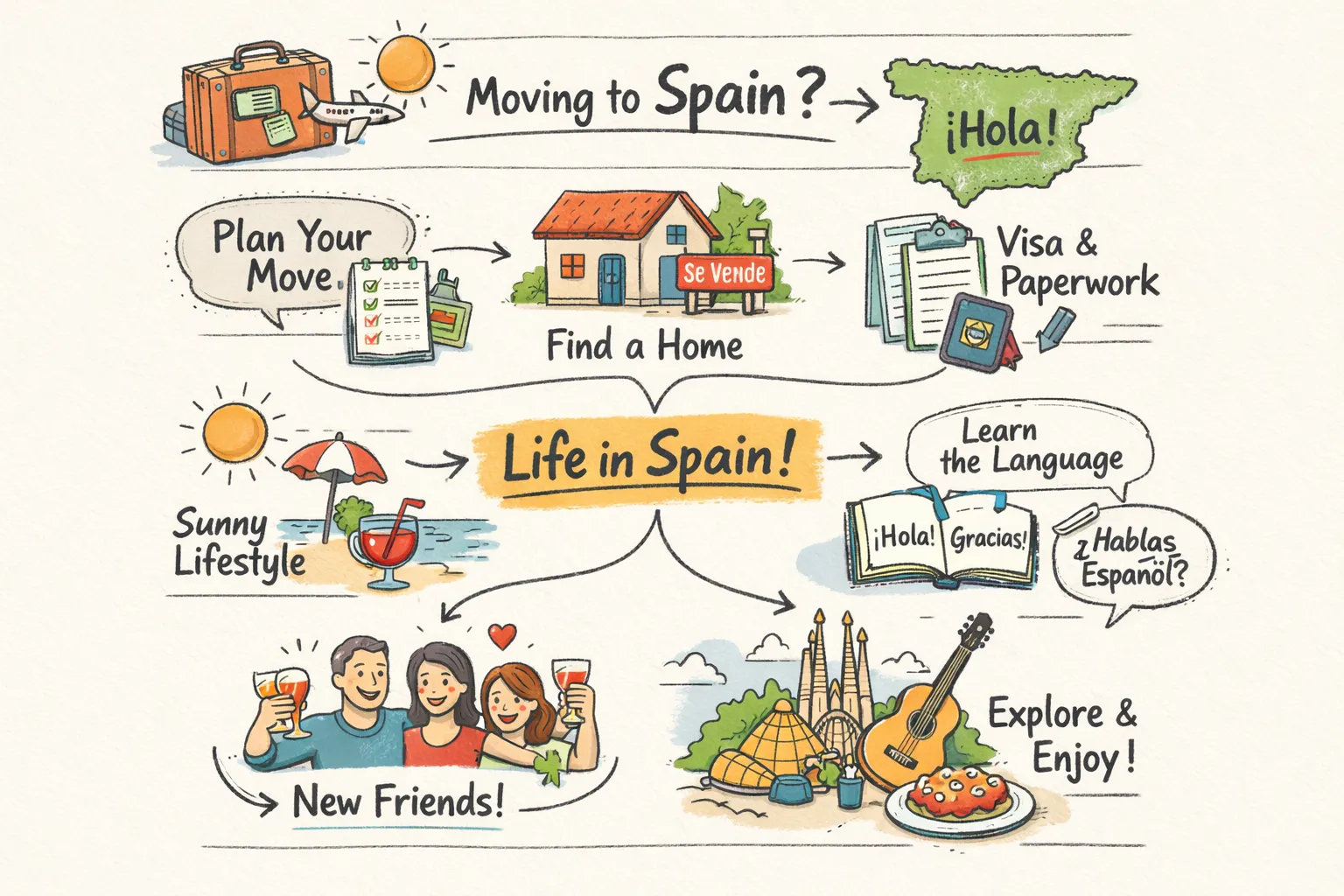
What this playbook gives you
By the time you finish this playbook you’ll be able to choose the right Spain residency route for your situation, build a realistic 90‑day timeline and budget, and complete the essential in‑country tasks — empadronamiento, obtaining an NIE/TIE, registering for healthcare and social security, and opening a bank account — with clear next steps and scripts to use on move day.
This is a condensed, field‑tested guide built from Expats World city research and on‑the‑ground experience. It strips the noise from official pages and gives practical steps you can follow now: what to book, what to bring, who to call, and when to escalate. A downloadable relocation checklist and editable email templates are available with the kit referenced in the final section.
Quick map — read this first depending on your priority
Need a visa decision? Start at “Choose the right visa” — the short decision checklist will point you to the best route.
Worried about money? Jump to “Build a realistic timeline and budget” for templates, city cost snapshots and the emergency fund rules you must follow.
Arriving soon? Read “The essential registrations” and “Move‑day checklist” to complete the first 30 days with confidence.
Choose the right visa: which route fits your life and job?
Pick the residency path that matches what you need to do in Spain: work, live off savings, invest, study, or join family. Below are the common options with the facts that matter.
Non‑lucrative visa (NLV)
Who it suits: people who can support themselves from savings, pensions or passive income and do not intend to work in Spain. Key requirements: proof of sufficient funds (400% of IPREM — roughly €28,800/year for the main applicant in 2026, plus €7,200/year per dependent), comprehensive private health insurance with no co‑pay if the consulate requires it, clean criminal record and medical certificate. Work rights: none. Where to apply: Spanish consulate in your home country. Typical processing: weeks to a few months; consulate fees and translation/apostille costs apply.
Work permit (employer‑sponsored)
Who it suits: those with a Spanish job offer. Key points: the employer usually manages the labour test and permit application; salary must meet the role and national minimum thresholds. Work rights: yes, tied to the sponsoring job (you can change status later under certain conditions). Where to apply: consulate or through the employer in Spain depending on the process. Processing: often 1–3 months; employer should guide you through required documents.
Digital nomad visa
Who it suits: remote employees or freelancers working primarily for non‑Spanish companies. Eligibility highlights: proof of remote work (contract or invoices), minimum net monthly income roughly €2,700–€2,800 (about 200% of Spain’s minimum wage in 2026), limitation on Spanish client share (commonly ≤20%), private health insurance and criminal record checks. Work rights: yes, for remote work only. Apply at the consulate or via some in‑Spain routes; processing commonly measured in weeks.
Golden Visa (Investor)
Who it suits: people investing substantial capital in Spain. Minimums: from €500,000 in real estate (most common), €1M in shares or deposits, or €2M in government bonds. Family can be included. Work rights: full. Residency benefits: fast track, broad Schengen access and minimal stay requirements. Where to apply: consulate; timeline tends to be faster than other long‑stay visas if documentation is complete.
Student and family‑reunification routes
Student visas require acceptance by an accredited school, proof of funds and health insurance. Family reunification depends on the sponsor’s rights in Spain and certified relationship documents (apostille and translations usually required). Both routes differ in documentation specifics and processing times — check your local consulate.
Decision checklist
- Do you plan to work for a Spanish employer? → Consider a work permit or Golden Visa.
- Will you live off savings or pensions and not work in Spain? → Non‑lucrative visa.
- Are you employed remotely by non‑Spanish clients or your own foreign company? → Digital nomad visa.
- Do you plan to invest €500k+ in Spanish property or equivalent? → Golden Visa.
- Are you arriving as a student or to join family? → Student or family reunification.
Quick case studies (real trade‑offs)
Anna chose the non‑lucrative route for freedom to stay but surrendered the right to work in Spain; she renewed twice because of stable passive income but later switched to a work permit when an employer offered sponsorship.
Diego used a digital nomad visa: lower documentation than full employment and the flexibility to keep his foreign contract, but he must maintain income thresholds and limit Spanish clients.
Sara bought a €520k apartment and applied under the Golden Visa for family inclusion — upfront capital tied her to market timing but opened full work rights and fast renewals.
Luis arrived with a job offer; his employer completed the labour test and he received a work permit tied to the company’s role within three months.
Marta applied as a student; the visa was quick but limited in work hours and required enrollment proof and health insurance.
Practical tip: Non‑lucrative visas generally must be applied for at your consulate; digital nomad and some work routes allow in‑Spain processing in specific circumstances. Common “gotchas”: appointment backlog at consulates, apostille + sworn translation requirements, municipal residence selection on forms, and strict entry windows after visa grant. Check your consulate’s checklist early.
Build a realistic timeline and budget before you move
Plan backward from your intended arrival date. Below are compact templates you can transpose into a personal calendar and a budget table you can adapt to your city choice.
Timeline templates (templates you can copy)
Six‑month plan: Months −6 to −4, gather core documents — passport, criminal record (issued within 3–6 months), medical certificate; request apostilles and sworn translations; verify financial statements; get private health insurance quotes; begin language classes if helpful; research neighbourhoods and shortlist cities. Months −3 to −2, book appointments with your consulate, arrange police checks, request employer documents (if relevant), start housing search and hold tentative move dates. Final month: confirm flights, temporary accommodation, international shipping quotes, and pack important originals in carry‑on.
Three‑month countdown: focus on bookings — flights, temporary lodging, initial bank transfer and doctor/insurance confirmations. Make digital copies of every official document and store them securely. Reserve viewings and schedule empadronamiento/NIE appointments as soon as you have an address.
30/14/7‑day prompts: 30 days — finalize housing and deposits, buy insurance covering your first month in Spain, get translation/apostille originals. 14 days — confirm NIE/TIE appointment, print and scan all documents, set up international payments. 7 days — pack essentials, confirm temporary accommodation check‑in and transportation from the airport, and prepare a “first 72 hours” folder of hard copies.
Budget line items
| Up‑front item | Typical cost (estimates) |
|---|---|
| Visa fees, consular payments | €80–€200 (varies by nationality and type) |
| Translations & apostilles | €50–€150 per document |
| Private insurance for visa | €400–€2,500/year (age dependent) |
| Flights (one‑way) | €200–€1,000 |
| Shipping vs buying locally | €500–€3,000+ (shipping); buy‑new often cheaper |
| Deposits & first month (rent + fianza + agency) | 2–4 months’ rent (varies by city) |
| Broker/agency fees | €0–1 month’s rent (market dependent) |
| Cash for first 3 months | €2,000–€6,000 depending on city and lifestyle |
| Emergency buffer | recommended 3–6 months’ expenses |
City cost snapshots (1‑bed center ranges; adjust for neighbourhood)
| City | 1‑bed center (€/month) | Approx. 3‑bed (center) |
|---|---|---|
| Madrid | €1,000–€1,600 | €2,000–€3,200 |
| Barcelona | €1,200–€1,700 | €2,400–€3,400 |
| Valencia | €800–€1,200 | €1,600–€2,400 |
| Málaga | €900–€1,200 | €1,800–€2,400 |
| Alicante | €600–€1,000 | €1,200–€2,000 |
Sample monthly totals (rent + essentials): an individual in Madrid/Barcelona should budget roughly €1,700–€2,000 as a modest baseline; in Valencia/Alicante the same comfort level often fits €1,200–€1,500. A family of four typically needs €3,000+ depending on school choices and neighbourhood.
Money rules of thumb
Keep a 3–6 month emergency fund in euros. For the non‑lucrative visa you must show roughly €28,800 for the main applicant (2026 IPREM guidance) plus €7,200 per dependent. For transfers use SEPA where possible; for one‑off large moves use Wise or a specialist FX provider to avoid SWIFT markups. If your total upfront cost exceeds your buffer, delay the move and build savings — that is the simplest risk‑reduction tactic.
Finding a home and signing the contract (rent or buy)
Search efficiently: Idealista and Fotocasa are the market leaders for listings; brokers speed up the process in competitive cities but charge fees; Facebook groups and local expat forums can uncover sublets or owner‑listed flats. Schedule viewings in blocks (two to three per day) to compare and to read the neighbourhood at different times.
Viewings — a phone checklist you can use in ten seconds
| Check | Why it matters |
|---|---|
| Heating/boiler condition | Costly repairs and comfort depend on it |
| Water pressure & hot water | Daily life test; ask about service interruptions |
| Community (comunidad) charges | Monthly fees can be separate from rent |
| Meter readings & utilities setup | Confirm current suppliers and transfer process |
| Internet availability & speed | Essential for remote work and applications |
| Noise & sunlight (time of day) | Visit at evening if possible |
| Building condition & elevator | Accessibility and maintenance |
| Inventory (inventario) & furnishings | Record existing items to avoid disputes |
| Security (locks, entry system) | Safety & insurance implications |
| Neighbourhood amenities & transport | Daily routines depend on this |
Lease mechanics: read the contrato de arrendamiento carefully. Key elements to confirm in the contract include the exact start and end dates, notice periods for both parties, the amount and conditions of the fianza (deposit), how comunidad charges are handled, and any agency or finder’s fees. Request an inventario of fixtures and used furniture and sign it together with photos to avoid deposit disputes.
Negotiation scripts — short, useable lines
Request a viewing (English): “Hello — I’m interested in the flat at [address]. Can I view it this week? I have references and a deposit ready.”
Solicitar visita (Español): “Hola, estoy interesado/a en el piso de [dirección]. ¿Podría verlo esta semana? Tengo referencias y depósito listo.”
Request inventory / lower rent (English): “Could you confirm what’s included in the inventory and if the landlord would consider a 6‑month discount or reduced notice period?”
Petición inventario / negociar (Español): “¿Puede confirmar el inventario y si el propietario consideraría un descuento por alquiler a largo plazo o reducir el plazo de preaviso?”
Renting red flags: wiring funds before viewing, refusal to show ID or contract, listings with drastically low prices, or landlords who ask to pay via non‑traceable methods. Verify ownership where possible and insist on a signed contract before paying any sums.
Buying: if you’re considering purchase with Golden Visa implications, plan for additional closing costs (taxes, notary, registry and legal fees). Use a local lawyer and request a nota simple from the Property Registry to confirm ownership and encumbrances.
The essential registrations once you arrive: NIE, empadronamiento, social security & TIE
Do these early: register your address at the town hall (empadronamiento) as soon as you have a long‑term address — many processes depend on the volante it issues. Apply for your NIE or EU registration certificate shortly after. If you are an employee, your employer will register you for Social Security; otherwise secure your social security number to access public healthcare or benefits. Non‑EU residents must apply for their TIE (residence card) within one month of arrival.
Empadronamiento
Documents typically required include passport, rental contract or landlord declaration and proof of address. Book an appointment (many large towns allow online booking) and request a volante de empadronamiento immediately — you’ll need this for healthcare enrollment, opening some bank accounts and school registration. Official guidance on registering as a resident and empadronamiento procedures is available on the national administration site: inscribirte como residente.
NIE / EU registration certificate
Forms vary by status; EU citizens use the EU registration certificate process (often Form EX‑18 in local guidance) while non‑EU residents follow consulate and Oficina de Extranjería instructions. You will pay the required fee (Modelo 790) and present passport, proof of resources or employment contract depending on visa type. Keep appointment confirmations and proof of payment on your phone.
Social Security and TIE
Employees are normally registered by their employer and gain access to the public healthcare system via the Social Security number. Non‑workers who need access must show the appropriate documentation. For non‑EU arrivals: apply for the TIE within 30 days, attend biometrics, and expect delivery times that can vary — keep a copy of the appointment and receipt while waiting.
Practical tips: bring multiple copies, keep certified translations or apostilles handy if requested, and save scanned copies of every submission. If appointment slots are full, try local police stations, alternate offices in the region, or a gestor (administrative agent) for faster processing; paying a professional can save days in crucial weeks.
Healthcare in Spain: public access vs private insurance
Public healthcare is accessed through Social Security for employees and via S1 forms for pensioners. The Tarjeta Sanitaria Individual is the card you use at your local centro de salud. If you’re on the non‑lucrative route you must have private medical insurance that meets consular requirements — typically comprehensive coverage with minimal or no co‑pay and a minimum coverage threshold.
Private insurance: common providers include Sanitas and Adeslas among others; expect premiums that grow with age and coverage level: younger adults may pay €40–€80/month, middle ages €70–€150/month, and older applicants higher. For visa purposes ensure your policy explicitly covers Spain and contains the consulate‑required clauses (no exclusions for pre‑existing conditions if asked).
Using the system: register at the local centro de salud with your empadronamiento and Social Security number (or private policy if non‑worker). Your GP is the gatekeeper for specialist referrals. Urgent care and emergencies use 112; pharmacies (farmacias) provide many OTC medications and local pharmacists can guide you in common cases. Wait times for non‑urgent specialists vary by region.
Documentation to register healthcare: passport/NIE, empadronamiento, Social Security number or private insurance policy (keep printed copies).
Banking, money transfers and paying taxes
Open a bank account early. Residents typically open a resident account (requires NIE and proof of address). Non‑residents can open special accounts but will face stricter checks. Documents usually asked for are passport, NIE or non‑resident certificate, proof of address and sometimes proof of income/source of funds. Digital banks (N26, Wise) are convenient for transfers; traditional banks (Santander, BBVA) are better for in‑person services.
Use SEPA transfers for euro‑to‑euro payments to minimize fees; use Wise, Revolut or other FX specialists for cost‑effective non‑euro transfers. Set up a local IBAN for recurring direct debits (utilities, rent, tax payments).
Tax residency: if you spend more than 183 days in Spain, or your centre of economic interests lies in Spain, you will likely be a tax resident subject to IRPF on worldwide income. Spanish tax is progressive and regionally variable; newcomers should review the “Beckham Law” and other special regimes if eligible (these can offer flat‑rate options for limited periods). US citizens must continue US filings (Form 1040, possible FBAR/FATCA) and can use foreign tax credits or exclusions — consult a bilingual tax adviser for year‑one planning.
Settling in: utilities, connectivity, schools, driving and daily life
Utilities and internet: main providers include Movistar, Orange and Vodafone. Installation windows vary; fibre is widely available in cities but confirm address availability on providers’ websites before signing a long rental. Expect to present ID and a rental contract when ordering services.
Mobile & SIM: choose between pay‑as‑you‑go or monthly plans; eSIM options are widely supported. Useful local apps include transport (Metro/Renfe), ride apps and delivery services — install these early to ease daily life on arrival.
Driving and vehicles: EU licences are usually valid; non‑EU licences may require exchange or a test depending on your country. Register with the DGT and insure the vehicle using Spanish insurance before driving long‑term.
Schools & childcare: public school placement uses empadronamiento to establish catchment. International schools require application fees and early enrolment; bring passports, empadronamiento and prior school records when registering.
Everyday culture and unspoken rules: shops, appointments and small businesses value politeness; greet with a “hola/buenos días.” Many services run on appointment times — book ahead to avoid waits. Expect slightly slower bureaucracy but strong neighbourhood networks that help solve practical problems.
Community: find local expat meetups and volunteer groups through Expats World city pages and forums — these pages collect trusted local contacts, meetups and editable templates for practical tasks like utility set‑ups and school enrolment.
Move‑day checklist, the 90‑day plan and next steps (downloadable kit)
Below is a compact, action‑first list for week one plus guidance for month one and the first 90 days. The downloadable kit includes editable templates (appointment emails, landlord letters, packing lists) you can use on move day.
First‑week checklist
- Get empadronamiento (volante) and save a digital copy.
- Confirm temporary accommodation and collect keys.
- Activate local SIM and make an emergency call to family.
- Withdraw a small amount of euros and open a basic bank account if possible.
- Book your NIE/TIE appointment and screenshot confirmations.
- Locate your nearest centro de salud and pharmacy.
First‑month priorities: secure long‑term housing and sign the lease, apply for NIE/TIE and Social Security, enroll in public healthcare or validate private insurance, open full bank accounts and set up utilities and internet. If you have children, start school registration with empadronamiento and previous records.
First 90 days & first year: complete TIE collection and keep proof of legal residency, review visa renewal windows and required documentation, file initial tax registrations if applicable, and gradually replace temporary contracts with long‑term services (electricity, internet, TV). Plan for the first renewal well ahead of expiry.
Troubleshooting quick fixes: lost passport — report to the police and contact your consulate immediately; denied appointment — try alternate offices, use a gestor, or escalate to the provincial Oficina de Extranjería; landlord disputes — document everything in writing, use the inventario as evidence, and contact local consumer arbitration if needed.
Downloadable kit & call to action
Use the downloadable relocation checklist in the kit to turn this playbook into a day‑by‑day plan. Expats World’s city guides contain neighbourhood briefings, vetted service provider lists and editable templates referenced in this article. If you prefer hands‑off support, personalised relocation planning and consultation bookings are available to walk you through visa paperwork, appointments and local registrations.
Final encouragement: friction is normal — missed appointments, translation hiccups and waiting times are part of the process. With the core actions done in the right order (visa confirmed, empadronamiento, healthcare and bank) most problems are solvable within days, and community resources will get you over the small bumps.
Recap — the critical first actions: confirm your visa route, secure a realistic timeline and buffer, register your address (empadronamiento), apply for NIE/TIE and Social Security, and set up healthcare and a local bank account. Download the checklist from Expats World to convert this playbook into a practical move‑day plan and to access city‑specific guides and templates to streamline your arrival.