
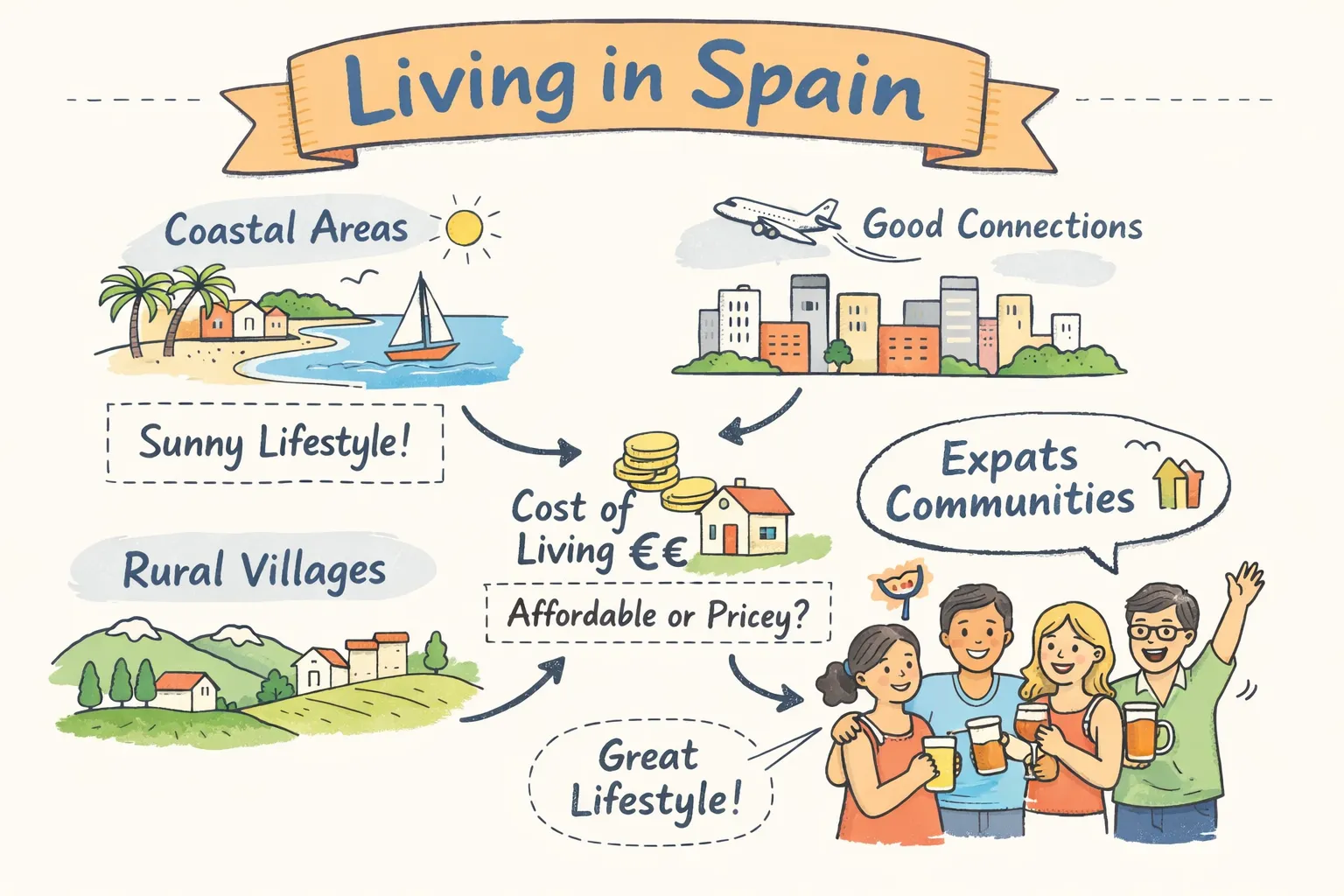
By the end of this guide you’ll be able to shortlist 2–4 Spanish cities that match your priorities, compare realistic cost brackets, identify where English speakers gather, and follow a concrete plug‑in plan for the first 30–90 days. At Expats World we’ve mapped neighbourhoods, local routines and the community channels that actually help newcomers settle fast. The data here pulls from 2024–2025 municipal and national sources; price and rent ranges are flagged where you should verify live listings before committing.
How to pick 2–4 Spanish cities that actually fit you
Good city selection is a scoring problem, not a gut test. Decide what matters, score cities against those criteria, then let numbers reduce a long list into a workable shortlist.
Score these seven criteria for your move on a 0–5 scale (0 = not relevant, 5 = critical): cost, climate, community size, job market, healthcare access, schools, travel links. For each city give a match score 0–5, multiply by your importance score, and sum. Higher totals = better fit.
Example: a digital nomad will weight job market and travel links heavily; a retiree will lean into community size, climate and healthcare. Two filled scorecards below show how 10–15 minutes of scoring turns a long wish list into 2–4 clear contenders.
| Criteria | Importance (0–5) | Valencia (match 0–5) | Valencia (weighted) | Barcelona (match 0–5) | Barcelona (weighted) |
|---|---|---|---|---|---|
| Cost | 4 | 4 | 16 | 2 | 8 |
| Climate | 4 | 4 | 16 | 4 | 16 |
| Community size | 4 | 3 | 12 | 4 | 16 |
| Job market | 5 | 3 | 15 | 4 | 20 |
| Healthcare | 3 | 4 | 12 | 5 | 15 |
| Schools | 0 | 0 | 0 | 0 | 0 |
| Travel links | 5 | 4 | 20 | 5 | 25 |
| Total | 91 | 100 |
| Criteria | Importance (0–5) | Torrevieja (match) | Torrevieja (weighted) | Alicante (match) | Alicante (weighted) |
|---|---|---|---|---|---|
| Cost | 5 | 5 | 25 | 4 | 20 |
| Climate | 5 | 4 | 20 | 4 | 20 |
| Community size | 5 | 5 | 25 | 4 | 20 |
| Job market | 1 | 1 | 1 | 2 | 2 |
| Healthcare | 5 | 3 | 15 | 4 | 20 |
| Schools | 0 | 0 | 0 | 0 | 0 |
| Travel links | 3 | 3 | 9 | 4 | 12 |
| Total | 95 | 94 |
Tip: set a cutoff (e.g., top 2–4 scores) and research those cities more deeply. Watch for red flags that change scores quickly: seasonal economies, island logistics, “language deserts” where English is rare, and small tourist towns with overstretched health services.
12 top international communities in Spain — short profiles and who they suit
Alicante
Alicante’s province hosts one of Spain’s largest foreign populations in absolute terms — over 380,000 foreign residents regionally — and a strong, service-oriented coastal infrastructure. Expats like reliable healthcare access, English‑friendly services, and good airport connections. Cost cue: mid‑range coastal — cheaper than Madrid/Barcelona but higher than inland towns. English signals: many British clubs and bilingual businesses. Tradeoff: summer crowds on the coast. Best for: retirees and families.
Torrevieja
Torrevieja shows one of the highest foreign‑resident shares (nearing 50%). It’s inexpensive, with a large British and Scandinavian presence, a dense network of international shops and healthcare geared to foreigners. Cost cue: among the most affordable coastal options. Watch out for heavy seasonality and quieter winter months. English signals: very strong in neighbourhood services. Best for: retirees seeking community and low cost.
Benidorm
Benidorm is a classic international seaside town with a disproportionate English‑speaking retail and hospitality scene and a year‑round tourist economy. It’s highly walkable and social but noisy at peak season. Cost cue: low‑to‑mid for apartments, good value for coastal life. English signals: strong — bars, clubs and services cater to the British market. Tradeoff: tourism intensity and limited “local” Spanish atmosphere. Best for: social retirees and short‑stay workers in hospitality.
Valencia
Valencia balances city life with the beach, increasingly attracting digital nomads and young families. Public transport, a growing tech scene and lower rents than Madrid/Barcelona are the draw. Cost cue: mid‑range, affordable relative to larger metros. English signals: growing — coworking spaces and language exchanges are common. Tradeoff: job market is improving but not as large as Madrid’s. Best for: digital nomads and families wanting city+sea balance.
Madrid
Spain’s capital is best for careers, cultural institutions and top‑tier healthcare. International companies and consulates create strong professional networks, but rents are higher and central neighbourhoods command premium prices. Cost cue: highest bracket nationally for central 1‑bed flats. English signals: excellent in business districts and universities. Tradeoff: cost and a faster urban pace. Best for: professionals and career‑focused moves.
Barcelona
Barcelona is cosmopolitan and globally connected with excellent transport and a large international community. Neighbourhoods vary dramatically: some feel global and pricey, others retain local Catalan character. Cost cue: high — expect significant variance by neighbourhood. English signals: strong in tourist and tech corridors, less so in traditional residential areas. Tradeoff: regulatory shifts and higher cost. Best for: cosmopolitan professionals and creative industries.
Málaga (province)
The Costa del Sol’s hub has lively expat clusters and extensive services aimed at long‑stay foreigners; Málaga province reports foreign shares north of 20% in places. Cost cue: mid‑range with coastal premiums in popular towns. English signals: robust across coastal municipalities. Tradeoff: tourist seasonality and uneven health resources in smaller towns. Best for: retirees and sun‑seekers wanting good services.
Marbella
Marbella is an upscale, internationally connected enclave with luxury real estate, golf, sailing and concierge services. The community skews affluent and internationally mobile. Cost cue: premium — expect substantially higher rents and purchase prices. English signals: very strong in luxury services and gated communities. Tradeoff: price and a more exclusive social scene. Best for: affluent retirees and lifestyle buyers.
Seville
Seville offers deep Andalusian culture, lower living costs than the large metros, and a family‑friendly pace. Expat presence is smaller than on the coasts but growing. Cost cue: affordable city living for quality of life. English signals: moderate — social circles often start with Spanish classes. Tradeoff: hotter summers and fewer large international employers. Best for: families valuing culture and affordability.
Girona
Girona reports a high share of foreign residents (around 20% in recent counts) and serves as a quieter gateway to Catalonia’s inland towns and the Costa Brava. It’s attractive for those who want proximity to Barcelona without the bustle. Cost cue: mid‑range outside tourist peaks. English signals: meaningful in international schools and small-town communities. Tradeoff: fewer big‑city amenities. Best for: families and people seeking quieter Catalan life.
Palma de Mallorca
Palma delivers island life plus international services: a large seasonal economy, good air connections and a visible foreign community. Cost cue: above‑average, especially in central and seafront areas. English signals: strong in hospitality and international schools, but island seasonality affects year‑round life. Tradeoff: higher costs and summer peaks. Best for: those who prioritise island living and international networks.
Tenerife & the Canary Islands
The Canaries offer year‑round mild climate and established long‑stay foreign communities with active English networks, particularly in southern tourist towns. Cost cue: mid to low depending on island and town. English signals: strong in tourist zones and long‑stay settlements. Tradeoff: flight connections to the mainland can be more limited and more costly. Best for: sun‑seekers and long‑stay retirees prioritising climate.
A practical cost snapshot: rent, bills and what to budget
Method: the figures below represent typical 1‑bed flats in city centre locations, plus an estimated monthly living budget that includes utilities, groceries, transport and a modest leisure allowance. Ranges reflect 2025 market scans; always verify live on rental sites and local groups before budgeting.
| City | 1BR city centre (est.) | Single monthly budget (incl. rent) | Couple monthly | Family (2+1) monthly |
|---|---|---|---|---|
| Madrid | €1,200–€1,500 | €1,900–€2,500 | €2,700–€3,700 | €3,800–€5,500 |
| Barcelona | €1,100–€1,400 | €1,800–€2,400 | €2,600–€3,600 | €3,700–€5,200 |
| Valencia | €800–€1,000 | €1,300–€1,700 | €2,000–€2,800 | €3,000–€4,200 |
| Málaga | €700–€1,100 | €1,250–€1,700 | €1,900–€2,600 | €2,800–€3,800 |
| Alicante | €900–€1,000 | €1,300–€1,700 | €2,000–€2,600 | €2,900–€3,900 |
| Seville | €800–€1,000 | €1,200–€1,600 | €1,900–€2,400 | €2,700–€3,500 |
| Marbella | €1,200–€2,000+ | €2,200–€3,000 | €3,000–€4,500 | €4,500–€7,000 |
| Palma de Mallorca | €1,200–€1,600 | €2,000–€2,800 | €2,900–€4,000 | €3,800–€5,200 |
| Torrevieja | €600–€800 | €900–€1,300 | €1,500–€2,100 | €2,200–€3,000 |
Typical agency fees and deposits: budget for a deposit of 1–2 months’ rent and be prepared to pay an agency fee commonly equivalent to one month’s rent (practices vary by region and some landlords cover agency fees). Expect first‑month rent up‑front, and for landlords to request proof of income or a guarantor if you have no Spanish employment.
How to update the numbers quickly: search Idealista/Fotocasa for “alquiler 1 dormitorio centro [city]”, check Numbeo for living costs, and join local WhatsApp or Facebook groups to confirm seasonality and current offers.
Where English speakers gather: groups, meetups and community hubs
Look beyond one‑off events. The most useful groups run frequent in‑person meetups, have clear admin, and a high ratio of “asks” to “offers”. Useful places to start include InterNations chapters, city‑specific Facebook groups, Meetup language exchanges, international schools, churches, golf/sailing clubs on the coast, co‑working spaces in bigger cities and volunteer organisations.
Evaluate a group by the number of in‑person events per month, the balance of practical posts vs endless classifieds, presence of active organisers, and whether members exchange real‑world help (rides, references, viewings).
- Three join‑in messages you can paste into a Facebook group or Meetup RSVP:
- “Hi — I’ll be in [city] from [dates] looking for a 1BR. Can anyone recommend a reliable agent or neighbourhood for [priority — quiet/transport/beach]? Thanks!”
- “New here — English speaker moving for work. Looking for tips on quick SIM cards, banks and a dentist. Any local recommendations?”
- “Hello — we just moved in and want to meet other families/sports clubs. Any parents who recommend youth football/swim clubs nearby?”
City starting points: coastal towns — check sailing and golf clubs first; Valencia and Málaga — coworking spaces and language cafés; Madrid/Barcelona — professional networking groups and university events; Palma/Tenerife — island expat social pages and sailing communities.
Housing & neighbourhood playbook: find a home without regret
Short workflow: book short‑term accommodation for arrival, spend 7–14 days viewing properly, then negotiate and sign. Use short‑term bookings to meet neighbours and test morning routes before committing long term.
When viewing, treat it like an inspection: test the internet, listen for noise, check water pressure and heating/cooling, and confirm storage and sunlight. Ask about community fees and whether utilities are included.
- Viewing checklist (on your phone during viewings):
- Internet speed and provider availability (run or ask for a speed test).
- Heating/cooling and insulation; radiator or A/C condition.
- Water pressure and drainage, bathroom fixtures.
- Noise (street, neighbours, bars) at different times if possible.
- Sunlight, security (locks, windows), lift access and stairs.
- Storage space, furniture condition (amueblado vs sin amueblar).
- Proximity to shops, transport and health services.
Contract practicalities: Spanish rentals commonly show up as “amueblado” (furnished) or “sin amueblar” (unfurnished); standard long‑term rent deposit ranges from one to two months; agency fees are often one month’s rent. Read the contract for clauses on subletting, repairs and inventory. Ask for the owner’s ID and a copy of the title deed if you want to verify ownership through the Registro de la Propiedad.
Negotiation script for rent and move‑in repairs: “We can sign today and provide a one‑month deposit. To proceed I’d need [repair A] fixed or a €X rent reduction for the first three months. Can you confirm in writing?” Use references, a job contract or proof of savings to strengthen your position.
Scams and warnings: don’t transfer large sums before seeing a property and validating ownership; avoid requests for wire transfers via Western Union, CashApp or crypto; confirm agency registration and insist on a written contract. If something feels rushed or consistently evasive, walk away and verify via local groups.
Residency, NIE and healthcare: the admin timeline for non‑EU arrivals
Main 2025 visa routes: Digital Nomad Visa (for remote workers; typical income floors apply and a 1‑year renewable permit is common), Non‑Lucrative Visa (passive income or pension; private insurance required), work visas (including entrepreneur/self‑employment and shortage occupation routes) and the new Job Seeker Visa offering up to 12 months to find work. Note: the Golden Visa rules changed in 2025 and are no longer the same route they once were — check current government notices.
Arrival admin (order matters): empadronamiento at the town hall (register your address), apply for the NIE (EX‑15 form) at a police or extranjería office, book TIE collection if your permit requires a physical card, register for social security and obtain a SIP health card, and maintain private insurance while waiting if your visa requires it. Typical timings: empadronamiento — immediate; NIE document: days to a few weeks; TIE and social security registration: weeks to months depending on region and appointment backlog.
Practical tips: prepare certified translations where required, carry originals and copies, prebook appointments online early, and consider using a local gestor (administrative expert) if you prefer a smoother turnaround — especially useful for property taxes, contracts, or complicated work permits.
Daily life and unspoken rules: what locals expect and how to belong
Small routines shape daily comfort. Many shops are open through the afternoon in cities, though small towns may close mid‑afternoon. Lunch is commonly 14:00–16:00 and dinner after 21:00. Greeting etiquette is relaxed: shake hands for first introductions and two kisses on the cheek become common with acquaintances. Weekends and fiestas reshape timetables — expect quieter daytime commerce during local festivals.
Language roadmap: English usually suffices in tourist and coastal hubs and in many professional pockets of Madrid and Barcelona, but Spanish (and Catalan in Catalonia) is essential for deeper integration and official paperwork. Three immediate language wins to practise: “Hola / Buenos días” (greeting), “¿Cuánto cuesta?” (how much?), and “¿Me puede ayudar, por favor?” (can you help me, please?). Practice them daily at markets, cafés and local shops.
Social integration tactics that work: become a regular at a local bar or café, sign your children up for local sports clubs, volunteer with a neighbourhood association, and take one course (cooking, language or craft) that forces weekly interaction. These actions build local ties faster than attending only expat events.
Shortlist exercise and 30‑day plug‑in checklist (with the Expats World toolkit)
Shortlist exercise: copy your top 4 scored cities into a simple table (name, total score, must‑have priority, dealbreaker). Convert scores into a final choice by removing any city with a hard dealbreaker (e.g., poor healthcare for medical needs) and keeping the top 2–3 by score. If you need speed, pick the top two and plan arrival checks in both for on‑the‑ground validation.
First‑week priorities (do these in‑country): get a local SIM, register (empadronamiento) at the town hall, open a local bank account or set up an IBAN‑ready fintech, book your NIE/TIE appointment and register with social security or arrange private insurance as required. Meet at least one neighbour or local store owner to establish a friendly contact.
30‑/90‑day follow ups: finalise a long‑term lease, register children at school if relevant, shift health coverage to long‑term public/private options, and join 2–3 local groups for weekly activity. Reserve complex admin (tax registration, company setup) for after your first month when you have an NIE and local address.
Quick wins vs things to do in country: you can handle visa paperwork, health insurance quotes and initial property searches remotely. Reserve NIE collection, contract signings, in‑person viewings and local bank ID verification for your arrival window.
Expats World resources: for this move we offer downloadable neighbourhood briefs, printable checklists (city comparisons, viewing sheets, admin timelines) and community directories that map local groups by city. If you want personalised support, book a consultation with our advisers to walk through your shortlist and the paperwork timeline. For step‑by‑step neighbourhood notes see our Moving to Spain as an Expat: Step‑by‑Step Playbook, and for broader city cost breakdowns check our Spain 2026: Real Expats’ Cost of Living — Madrid & More.
Two final points to remember: pick cities by fit, not reputation — your priorities should guide the scorecard — and verify costs and listings live before committing. When you’re ready, use the checklist and neighbourhood brief to turn a shortlist into a confident move. For more general cost guidance in 2025, see this cost of living overview for Spain.
Key takeaways: Score cities against the seven core criteria to reduce options quickly, verify rent and living costs on local platforms, and plug into English‑speaking communities via targeted groups and local clubs. When you need step‑by‑step neighbourhood notes or printable checklists, Expats World’s toolkit is designed to get you settled faster.