
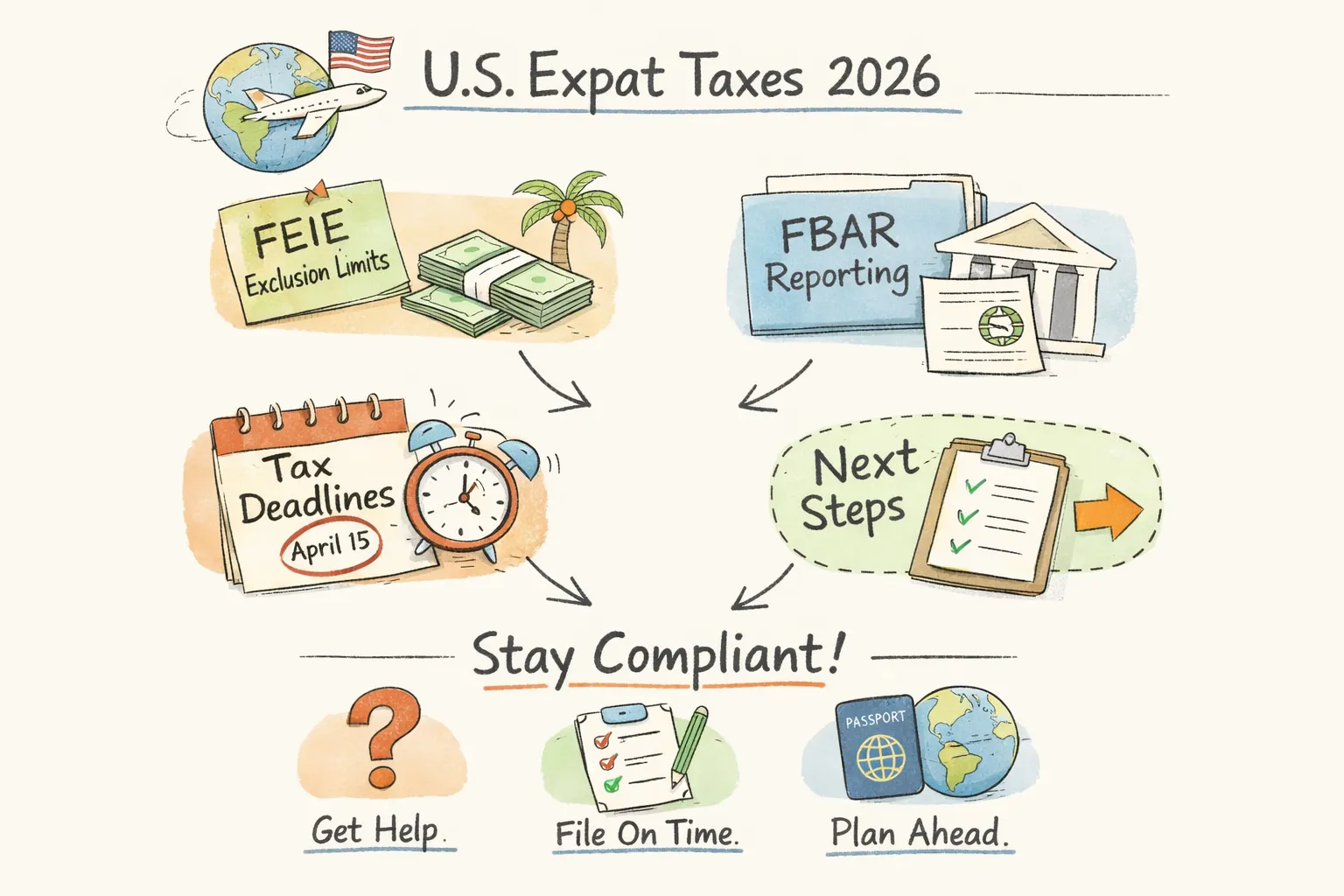
Yes — in most cases an American living abroad still has U.S. filing obligations. The good news is those obligations are predictable: once you know the filing thresholds, the small set of forms to watch, and the two main choices for avoiding double taxation, you can plan with confidence. At Expats World we’ve helped thousands of readers map this exact decision; below is a concise, practical roadmap you can use right away.
Read this and you’ll be able to decide whether you must file for the 2025 tax year (filed in 2026), identify the exact forms and deadlines you may need, run a quick FEIE vs. FTC comparison, understand FBAR/FATCA exposure, and pick the filing route that fits your situation.
Do you need to file U.S. taxes from abroad? A quick checklist
The filing decision starts with a simple threshold test: if your worldwide gross income meets or exceeds the standard filing amount for your status, you generally must file Form 1040 even if some of that income will later be excluded under the FEIE. Use the table below to check the common thresholds for the 2025 tax year (filed in 2026).
| Filing Status | Under 65 | 65 or Older |
|---|---|---|
| Single | $15,750 | $17,750 |
| Married filing jointly | $31,500 | Higher (see IRS rules) |
| Married filing separately | $5 | |
| Head of household | $23,625 | Higher (see IRS rules) |
Self-employed? If your net earnings from self-employment are $400 or more, you must file to report Self‑Employment tax and Schedule SE, regardless of other thresholds.
Remember: the IRS measures this against your gross worldwide income — that means foreign wages, foreign self-employment net income, interest, dividends, rental income, and other income before you apply FEIE. If your combined worldwide gross meets or exceeds the threshold in the table, plan to file Form 1040.
Quick practical check you can run in 10 minutes: locate your last 12 months of paystubs and foreign bank/brokerage statements, write down total gross wages, add foreign interest/dividends and rental or business net income, convert large items to USD if needed, and compare to the threshold for your filing status. If you’re close to the line, gather supporting documents and consider filing — sometimes a refund or credits make filing worthwhile even below the threshold.
Essential forms and deadlines for the 2025 tax year (filed in 2026)
There are a few forms that keep recurring in expat returns. Know what each does and when it’s due.
- Form 1040 — Your annual U.S. income tax return; other expat forms attach here.
- Form 2555 — Claim the Foreign Earned Income Exclusion (FEIE) and housing exclusion/deduction.
- Form 1116 — Claim the Foreign Tax Credit (FTC) for foreign taxes paid.
- FinCEN Form 114 (FBAR) — Separate electronic filing for foreign financial accounts (file at bsaefiling.fincen.gov).
- Form 8938 (FATCA) — Attach to Form 1040 to report specified foreign financial assets when thresholds are met.
- Schedule C and Schedule SE — Report business income and compute self‑employment tax.
- Form 4868 — File to request an extension to October 15 (see timing below).
Key deadlines and payment timing:
Taxes owed are due April 15, 2026. U.S. citizens and resident aliens living abroad receive an automatic filing extension to June 15, 2026, for filing (no form required), but interest accrues on unpaid tax after April 15. If you need more time to file beyond June 15, submit Form 4868 by June 15 to extend the return deadline to October 15, 2026. Note: extensions extend filing time only — they do not extend time to pay.
The FBAR (FinCEN Form 114) is due April 15, 2026, with an automatic extension to October 15, 2026; file electronically at bsaefiling.fincen.gov. For practical tips on FBAR pitfalls and common filing mistakes, see this FBAR compliance guidance.
Form 8938 follows your 1040 timetable and is attached to your return.
Filing tip: before you start, collect foreign bank and brokerage statements showing the highest balances during the year (FBAR needs maximum values), gather foreign tax returns and receipts, and request employer letters that confirm foreign wages and tax withholdings — it makes completing Forms 2555 and 1116 far quicker.
FEIE and the qualifying tests: what counts and how to qualify
The Foreign Earned Income Exclusion (FEIE) allows qualifying U.S. taxpayers to exclude foreign earned income up to the annual limit from U.S. taxable income. For the 2025 tax year (filed in 2026) the maximum exclusion is $132,900 per qualifying person. Married couples can each claim their own exclusion if they independently qualify.
Two ways to qualify:
Physical Presence Test
You meet this test if you are physically present in one or more foreign countries for at least 330 full days during any consecutive 12‑month period. Days must be full calendar days abroad; short U.S. transits break a “full day” count. The 12‑month period can cross tax years and exclusion is prorated if your qualifying days are fewer than 365 (exclusion × qualifying days ÷ 365).
Bona Fide Residence Test
This is a fact-based test: you must be a bona fide resident of a foreign country for an uninterrupted period that includes an entire tax year. The IRS looks at intent, whether you established a home abroad, family ties, employment, foreign tax status, and local registrations. There’s no precise day count, but the requirement is stricter on intent and permanence.
Housing exclusion/deduction: Form 2555 also permits a housing exclusion or deduction for reasonable housing expenses above a base amount. For 2025 the base is roughly 16% of the FEIE maximum (≈ $21,264) and the general cap is about 30% of the FEIE maximum (≈ $39,870), with higher location limits for very costly cities. Housing exclusion reduces taxable income further but does not affect self‑employment tax.
What doesn’t qualify: pensions, most investment income, capital gains, and other passive income are not FEIE‑eligible. The FEIE also does not exempt you from self‑employment tax; if you run a business abroad you may still owe Social Security/Medicare unless a totalization agreement applies.
Documenting qualification: keep a days‑abroad log, passport stamps, employer letters showing assignment dates and foreign wages, local lease or mortgage statements, utility bills, and foreign tax certificates. These materials make both the Physical Presence and Bona Fide Residence tests straightforward to substantiate if asked. For a practical walkthrough and worked examples of FEIE calculations, consult this FEIE guidance.
FEIE vs Foreign Tax Credit: how to run the numbers and choose
FEIE and the Foreign Tax Credit (FTC) address double taxation differently. FEIE excludes earned income up to the limit, lowering your AGI; FTC gives a dollar‑for‑dollar credit for foreign income taxes paid and can cover both earned and passive income. You cannot claim both on the same dollar of income, but you can mix — exclude some earned income with the FEIE and use FTC for taxes on remaining foreign income.
Here’s a straightforward way to compare the two for your situation:
- Calculate your worldwide gross income and determine U.S. taxable income before any exclusions or credits.
- Compute your U.S. tax liability on that full taxable income (this is your baseline U.S. tax).
- Apply FEIE: reduce taxable income by the FEIE limit (or prorated amount) and recompute U.S. tax. Note how AGI and qualification for deductions/credits change.
- Alternatively, compute FTC: total your foreign income taxes paid, complete Form 1116 to find the FTC limitation, and calculate the allowed credit. Subtract allowed FTC from your baseline U.S. tax.
- Compare net U.S. tax under each approach and consider secondary effects (lower AGI can affect student loan payments, IRA deductibility, or eligibility for certain credits).
Two concise examples:
Low‑tax country (e.g., UAE): You earn $95,000 in wages abroad, pay no foreign income tax. Under FEIE you can exclude almost all earned income (up to $132,900), leaving little or no U.S. tax on wages. FTC is moot because there are no foreign taxes to credit. FEIE typically wins in no/low‑tax jurisdictions.
High‑tax country (e.g., Germany): You earn $150,000 and pay $40,000 in foreign income tax. FEIE would exclude up to $132,900 of earned income, but significant tax has already been paid abroad on the full $150,000. Using FTC, you compute the limitation and often find that foreign tax credits nearly eliminate U.S. tax and may protect passive income that the FEIE cannot cover. In many high‑tax countries FTC is the better outcome. For step‑by‑step help claiming the Foreign Tax Credit with Form 1116, H&R Block’s guide is a helpful reference: how U.S. expats claim the Foreign Tax Credit.
Rule of thumb: FEIE fits low/no‑tax situations and when your income is largely earned wages. FTC fits high‑tax countries and mixed income portfolios (wages plus dividends, rentals). When in doubt, run both scenarios — the numbers tell the story. For broader long‑term planning and investment considerations linked to these tax choices, see our Wealth Building Essentials.
FBAR and FATCA explained — what to report, how, and penalty traps
FBAR (FinCEN Form 114) and FATCA (Form 8938) are separate filings with different scopes and thresholds. Filing one does not substitute for the other.
FBAR triggers when the aggregate maximum value of your foreign financial accounts exceeds $10,000 at any point during the calendar year. That includes bank accounts, brokerage accounts, and certain pension or insurance accounts. For FBAR you must report the maximum balances during the year (not just year‑end), convert to USD using Treasury/IRS guidance, and file electronically at bsaefiling.fincen.gov.
Form 8938 (FATCA) requires reporting specified foreign financial assets on your Form 1040 if you exceed higher thresholds. For taxpayers living abroad those thresholds are roughly $200,000 on the last day of the year or $300,000 at any time during the year for single filers, and $400,000/$600,000 for married filing jointly. Form 8938 covers some assets that FBAR does not (e.g., foreign stock held directly), and FBAR covers some accounts that 8938 may exclude — they are complementary.
Penalties are real. FBAR non‑willful penalties can reach several thousand dollars per violation; willful violations can be far larger (including penalties that are a percentage of account balances). Failure to file Form 8938 can result in $10,000+ penalties that escalate if not corrected. If you made an honest mistake, don’t ignore it — the IRS Streamlined Procedures and other relief routes exist, but proactive disclosure is safer than silence.
Practical safeguards: keep monthly or end‑of‑month balance snapshots, consolidate statements into a single spreadsheet, note currency conversions, and store screenshots or PDFs of account summaries. When filing FBAR, use the BSA E‑Filing System (bsaefiling.fincen.gov) and keep the filing receipt for your records.
State tax traps and how to sever your U.S. ties properly
Even when federal tax is sorted, state taxation can come as an unexpected problem. Some states aggressively assert residency for taxpayers living abroad. Watch especially for California, New York, New Jersey, Massachusetts, and Virginia — these jurisdictions have high audit activity and broad residency tests.
To reduce the risk of continued state tax liability, create a clear paper trail showing your new foreign life: sell or rent out your U.S. home or document a bona fide foreign residence; move immediate family with you where possible; obtain local identification and tax registration; open local bank accounts; register to vote and cancel your U.S. voter registration; and update your driver’s license and mailing address to the foreign country. Keep a travel log that documents the dates you enter and leave the U.S.; many states use day counts in residency tests.
Documentary evidence matters more than assertions. Keep lease or sale contracts, utility bills, employment contracts, foreign tax returns, and local social registrations. If a state’s rules are complex or you anticipate an audit, request a residency determination from the state revenue department or consult a state‑specialized CPA — or consider Expats World’s Financial Consulting for assistance with state residency issues and audit preparedness.
Sample script for a residency clarification email or call: “Hello — I am a former [state] resident who relocated overseas on [date]. My tax home is now in [country]. Please advise whether I must file a resident return for tax year 2025 and what documentation you require to support non‑residency.” Keep the exchange brief and save any formal acknowledgements.
How to file: DIY, expat tax software, or hiring a specialist
Choose the filing route that matches your complexity, risk tolerance, and budget. Ask yourself: Do you have one foreign paycheck, a simple savings account, and no FBAR/FATCA exposure? Then DIY or mid‑level expat tax software may suffice. Do you run a business, own rental property abroad, have complex foreign investments, multiple countries of income, or state residency questions? Then hire an expat‑specialist CPA.
Quick pros and cons in practice: DIY is lowest cost and acceptable for simple FEIE-only returns, but it’s easy to miss FBAR/8938 nuances or make conversion errors. Expat tax software is mid‑cost and efficient when it explicitly supports Form 2555, Form 1116, and 8938; you still file FBAR separately. A specialized expat CPA is higher cost but offers audit support, multi‑country planning, and relief procedures (e.g., Streamlined). Expect pricing to vary widely — ask for sample deliverables and a fixed scope upfront.
When preparing to hand off to a pro, gather: passport and travel log, last two years of U.S. returns, foreign payslips and employer letters, foreign tax returns and receipts, monthly bank/brokerage statements showing maximum balances, details of foreign businesses or trusts, prior FBAR filings, and any correspondence with state tax authorities. If you want help organizing these items into a long‑term plan, our Personal Financial Planning service can create a single checklist tailored to your situation.
Vet prospective tax pros for expat experience, credentials (EA, CPA, or tax attorney), familiarity with the Streamlined Filing Compliance Procedures, transparent fees, and references from clients in your same country or situation. A well‑documented handoff saves time and often reduces cost. For official rules and thresholds, consult the IRS filing guidance for citizens and residents abroad: IRS filing requirements for citizens and residents abroad.
A good specialist will also explain when Form 1116 is preferable and how to prepare it; for a plain‑language overview of claiming the FTC see the H&R Block guide linked above.
Your 30/60/90‑day action plan (and how Expats World helps)
First 30 days — immediate items
Assemble payslips, last year’s foreign tax returns, and bank statements. Start a days‑abroad log (date, country, purpose). Do a quick gross income tally to see whether you meet the filing threshold. If you estimate tax due, make a payment by April 15 to limit interest. Note FBAR exposure by checking whether your total foreign account maxima exceeded $10,000 at any point.
Next 60 days — decide your tax strategy
Run the FEIE vs. FTC numbers using simple worksheet steps (compute worldwide income, compute U.S. tax with and without exclusion, compute FTC limit). Draft Form 2555 or Form 1116 worksheets to see which saves more. Gather maximum balances for each foreign account and prepare the data you’ll need to file FBAR online. If you want a guided walkthrough and practical templates for these exercises, use our Financial Freedom Blueprint.
By day 90 — file or extend
File your 1040 if ready, or file Form 4868 by June 15 to extend to October 15. File FBAR electronically at bsaefiling.fincen.gov before the October extension deadline if needed. Attach Form 8938 to your 1040 if thresholds are met. Keep a digital audit folder with all receipts and records for at least six years.
How Expats World helps: our country and city guides explain local tax timing and common documentation practices, and our practical resource pages include downloadable checklist templates — a days‑abroad travel log, an FBAR helper spreadsheet, and clear Form 2555/1116 worksheet templates you can use to run the numbers. Use these templates to prepare your materials before you file or hand them to a tax professional.
Conclusion
Your path forward is three clear checks: (1) do a quick threshold test with your worldwide gross income; (2) gather account maxima and foreign tax records so you can file FBAR/8938 if required; and (3) run a simple FEIE vs. FTC calculation to see which lowers your U.S. tax burden. If your situation is straightforward, you can safely handle filing yourself or with expat tax software; if you have multiple countries, investments, or state residency questions, hire a specialist.
Take action in the next 24–72 hours: tally your gross foreign income, snapshot your highest foreign account balances, and start a days‑abroad log. For country‑specific steps and printable checklists, visit Expats World’s practical guides — the templates there will save time and reduce uncertainty as you prepare your 2025 return. For a broader pre‑departure checklist, see our Ultimate Pre‑Move Checklist for Expats.