
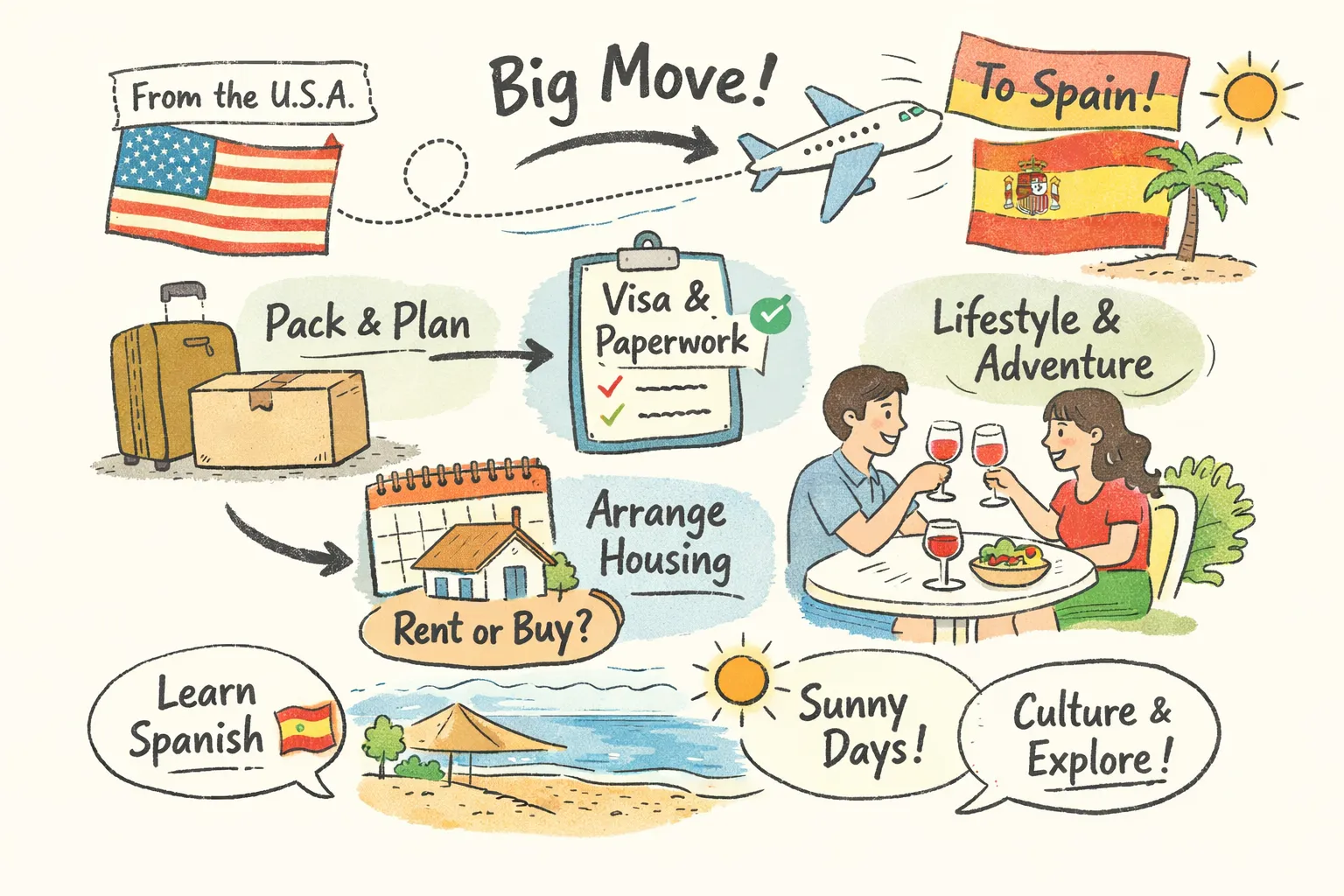
Imagine you’ve booked a one‑way ticket to Spain and you’re staring at three questions that decide everything: which visa will give you the rights you need, how will you handle U.S. and Spanish taxes and healthcare, and where in Spain will make your life actually easy? Those three choices—visa, taxes/healthcare, and location—shape work rights, access to the public health system, and day‑to‑day costs.
Read this guide to finish with a clear, practical plan: pick the right visa, understand the tax basics you must report to both countries, build a realistic monthly budget for Madrid, Barcelona, Valencia or Málaga, complete the critical admin tasks (NIE, empadronamiento, bank, social security), and follow a 90‑day timeline for settling in. Along the way you’ll find sample timelines, document checklists, and short scripts you can copy into emails.
Expats World is the practical partner for the next steps: the Spain relocation checklist, an interactive visa comparison tool, and city‑by‑city guides are available to download if you want ready‑made templates and vetted local tips after this article. Use the decision order in this guide—visa → taxes/healthcare → location—and follow the 90‑day playbook at the end.
1) Choosing a visa: which route fits your situation?
Your visa choice determines whether you can work, what benefits you access, how long you can stay, and which family members can join. Make the decision on two axes: (1) do you plan to work for a Spanish employer or be tax‑resident in Spain, and (2) are you earning active income (salary/freelance) or living off savings/passive income? The sections below translate those choices into the main pathways.
Digital Nomad Visa
Who it fits: remote employees or freelancers who provide services to non‑Spanish clients and want to live in Spain. Key requirements are a university degree or three years’ professional experience, proof of remote employment or contracts, private health insurance, and a minimum income threshold (roughly €2,762/month in 2026—about 200% of Spain’s SMI). Family may apply as dependents.
Process & timeline from the U.S.: gather degree/proof of experience, recent payslips/invoices and bank statements (2–4 weeks), obtain an apostilled FBI report (FBI background check), buy private health insurance, book the consulate appointment (1–4 weeks wait depending on location), and expect a decision in about 20 business days. Consular approvals usually issue a 1‑year visa; once in Spain you can apply to immigration for a multi‑year residence permit (three years initially, renewable).
U.S. applicants can find a practical step‑by‑step overview in this guide to Spain’s Digital Nomad Visa for U.S. citizens.
Pros/cons: quick route for remote workers and family inclusions; gives residence rights and easier banking. Cons: income and documentation thresholds and partial limits on Spanish‑sourced work (check the ≤20% Spanish income rule). Use the visa comparison tool in the Expats World packet to see how it stacks against other options for your exact situation.
Non‑Lucrative Visa (NLV)
Who it fits: retirees or people living on passive income or savings who do not plan to work in Spain. The key financial benchmark is roughly 400% of the IPREM (about €28,800/year for the main applicant in recent guidance). You must show stable passive income, have private health insurance covering all risks in Spain, and supply apostilled criminal records and medical certificates.
Notes: the NLV prohibits work performed in Spain. Remote work for foreign clients is generally incompatible with this visa—use the Digital Nomad Visa instead. Initial grants are usually for one year with renewals in two‑year increments.
Work Visa & Highly Qualified Professional
Who it fits: employment sponsored by a Spanish company. Employers initiate most work visas and must demonstrate the job cannot easily be filled locally or that the applicant meets specialized qualification and salary thresholds (typical guidance places many roles in the €40,000–€56,000 range for highly qualified positions, but this varies by role and region).
How it works: employer applies to immigration for the work authorization, you apply for the visa at a consulate, then enter Spain and complete TIE formalities. Processing depends on the employer’s paperwork and regional offices—expect several weeks to a few months.
Student & Family Reunification
Student visas allow full‑time study and limited work hours; family reunification lets dependents join a lawful resident under specific criteria (spouse, minor children, dependent parents in defined cases). Use family reunification when the principal applicant already holds a valid residence permit.
Recent administrative notes
Spain centralized many filings on a digital platform in 2026, which speeds some processes—check your consulate’s guidance. The Golden Visa program ended in 2025; investor routes are no longer available.
Decision scenarios and what to prepare
Vignette 1 — Remote engineer with U.S. employer who wants Spanish residence: Digital Nomad Visa (prepare degree, employer letter, payslips, FBI apostille, private insurance). Vignette 2 — Retiree living on investment income: Non‑Lucrative Visa (prepare proof of funds, bank statements, full private health plan). Vignette 3 — Corporate transferee: employer‑sponsored work visa (ensure employer handles authorization paperwork).
Before any application, prepare: passport + copies, apostilled criminal record, degree or employment history, three months of bank statements, proof of accommodation in Spain, and private health insurance. Translations must be official where requested. Download Expats World’s visa comparison checklist to line up documents for consular appointments.
2) Taxes and social security: what U.S. citizens in Spain must plan for
Taxes are a frequent surprise. Spain taxes residents on worldwide income; the U.S. taxes citizens on worldwide income. Relief comes from the Foreign Earned Income Exclusion (FEIE), the Foreign Tax Credit (FTC), and the U.S.–Spain tax treaty. Residency determines the Spanish tax bill: stay more than 183 days a year, have your center of vital interests in Spain, or keep your family here and you’re a Spanish tax resident.
The FEIE (Form 2555) can exclude earned income up to the 2026 cap of $132,900 if you meet the bona fide residence or 330‑day physical presence test. High earners often prefer the FTC (Form 1116) because Spanish progressive rates can exceed the FEIE cap. You must still file a U.S. Form 1040 and report foreign accounts (FBAR/FinCEN Form 114) if aggregate overseas accounts exceed $10,000, and Form 8938 for FATCA thresholds.
For a practical, U.S.‑focused breakdown of tax issues while living in Spain, see this Americans in Spain: expat taxes guide.
| Common U.S. filings | Trigger |
|---|---|
| Form 1040 | Annual U.S. tax return |
| Form 2555 (FEIE) | Qualify via residency/presence to exclude earned income |
| Form 1116 (FTC) | Claim credit for foreign taxes paid |
| FinCEN 114 (FBAR) | Aggregate foreign accounts > $10,000 |
| Form 8938 (FATCA) | Specified foreign assets above thresholds |
Example: if your salary is under the FEIE cap and you qualify, you may avoid U.S. federal income tax on that salary. If your salary is larger, the FTC often limits double taxation by offsetting U.S. tax against Spanish tax paid.
Social security follows different rules. Spain and the U.S. have a Totalization Agreement to prevent double contributions. Employees typically pay into the country where they work; short assignments and posted workers can stay under their home social security if the employer certifies coverage (A1 certificate equivalent). Self‑employed people (autónomos) normally pay Spanish social security contributions once resident and registered; if you remain U.S.-covered as posted staff, confirm with your employer and a benefits specialist.
Actionable tax checklist: tell your U.S. CPA your planned residency date, provide monthly/annual income and types (salary, freelance, investment), ask whether FEIE or FTC serves you best, and confirm FBAR/FATCA exposure. Hire an expat tax advisor if you have investment income, rental properties, or plan to become a Spanish tax resident—these are common triggers for complexity.
3) Healthcare: how to get covered fast (public system and private backup)
Spain offers a high‑quality public system (Sistema Nacional de Salud, SNS) that legal residents access. For visa compliance and speed, many expats buy private insurance first, then register with the SNS once they have social security coverage.
Typical path to public coverage: obtain your NIE, register at your local town hall (empadronamiento) to prove address, get a social security number (your employer often helps), then pick up your health card (TSI/SIP) at the local health center and receive an assigned GP. In big cities the overall process can take 2–8 weeks once documents are in order; smaller towns often move faster.
If you are not contributing yet, consider the Convenio Especial (a voluntary contribution scheme) or maintain private insurance for the interim. The Convenio can be cost‑effective for some long‑term non‑contributors but rules vary by region and age.
For a clear primer on how the Spanish healthcare system operates and what to expect as a newcomer, read how the Spanish healthcare system works.
Private insurance is required for Non‑Lucrative visas and commonly used by digital nomads for quick access and English‑speaking doctors. Expect premiums roughly in the range €50–€200 per month depending on age and coverage. Shop for full‑coverage plans if you plan a family or have pre‑existing conditions.
Quick tip: register children early—local clinics prioritize pediatric enrollment; bring full birth certificates, apostilles where required, and empadronamiento. If you need immediate care on arrival, private clinics provide faster access while you sort public registration.
4) Money matters and cost of living: real budgets for four cities
We use a simple methodology: rent + utilities + groceries + transport + modest extras. Ranges reflect mid‑2026 market conditions for expat‑friendly neighbourhoods.
| City | 1‑bed center | 1‑bed outside | 3‑bed center/outside |
|---|---|---|---|
| Madrid | €1,000–1,500 | €700–1,000 | €1,800–2,500 |
| Barcelona | €1,200–1,700 | €800–1,100 | €2,000–3,000 |
| Valencia | €800–1,200 | €600–900 | €1,400–2,000 |
| Málaga | €900–1,400 | €650–1,000 | €1,500–2,200 |
| Household | Madrid | Barcelona | Valencia | Málaga |
|---|---|---|---|---|
| Single | €1,900–2,200 | €2,000–2,400 | €1,600–1,900 | €1,700–2,000 |
| Couple | €2,600–2,900 | €2,800–3,200 | €2,200–2,600 | €2,300–2,700 |
| Family (4) | €3,200–3,700 | €3,400–4,000 | €2,800–3,300 | €2,900–3,500 |
Money logistics: open a Spanish bank account once you have (or while you’re applying for) a NIE—many banks accept passport + empadronamiento temporarily, but a full account often requires an NIE. Use regulated currency transfer services (not airport kiosks) for moving savings; SEPA transfers with IBAN are standard for salary deposits. Keep a U.S. account for long‑term investment access and link accounts via a transfer provider that offers transparent FX rates.
Cost‑saving rules of thumb: live outside the historic centre to save 20–30% on rent, shop weekly at mercados for fresh produce, and use monthly transport passes. Shared housing or a two‑room flat can halve housing costs for singles.
For more detailed city‑by‑city comparisons and budgeting, consult this cost of living guide for Spain.
5) Where to live, how to find housing, and must‑do admin in the first weeks
Choose a neighborhood by commute to work or school, proximity to a health center, and access to daily needs (supermarket, mercado, public transport). Expats World’s city guides break neighborhoods down by routine—which ones are best for families, nightlife, and quieter life; see our Valencia Expat Guide or Seville Expat Guide for neighborhood examples.
Housing search realities: agents (inmobiliarias) are common in big cities and usually charge one month’s rent + VAT or a broker fee; private listings remove that cost but require quicker action. Deposits are typically one to two months. Read leases carefully for duration, indexation clauses (many leases include CPI indexation or “IPC” adjustments), permitted subletting, and notice periods (commonly 30–60 days).
Arrival admin order that avoids stalls: book your NIE appointment immediately; secure housing so you can empadronarte; empadronamiento enables health registration; open a bank account; then register for your social security number and TIE. If the NIE is delayed, use a gestor to file while you move forward with other steps.
Copy‑ready templates:
Rental inquiry (short)
Subject: 1‑bed rental inquiry — Calle X, available 1 June
Hello, I’m an American arriving in Madrid in June looking for a 1‑bed long‑term rental. I work remotely for a US company, have references and a security deposit ready. Can we schedule a viewing? — [Your name, phone]
Appointment request (empadronamiento)
Subject: Solicitud cita empadronamiento
Buenos días, necesito solicitar empadronamiento en [municipio] para residencia. Adjunté copia de contrato y pasaporte. ¿Qué documentación adicional necesitan? — [Nombre, NIE if available]6) Working and freelancing in Spain: the practical how‑to
Paths: employer‑sponsored employment visas, Highly Qualified permits, Digital Nomad visas, or self‑employment as autónomo. Each route has different tax and social security consequences; choose after reviewing section 2 and contacting a local accountant.
To register as autónomo (self‑employed): obtain a social security number, register with the Tesorería General de la Seguridad Social, and register for economic activity at the tax office (AEAT). You’ll make monthly social security payments and file quarterly tax returns (IRPF) and VAT/IVA returns if you charge VATable services. Invoices should include: your name/company, NIF, client details, sequential invoice number, date, description, base amount, VAT rate, and total.
Business realities: expect a learning curve for VAT reporting and invoicing norms; many freelancers hire a gestor or bilingual accountant. Co‑working spaces are widely available in the four cities and are useful for networking and broadband reliability.
First‑invoice checklist (quick): confirm your client’s VAT status, include your NIF and invoice number, apply the correct IVA rate, state payment terms (30 days typical), and retain bank receipts for record keeping. Ask your accountant whether to apply the 7% reduced rates in special cases and how to handle cross‑border reverse charge rules.
7) Moving with family: schools, childcare and long‑term residency
School choice shapes neighborhood, budget and application timing. Public schools enroll based on catchment (zona escolar); you need empadronamiento and your child’s documentation for enrollment. Many cities have language immersion or bilingual programs; ask the school about the “educación primaria” calendar and whether they offer language support for non‑Spanish speakers.
Concertada (semi‑private) and private/international schools have fees and waiting lists; international schools often fill a year in advance and charge substantial tuition—budget accordingly. Early childcare options include municipal daycare plazas (some subsidized) and private centros de educación infantil.
Family visas: dependents join via family reunification or as included dependents on Digital Nomad/Work visas; each family member provides passport, apostilled birth/marriage certificates, and proof of funds/health insurance. Commonly forgotten items: translated and apostilled school transcripts, signed parental consent forms for minors traveling alone, and up‑to‑date vaccination records.
Residency pathway: five years of legal residence grants permanent residency; ten years is the usual pathway to citizenship. Spain does not generally permit dual citizenship with the United States—naturalization normally requires renunciation of previous nationality—so many Americans prefer long‑term residency instead of naturalizing. Consult an immigration lawyer for family‑specific cases.
8) Your 90‑day move plan and resources — checklists, templates, and where Expats World helps
Order matters. Use the timeline below to avoid common administrative stalls. Keep digital and physical copies of all documents, and carry apostilles for U.S. documents where requested.
Pre‑departure (2–4 weeks before): gather passport copies, obtain apostilled FBI background check and birth/marriage certificates, get certified translations if required, buy private health insurance (if visa requires), notify banks and order a debit/credit card for international use.
Day 0–7: land and secure short‑term housing; book your NIE cita previa as soon as possible; start the rental search and request empadronamiento documents from your landlord; maintain a folder of all receipts and agreements.
Weeks 2–4: complete empadronamiento at town hall, open a Spanish bank account (passport + empadronamiento), apply for social security number or confirm employer has applied, and register children for school where needed.
Weeks 5–12: attend the TIE appointment and biometrics, pick up your health card and choose a GP, file initial tax residency notes with your U.S. CPA (record residency date), and set up utilities and broadband. By week 12 you should have a bank account, social security number, empadronamiento, and health coverage.
Downloads from Expats World: the full relocation packet includes a Spain checklist, appointment email templates, a visa documents checklist, a landlord negotiation script, and a month‑1 calendar you can import to your phone. You can also download the Moving to Spain as an Expat: Step‑by‑Step Playbook and access the city guides with curated local professionals.
| Surprise | Fast fix |
|---|---|
| Visa timing slips | Book consular appointments early and have a temporary plan in country; use Expats World checklist to avoid missing docs. |
| Unexpected Spanish tax residency | Set a clear arrival date and talk to a tax advisor before 183 days pass. |
| Healthcare delays | Buy private insurance for the first months, then register with SNS once you have social security number. |
| Rental scams | View in person or via trusted broker; never wire funds without contract and ID checks. |
| Empadronamiento misunderstandings | Bring rental contract, ID and landlord contact; some towns accept walk‑ins faster. |
| Bank holds on accounts | Bring NIE/empadronamiento and proof of income; consider banks with expat desks. |
| Translation/apostille gaps | Get key documents apostilled and translated before departure. |
| Self‑employed tax complexity | Hire a gestor for quarterly VAT/IRPF filings and invoice templates. |
Closing steps & invitation
Move in the order that prevents stalls: get your NIE, register at the town hall, open a bank, and secure social security and health coverage. For concrete templates and a printable timeline, download Expats World’s Spain relocation packet and the visa comparison tool. If you’re deciding between routes, use the decision checklist in that packet to match your circumstances to the right visa and supporting documents.
Appendix: quick reference & glossary
| Topic | Where to look |
|---|---|
| Visa & consular guidance | Spanish consulate in the U.S. and Ministry of Foreign Affairs (exteriores.gob.es) |
| Book NIE/TIE appointments | Ministry of Interior electronic appointments (sede.administracionespublicas.gob.es or local extranjería site) |
| Spanish taxes | Agencia Tributaria (agenciatributaria.gob.es) |
| Social Security | Seguridad Social (seg-social.es or sede.seg-social.gob.es) |
| U.S. tax & reporting | IRS (irs.gov), FinCEN FBAR (fincen.gov) |
Glossary (short): NIE — foreigner ID number; TIE — biometric residence card; empadronamiento — municipal registration; FEIE — Foreign Earned Income Exclusion (Form 2555); FBAR — FinCEN 114; FTC — Foreign Tax Credit (Form 1116).
Final note: relocation is an ordered sequence of small wins. Decide your visa first, lock down admin, and the rest becomes logistics. Use the resources on Expats in Spain (checklist, visa comparison, and city guides) to turn this map into a set of documents on your phone—then execute the 90‑day plan. Spain rewards patience and preparedness; with the right sequence you’ll be living like a local faster than you expect.