
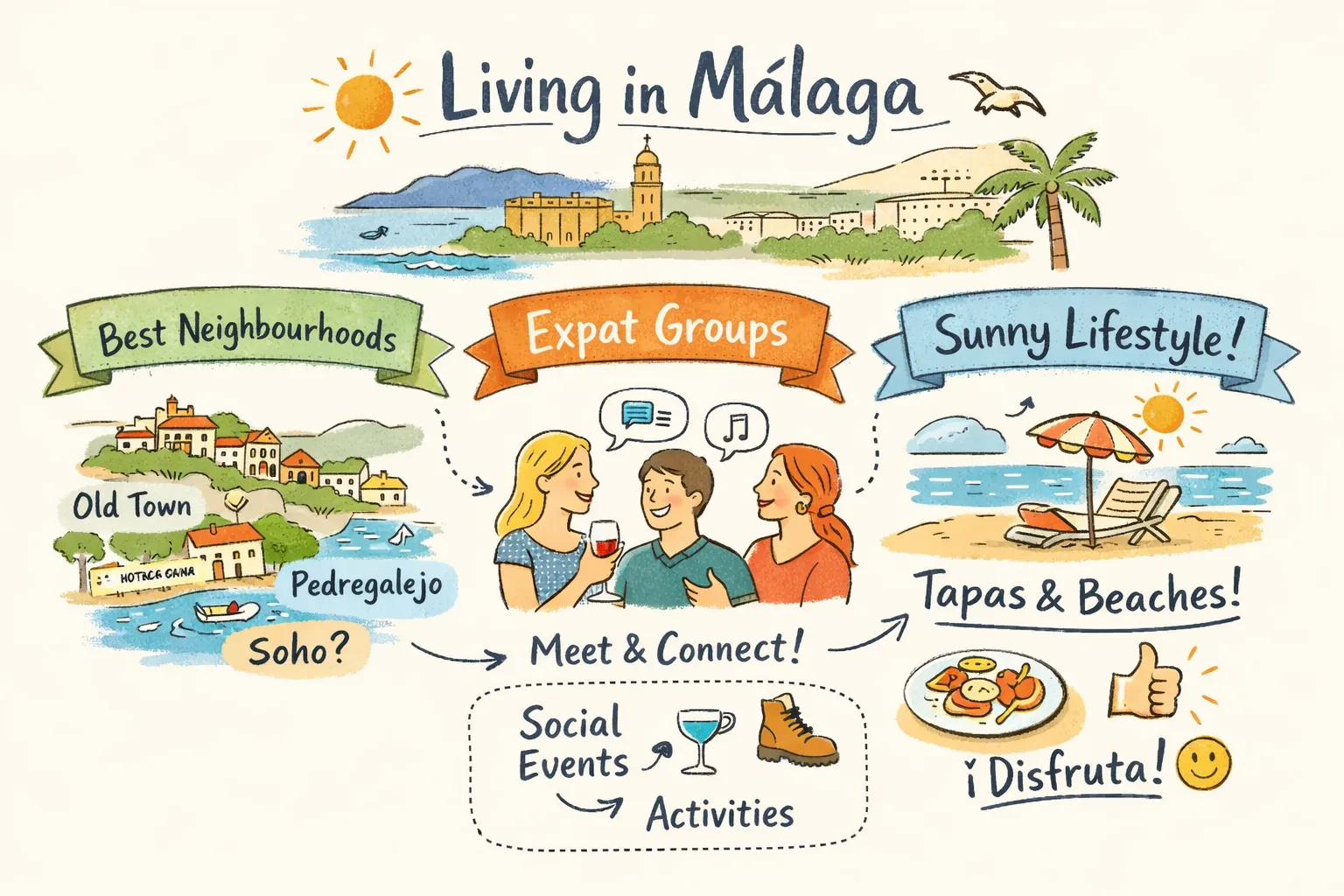
Arrive in Málaga and, within minutes, you should be able to join the right groups, shortlist two or three neighbourhoods, and start the admin steps in the correct order. This guide gives those minutes back to you: a fast route map to the local communities that actually meet in person, a practical neighbourhood match for your lifestyle, the housing workflow landlords expect, the legal steps you can’t skip, realistic budgets, and a concise move‑in timeline to follow from day one to month three.
Plug in fast: how Expats World and local networks connect you in Málaga
Your fastest route to stability is human: the right community shortens the housing hunt, speeds administrative appointments, and turns acquaintances into practical help. Expats World’s Málaga hub is designed as that landing pad—a curated list of verified meetup links, a downloadable move‑in checklist and starter templates, plus introductions to local mentors who have handled dozens of relocations. Curated lists matter because they cut through noisy, out‑of‑date groups and surface the circles that actually run events.
What the Málaga hub gives you straight away: verified group links (Facebook/Meetup/InterNations pointers), a Move‑In Checklist PDF (inventory scripts, viewing checklist), and sample messages to use when you introduce yourself. If you sign up at the hub you can also request a mentor intro—someone who’s recently moved here and will answer one quick question by message.
First 24‑hour wins (do these if you can): buy a Spanish SIM, join two local groups (one neighbourhood group and one activity group), and lock a temporary place for your first week. Expats World’s downloadable “Málaga starter pack” bundles those sample messages and the checklist so you don’t type the same intro three times.
The communities that actually meet up: online groups, meetups and where to say “hi”
Global expat groups can be noisy and full of outdated posts. Look instead for locally moderated communities that post regular events, share venue pictures, and have clear joining rules. In 2026 people in Málaga still meet through Facebook groups, Meetup events, InterNations circles, Reddit threads, and fast‑moving Telegram/WhatsApp lists. Offline, language exchanges, coworking events and tapas walks are where regulars meet.
For a countrywide comparison of active expat hubs, see our Best Expat Communities in Spain: 12 Top Picks 2026.
Choosing a good group
- Activity level: recent posts and event RSVPs in the past month.
- Rules & moderation: clear rules reduce spam and risky invites.
- Event frequency: groups that run weekly or biweekly meetups are better than “join if interested” groups.
- Language mix: bilingual groups invite locals; English‑only groups tend to be more international but less integrated.
How to join and say hello (use these short templates)
Copy‑paste these and personalise the brackets.
Facebook/Group intro — English Hi everyone — I’m Alex, moving to Málaga from [country] on [date]. I work in [field] and I love running and tapas. Looking for neighbourhood tips and to join upcoming meetups. Happy to help organise a coffee for newcomers.
Facebook/Group intro — Spanish Hola a todos — soy Alex, me mudo a Málaga desde [país] el [fecha]. Trabajo en [profesión]. Busco recomendaciones de barrios y quedadas. ¡Gracias!
WhatsApp/Telegram intro — short Hi — I’m Alex, invited by [name]. New in Málaga and would love to join the next meetup.
Etiquette: search pinned posts before asking the same question, avoid sending money or personal documents via chat, and wait for a public welcome thread before sharing long personal details. For WhatsApp/Telegram invites, confirm the admin who invited you before sharing sensitive data.
Finding in‑person meetups
On Meetup and Facebook, search tags such as “language exchange,” “digital nomads,” “tapas walk,” “family meetups,” and “coworking.” Weeknights are best for language exchanges; weekends for family‑friendly events and outdoor meetups. If you want coffee and conversation, target events that list regular hosts—the same faces week after week indicate a stable group.
Which Málaga neighbourhood matches your life: a persona‑based guide
Decide by asking what you need daily—work commute, beach access, schools, or nightlife—and match that to a neighbourhood that supplies it. Below are succinct portraits followed by practical data to compare at a glance.
Compare these profiles with our broader analysis of where expats settle across Spain in Where Expats Live in Spain: 12 Communities & Costs.
| Neighbourhood | Vibe & best for | Typical rent (1‑BR / 2‑BR) | Transport & a spot to try | Local tip |
|---|---|---|---|---|
| Centro Histórico & Soho | Historic centre, tapas, creative scene — best for culture lovers and young professionals | €900–1,200 / €1,200–1,700 | Walkable; try a café in Soho or the CAC events | Expect tourist noise in summer; parking is tight |
| La Malagueta | Beachside, upmarket — ideal for beach lovers and couples | €1,200–1,800 / €1,800–2,500+ | Close to port and beach promenades | Higher rents for sea views; quieter outside peak season |
| Pedregalejo & El Palo | Authentic seaside neighbourhoods — families and retirees | €800–1,200 / €1,100–1,600 | Coastal buses; try a beachside chiringuito | Strong local community—social life centers on the promenade |
| Teatinos | Modern, practical — students, tech workers, digital nomads | €750–900 / €1,100–1,400 | Metro Line 1; coworking spaces near the university | Good value and direct metro to centre; fewer historic charms |
| El Limonar & Cerrado de Calderón | Leafy, residential — international schools and larger homes | €900–1,600 / €1,400–2,200 | Car recommended; quieter cafés and private schools | Preferred by families; expect commutes into the centre |
| Huelin & Carretera de Cádiz | Good value, parks, and transport links — practical family option | €700–900 / €900–1,300 | Near María Zambrano station; try Parque de Huelin | Renovations are ongoing—you’ll find modern flats at lower cost |
Neighbourhood test — three quick questions
1) What’s your realistic commute tolerance in minutes door‑to‑door? If under 30, favour city centre or Teatinos. If 30–60, El Limonar or Pedregalejo are reasonable.
2) Do you prioritise daily beach access or city amenities? Choose coastal neighbourhoods for the former, Centro/Soho for the latter.
3) Is nightlife important or do you want quiet evenings? Centro is lively; Pedregalejo and El Limonar are quieter.
Finding a home in Málaga: search workflow, what landlords expect and local traps
Workflow to follow: search → view → sign → inventory (inventario / acta de entrega) → move‑in. Stick to this sequence and you minimise misunderstandings and deposit disputes.
Where to look
Start with Idealista, Fotocasa and Habitaclia for broad coverage. Check local agency websites for exclusive listings and browse neighbourhood WhatsApp groups for short‑term sublets. Use an agent if you need speed, bilingual contracts or legal checks—expect an agency fee commonly equal to one month’s rent (sometimes plus VAT). Private lets can be cheaper but require more diligence. For local agency recommendations and practical tips, consult the Málaga Expat Guide.
Documents landlords commonly request — and what to do if you don’t have an NIE
Commonly requested: passport, NIE or proof you’ve applied for one, three recent payslips or proof of income, employer reference, bank statements, and a Spanish guarantor or international guarantor when necessary. If you don’t yet have an NIE, offer a guarantor, provide several months’ bank statements, or be prepared to deposit 2 months’ rent up front—some landlords accept this as security.
Money basics and the inventory
Deposits: typically 1 month for long‑term rentals, sometimes 2 for furnished or short‑term lets. Agency fees are often one month’s rent paid by the tenant. Always insist on an inventory (inventario) and signed move‑in acta de entrega documenting the state of the apartment and meter readings—these protect the deposit return.
Critical lease clauses to check
Watch for contract duration, automatic renewal terms, notice periods, subletting permissions, responsibility for community fees and IBI, repair responsibilities, and clauses about pets or furniture condition. If the contract is only in Spanish and you do not read Spanish, ask for an English version or have a mentor/translator review it before signing.
Viewing tips and scripts
Photograph every room, utilities, meters, the front door and lock, balcony and any damage. Check the water and electricity meters and take time to test taps and showers. Use this short viewing checklist available in the Expats World viewing PDF.
Questions to ask the landlord (English): How long has the property been on the market? Are any community fees or IBI included? What is the average monthly cost for utilities? Is the internet connection fibre and who is the provider? Are there any planned works or repairs?
Preguntas para la visita (Español): ¿Cuánto tiempo lleva el piso en alquiler? ¿La comunidad está incluida? ¿Cuál es el coste medio de suministros? ¿Hay fibra? ¿Se van a hacer obras?
Red flags and scams
Decline any request to pay a deposit before seeing the property or signing a contract. Be wary of listings that only communicate via WhatsApp and refuse a video tour or paperwork. “Too cheap for the area” is usually a red flag. Never share passport scans or bank details in a group chat—use email for documents and insist on a written contract.
Sample landlord message — English Hello [Name], I’m [Your Name], interested in the apartment at [address]. I arrive in Málaga on [date] and can provide references and recent payslips. Is it available for viewing on [day/time]? Best, [Your Name]
Mensaje al propietario — Español Hola [Nombre], me llamo [Tu Nombre] y estoy interesado en el piso en [dirección]. Llego a Málaga el [fecha] y puedo aportar referencias y nóminas recientes. ¿Está disponible para visita el [día/hora]? Gracias, [Tu Nombre]
Expats World offers a downloadable “viewing checklist” and a script pack to use during visits—grab that from the Málaga hub to save time.
Visas, NIE/TIE, empadronamiento and healthcare — the admin you must prioritise
Order matters. If you are outside the EU, secure the correct visa before a long stay. Get an NIE early (you often need one to open a bank account), register on the padrón (empadronamiento) once you have an address, and collect your TIE after your residence is approved. Healthcare registration follows social security affiliation or TIE status.
Visa overview
Common routes: Digital Nomad, Non‑Lucrative, work permits, student visas, and family reunification. Requirements vary—typically passport, clean criminal record, proof of income or savings, and health insurance where required. As of 2026 the Digital Nomad visa lists a minimum income benchmark (around €3,000+/month in many cases); thresholds and rules change, so always verify with your consulate or an immigration gestor. For an accessible overview of the Digital Nomad visa and common requirements, consult that specialist guide. If you’re coming from the U.S., our Moving to Spain from the U.S.: The Practical Roadmap outlines practical pre‑departure steps and timelines.
NIE & TIE
To get an NIE you book a Cita Previa at the police or consular office and bring passport, completed Modelo Ex‑15, and appointment printout. For the TIE you attend the police appointment within 30 days of arrival, pay the fee, submit fingerprints and documents, and collect the card later—expect roughly 4–12 weeks total depending on local queues. For detailed, practical notes on Spanish residency permits for non‑EU citizens and local procedures, this reference is helpful.
Empadronamiento (padrón)
Registering at the town hall gives you a padrón certificate. It’s required for school enrolment, many administrative processes and sometimes for healthcare registration. Bring your lease or a signed owner declaration plus your passport/NIE.
Healthcare
Certain visas require private health insurance at application. Employed residents register with Social Security (Seguridad Social) and then enrol at the local Centro de Salud to receive a Tarjeta Sanitaria (health card). For the Tarjeta Sanitaria you will usually need your NIE/TIE, padrón certificate and Social Security document. If you’re not eligible immediately, consider private insurance or the Convenio Especial pay‑in option.
For a practical walkthrough of healthcare in the Costa del Sol and how expats can access Spain’s public and private systems, see that guide.
Fast pass tips: book your NIE/TIE cita as soon as you have an address; get padrón done the same week you sign a lease. Use a local gestor or an Expats World mentor to help navigate cita systems if slots are scarce.
Money on the Costa del Sol: cost of living and realistic budgets
Expect a practical baseline: a single person aiming for a comfortable city‑centre life should budget roughly €1,800–2,200/month. That figure includes rent, utilities, groceries and transport but excludes occasional travel and larger one‑off items.
Typical monthly costs (approximate): rent 1‑bed in centre €900–1,200; utilities (electricity, water, internet) €150–250; groceries €300–500; transport €50–120; private health insurance €50–120 depending on cover. Initial move costs include deposit (1–2 months), agency fee (commonly 1 month), and basic furnishings if needed.
For a deeper breakdown of national averages and how Málaga compares within Spain, review the cost of living in Spain 2026 and the ThinkSpain cost‑of‑living guide for practical numbers you can model your budget on.
Salary reality: Málaga’s job market supports tech and remote roles (senior tech salaries can be €45k–€85k) and customer support or tourism roles (€24k–€32k). If you rely on local wages, match roles to expected ranges and budget accordingly.
Money‑saving tips that work: shop at Mercadona or Carrefour for basics, avoid peak summer rental searches (prices rise in high season), choose energy plans with a stable rate if you run AC in summer, or look for furnished places with included appliances to avoid immediate setup costs.
Quick budget formula: rent + utilities + groceries + transport + health insurance + 10% buffer = monthly target.
Make friends, learn Spanish and fit into local life — cultural tips that speed belonging
Small behaviours accelerate belonging more than big gestures. Greet neighbours with a smile (two kisses or a handshake depending on context), accept invitations to share tapas (food is communal), and adapt to local rhythms—lunch around 14:00, dinner after 21:00, shops often close mid‑afternoon in smaller neighbourhoods.
Language and social life
Conversation exchanges (intercambios), private language academies and informal groups at cafes are the fastest ways to learn practical Spanish. Learn key phrases that change how locals respond: “¿Cómo se dice…?” (How do you say…), “Perdona” to get someone’s attention politely, and “Muchas gracias” with a smile goes a long way.
Where friendships form: volunteering at local events, joining a sports club, consistent attendance at a meetup, and neighbourhood bars or beaches where the same people appear. To move from chat to friendship, propose a concrete next step—coffee, a beach walk, or helping with a local event.
Conversation starters for language exchanges: “What food would you recommend in this barrio?”, “How long have you lived here?”, “Where do you go to buy fresh fish?”
What to bring to a tapas night: cash for rounds, an openness to share plates, and a small compliment to the host or staff—Málaga embraces warmth.
Move‑in checklist — the first 48 hours, first 30 days and first 90 days
This is your practical timeline. Everything not on one of these lists can wait.
- First 48 hours: buy a local SIM, withdraw a bit of cash, find a café with Wi‑Fi and a plug, join two local groups (neighbourhood + interest), secure temporary accommodation if needed, note emergency numbers, and locate the nearest supermercado and farmacia.
- First week: open a bank account or set up an online bank, sign the lease and complete the inventario/acta de entrega with photos, register on the padrón, book NIE/TIE cita or confirm visa next steps, choose health insurance if required, and connect internet and utilities.
- First 30 days: collect your NIE/TIE if ready, enrol children in school if needed, register for public healthcare or finalise private plan, choose a local GP, and finalise long‑term housing arrangements.
- First 90 days: settle energy and TV accounts, start regular language classes or join a long‑term club, sort tax/residency paperwork if applicable, and deepen local networks by volunteering or committing to a recurring meetup.
What to carry on moving day (one‑page folder): passport, printed lease, proof of funds, recent bank statements, the padrón receipt (when available), emergency medical information, and contact details for your landlord and any local mentor.
Three quick things you can finish in three hours: buy a Spanish SIM, complete your padrón registration (if you have the lease), and join the Expats World Málaga group to download the Move‑In Checklist and request a mentor intro.
Download the Málaga starter pack from the Expats World hub for the printable viewing checklist, sample messages, and the one‑page moving folder template. It will save you small mistakes that take hours to undo.
Final two points to take with you: connect before you arrive (join one neighbourhood group and one activity group) and prioritise paperwork in the first week (NIE/padrón). Do those, and the rest of Málaga falls into place faster than you expect. If you want help narrowing neighbourhoods or checking a lease clause, the Expats World Málaga hub is where our curated local mentors and verified group links live—use the starter pack and you’ll have a checklist to follow from day one.
For a compact plan on early practical steps, see Setting Up Life Abroad in Your First 30 Days to align your first 30‑day actions with this checklist.