
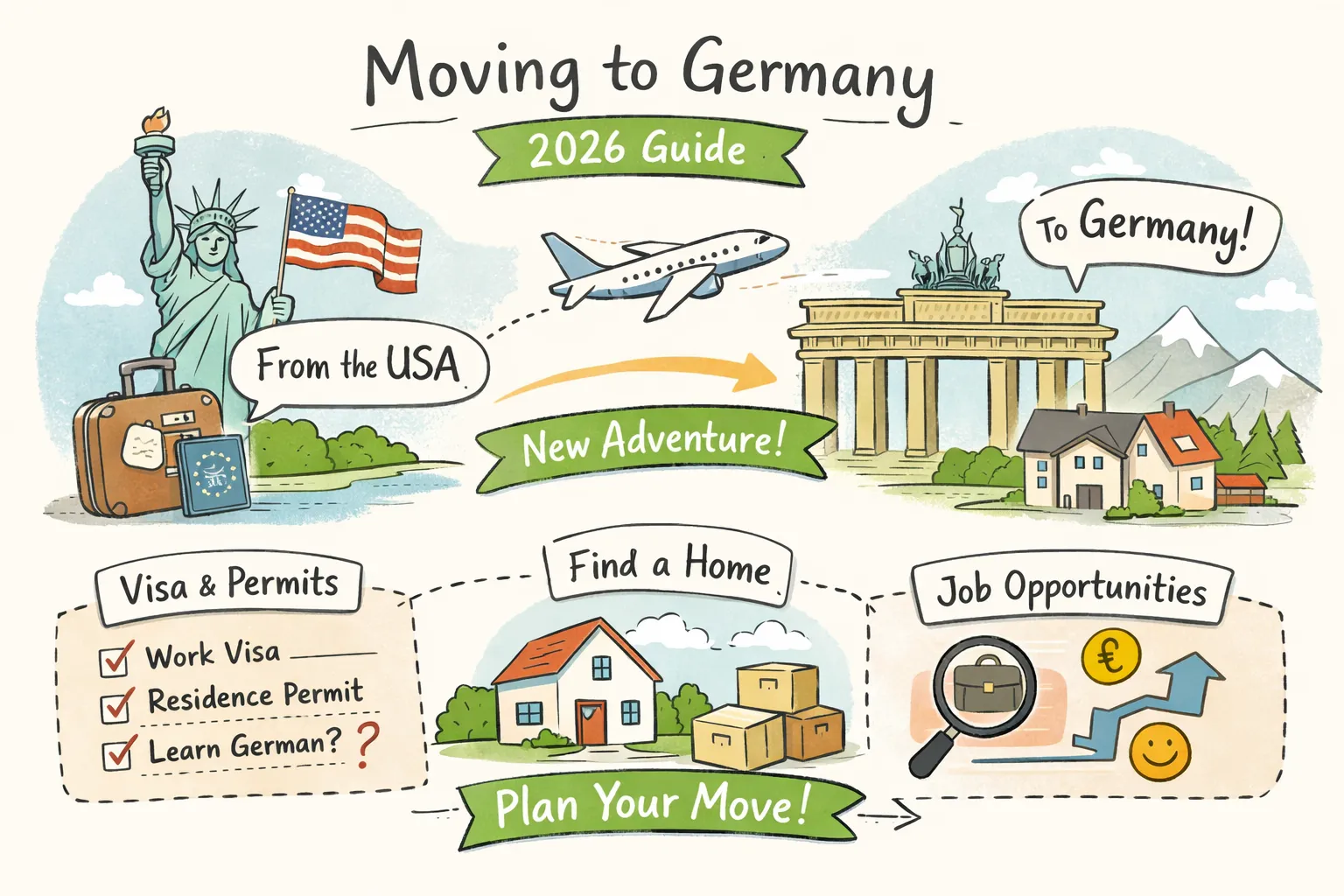
Paperwork, timing and the small daily adjustments — these are what trip up most Americans relocating to Germany. This guide gives you a single, step‑by‑step workflow so you can choose the right visa, gather every required document, budget realistically, arrange insurance and banking, complete Anmeldung and residence‑permit steps, and prioritise what to do before and after arrival. Expats World’s Germany move planner and city guides are the companion you’ll need for the steps below — download the printable checklist to follow this roadmap on the go.
After reading you will be able to pick the visa route that fits your profile, assemble the exact documents consulates and local offices expect, estimate moving and monthly living costs for Berlin, Munich and Hamburg, enrol in the right health plan, open a German bank account, complete Anmeldung and residence‑permit tasks, and follow a prioritized 30/90/180‑day timeline for settling in.
Choose the right visa route
Start by answering four questions: are you arriving with a job offer, planning to look for work from within Germany, intending to freelance, moving as a student, or joining family? The correct visa depends on that first answer. Below are compact profiles so you can identify the best route quickly and lock the documents you’ll need.
Employment visa
Who it fits: candidates with a concrete job offer from a German employer. What you need: signed employment contract, proof your qualifications match the role (degree, certificates, CV), passport and biometric photos. Typical processing time: often 4–8 weeks at the consulate; final residence‑permit formalities are completed locally after arrival. Employers commonly assist with health‑insurance enrolment and payroll setup.
EU Blue Card
Who it fits: high‑skilled professionals. 2026 salary thresholds: generally €50,700 gross per year; reduced threshold €45,934.20 for shortage professions (IT, engineering, healthcare) and some recent graduates. What you need: university degree recognition and a qualifying job contract at or above the threshold. Typical processing: 4–8 weeks. Advantage: faster track to permanent residency (21 months with B1 German, 33 months without). (See the latest reporting on the EU Blue Card salary thresholds.)
Freelance / self‑employment visa
Who it fits: independent professionals able to prove viable business activity in Germany (consultants, IT contractors, creatives). What you need: a clear business plan, letters of intent or client contracts, evidence of capital or billing potential, and proof of accommodation. Processing is variable but often similar to work visas (roughly 4–8 weeks). Realistic for Americans with validated clients or substantial savings.
Student visa
Who it fits: admitted university students or language programme participants. What you need: acceptance letter, proof of funds (blocked account ~€11,904/year), health insurance and accommodation evidence. Processing: typically 4–8 weeks. Students can work part time and often convert to a work visa after graduation.
Family reunification
Who it fits: spouses and dependent children joining a resident in Germany. What you need: marriage/birth certificates (often with apostille and certified translation), sponsor income statements and housing proof, sometimes a Verpflichtungserklärung (formal obligation). Processing varies widely — weeks to a few months — and is reviewed carefully for sponsor capacity.
Opportunity Card / Job seeker
Who it fits: skilled professionals who want to enter Germany to find work without an offer. This points‑based route requires proof of qualifications, some language or work experience points, and funds to support yourself while searching. Processing and eligibility are changing under the Skilled Immigration Act; it’s practical if you have strong qualifications but no employer yet.
Recommendation in plain language: if you already have a job that meets the salary requirement, an EU Blue Card is the fastest path to long‑term residence; if you have no job but strong qualifications, consider the job‑seeker route; if you are launching a business and can show clients and financial plans, the freelance visa is realistic.
Expats World tip: if your case involves family members, cross‑border tax ties, or mixed employment/self‑employment income, consult a specialist. Download the Visa Decision Checklist from Expats World to map your options and the documents you’ll need. (For personal perspectives on whether the move is worth it, see our Is Moving Abroad Worth It? Honest Pros and Cons From Expats.)
Applying from the U.S.: the consulate workflow
All long‑stay visa applications start at the German embassy or the consulate that covers your U.S. state (many use an outsourced centre such as BLS for initial submission). Start the process early — book appointments and begin document collection 8–12 weeks before your planned move. For official guidance on consular procedures and application requirements consult the German missions’ visa information.
Core documents most long‑stay visas require include a valid passport (issued within the last 10 years and valid at least three months past your stay), biometric photos (35 x 45 mm), completed application forms, proof of U.S. address, travel/visa health insurance with a minimum €30,000 coverage for the consular stage, and purpose‑specific documents (employment contract, university admission, business plan or marriage/birth certificates). Non‑German public documents generally require a state Apostille and certified German translations if not in English or German — arrange apostilles and translations early.
At the appointment expect to hand in originals and copies, pay a fee (generally €75–110), possibly provide fingerprints, and answer purpose‑specific questions about your move. Typical consular post‑appointment processing averages 2–8 weeks depending on visa type and document completeness. If the consul requests additional documents or refuses, request a written explanation, supply missing items fast and use official channels to appeal or reapply; a clear response letter (templates are available) reduces delays.
Practical security: keep scanned copies of every submission in an encrypted cloud folder and carry a printed “application pack” (passport, copies, insurance proof, contract) in your hand luggage for both the flight and consular visits.
Packing, shipping and customs — keep costs predictable
Decide early whether to ship furniture or buy locally. Shipping options are full container (FCL), shared container (LCL) or air freight; sea transit usually takes several weeks (15–45 days door‑to‑door depending on origin and origin port). A 20ft container from New York to Hamburg can range from roughly $1,000 to $2,600 in recent years, while West Coast origins are typically higher; get live quotes for accurate pricing. For recent average figures and shipping‑cost guides see published international container shipping costs.
Read mover quotes line‑by‑line: door‑to‑door transit, basic insurance, and packing are commonly included; destination terminal handling charges (DTHC), customs clearance fees, local delivery surcharges and long‑term storage are frequently extra. To compare fairly, request three written quotes using the same itemised inventory and insist on a pre‑move survey that verifies volume.
Customs clearance for household goods usually requires a detailed inventory, passports, proof that you are moving your residence to Germany and, in some cases, proof of previous residency if you claim duty relief. If your shipment includes a vehicle, piano or commercial goods, hire a customs broker or let an experienced mover handle clearance — the small fee is worth avoiding unexpected port bills.
Packing advice that saves money: sell or donate bulky furniture you can replace affordably in Germany; photograph valuable electronics and serial numbers; label boxes in English and German; and produce one inventory file to share with all movers. When you discuss quotes, insist you get a written breakdown of included insurance level and any excess, DTHC, expected transit time and storage terms.
Expats World resource: use a moving‑cost estimator and the sample inventory template on Expats Guide for Germany to request comparable quotes from movers.
Money, banking and taxes — set up the basics first
On arrival you will need a German bank account (Girokonto) with a German IBAN so your employer can deposit salary and social contributions can be set up. Banks typically ask for a passport, the Meldebescheinigung (registration certificate you get after Anmeldung) and proof of income or employment contract. Several online banks allow provisional account opening before Anmeldung but will require the Meldebescheinigung later. (For city‑specific living and banking costs see our Expat cost of living in Germany guide.)
Choose between a traditional bank branch (local service, in‑person support) and challenger banks (faster online onboarding and cheaper international transfers). For inbound funds and currency conversion, services such as Wise or a low‑cost transfer specialist generally beat standard bank wire rates; bring a small cash wedge for the first days (€100–€300) to cover transport and small expenses.
Tax and social security notes you need immediately: your Steuer‑ID (tax ID) is issued automatically after Anmeldung and arrives by mail; your Sozialversicherungsnummer (social security number) is issued once you start work. Employers withhold payroll taxes and social contributions; your tax class is assigned based on marital status and other details. If you retain U.S. tax ties (investments, filing requirements), plan to talk to a cross‑border tax advisor — U.S. obligations like FBAR/FATCA persist even when you live abroad. (For finance‑heavy city guidance see our Frankfurt Expat Guide.)
Practical banking checklist: open a Girokonto, set up online banking and a local IBAN, provide your IBAN to HR for salary deposits, link an international transfer service for moving funds, and keep receipts for moving expenses — some may be tax‑relevant.
Health insurance and social security — set coverage early
Proof of health insurance is required at the consulate stage (visa) and again when you apply for a residence permit. Don’t let coverage lapse: the visa stage normally requires travel/visa insurance with minimum coverage of €30,000; once resident you must move to an appropriate German plan.
The main choice is statutory public insurance (GKV) or private insurance (PKV). GKV is income‑based and generally mandatory for employees below the compulsory threshold; it offers predictable costs, standard coverage and family co‑coverage for non‑working dependents. PKV is premium‑based, risk‑rated, often offers faster access and extras but can be more expensive long term and carries stricter underwriting rules. For 2026, public contributions are roughly 14.6% of gross salary plus an average additional contribution (Zusatzbeitrag) of about 2.9% — roughly 17.5% total split between employer and employee; long‑term care insurance adds another contribution (around 3.6%, shared). Private premiums vary widely by age and health status (typical newcomer range €200–€1,000+ monthly depending on coverage). For a practical overview of options and how statutory vs private plans work, read this guide to German health insurance.
How you enrol depends on status: employers typically register employees in GKV unless you opt for PKV and meet opt‑out rules; self‑employed applicants must apply directly; students qualify for reduced student rates. Get a confirmation letter or membership number quickly — this is one of the documents the Ausländerbehörde will want for your residence permit.
Checklist for insurance proof: secure visa travel insurance for the consulate, keep the policy PDF handy for the first Anmeldung and Ausländerbehörde steps, then register with a German statutory or private provider and obtain your electronic health card (Gesundheitskarte).
Registering your address (Anmeldung) and residence permit
Registration is a legal requirement. You must register your address at the local Einwohnermeldeamt / Bürgeramt within 14 days of moving into a German address. Book the appointment early; typical documents are passport, the landlord‑signed Wohnungsgeberbestätigung (landlord confirmation of move‑in date) and your rental contract. The office issues a Meldebescheinigung — you will need that for banks, the Ausländerbehörde and many service providers.
After Anmeldung, you apply for the residence permit (Aufenthaltstitel) at the local Ausländerbehörde. If you entered Germany on a national D‑visa, apply before it expires; if you entered visa‑free, apply within 90 days when eligible. The Ausländerbehörde process generally starts with a remote submission of copies, followed by an in‑office appointment for originals, fingerprints and fee payment. Typical fees are around €100–110; processing times vary by city and application type (expect several weeks to a few months in busy offices). If processing extends, you may receive a Fiktionsbescheinigung — a temporary certificate that extends your legal stay while the permit is processed.
Bring these key documents to the Ausländerbehörde appointment: passport and visa copy, Meldebescheinigung, biometric photos, completed application form, evidence of purpose (employment contract, enrolment or business plan), health‑insurance confirmation, rental contract, and recent bank statements. Translations and apostilles can be required for civil status documents; check your local Ausländerbehörde checklist in advance.
If a permit is delayed: keep proof of your appointment and any interim Fiktionsbescheinigung, notify your employer if a start date is affected, and request expedited handling only where work start or family circumstances justify it — offices move faster when the need is documented.
Finding a home and budgeting monthly living costs (Berlin, Munich, Hamburg)
Understand the rent language: Kaltmiete is base rent; Warmmiete includes heating and sometimes other utilities. Nebenkosten are service charges (water, garbage, building maintenance) and Heizkosten usually covers heating. Expect to pay a Kaution (security deposit) commonly equal to two to three months’ Kaltmiete. Broker (Makler) fees vary — verify who is liable and always get a written fee agreement.
Practical city cost ranges for a single person (monthly, mid‑2025–2026 cues): Berlin ≈ €1,800–€2,500, Munich ≈ €2,200–€3,000+, Hamburg ≈ €2,000–€2,700. For a family of four expect roughly Berlin €3,500–€4,500, Munich €4,000–€5,000+, Hamburg €3,800–€4,800. Rent dominates budgets; a one‑bed city‑centre apartment in Munich will cost considerably more than in Berlin.
Where to search: major portals and local Facebook/WhatsApp groups are the norm — create a concise applicant Kurzprofil (one paragraph with name, employer, salary, move‑in date and references) and attach key documents (passport copy, employment contract, recent pay slips or proof of funds, and a short cover email). At viewings check heating, hot water, internet availability, mold and noise; ask about Nebenkosten inclusions and the average winter heating bill.
Sample one‑line German to open emails to landlords: “Hallo, mein Name ist [Name]. Ich arbeite bei [Firma], suche eine Wohnung ab [Datum] und kann Einkommensnachweise vorlegen.” Pair it with an English version if the listing is in English.
Ways to save: share a flat (WG), choose suburbs with strong transit links, buy second‑hand furniture or rent a furnished short‑term flat while you search for permanent housing.
Priority timeline and practical pre‑departure & arrival checklist
Your prioritisation rule: secure legal entry (visa), then legal residence (Anmeldung and insurance), then the financial plumbing (bank and salary), then housing and household logistics. Ship bulky goods only once housing and arrival dates are firm.
- 8–12 weeks before: finalise and submit your visa application; apostille and translate birth/marriage/diplomas; request official U.S. copies; gather employment letters; start mover quotes and decide whether to ship; buy travel and visa insurance; create a secure digital document pack.
- 4 weeks → 1 week before: confirm shipping dates; collect prescriptions and medical records; obtain an international driving permit if needed; cancel or suspend U.S. subscriptions; set up mail‑forwarding; make copies of all important documents.
- Travel day: carry originals and copies in hand luggage (passport + visa, insurance certificates, employment/enrolment letters, Wohnungsgeberbestätigung if arranged); have an eSIM or roaming plan ready.
- First 48 hours: secure temporary accommodation keys, meet landlord for Wohnungsgeberbestätigung so you can register, book Anmeldung appointment within 14 days, get a local SIM and buy a transit ticket for immediate travel.
- First week → first month: complete Anmeldung, open a Girokonto, confirm health‑insurance enrolment, apply for the residence permit at Ausländerbehörde, start apartment hunting if needed and collect required documents for landlords.
- First 3–6 months: settle long‑term housing, begin language classes, register children for school if applicable, finalise local service contracts (internet, electricity), and assess whether to ship remaining household goods.
Must/Should/Nice quick guide: must — visa, passport, Anmeldung, health insurance, bank account for salary; should — local phone, Steuer‑ID set up, residence permit appointment; nice — furniture shipped, gym & social clubs. Use the 30/90/180 rhythm: immediate legal necessities, then financial & housing set up, then social integration and language.
Final CTA: download Expats World’s printable 30/90/180 Move Planner and the Germany visa decision checklist to follow these steps in order. Explore our city guides to decide neighbourhoods and local routines for Berlin, Munich or Hamburg.
Conclusion
Relocating to Germany from the U.S. is a sequence of interlocking legal and practical steps: pick the correct visa, prepare authenticated documents, secure health insurance, register your address, and set up banking and payroll. Tackle those steps in that order and you remove most surprises. Use the checklist and city guides from Expats World to keep your move organised, and treat the first three months as a phased project — paperwork first, housing second, social life third. With the workflow above, you’ll arrive with control instead of chaos.