
Quick answer — the short version
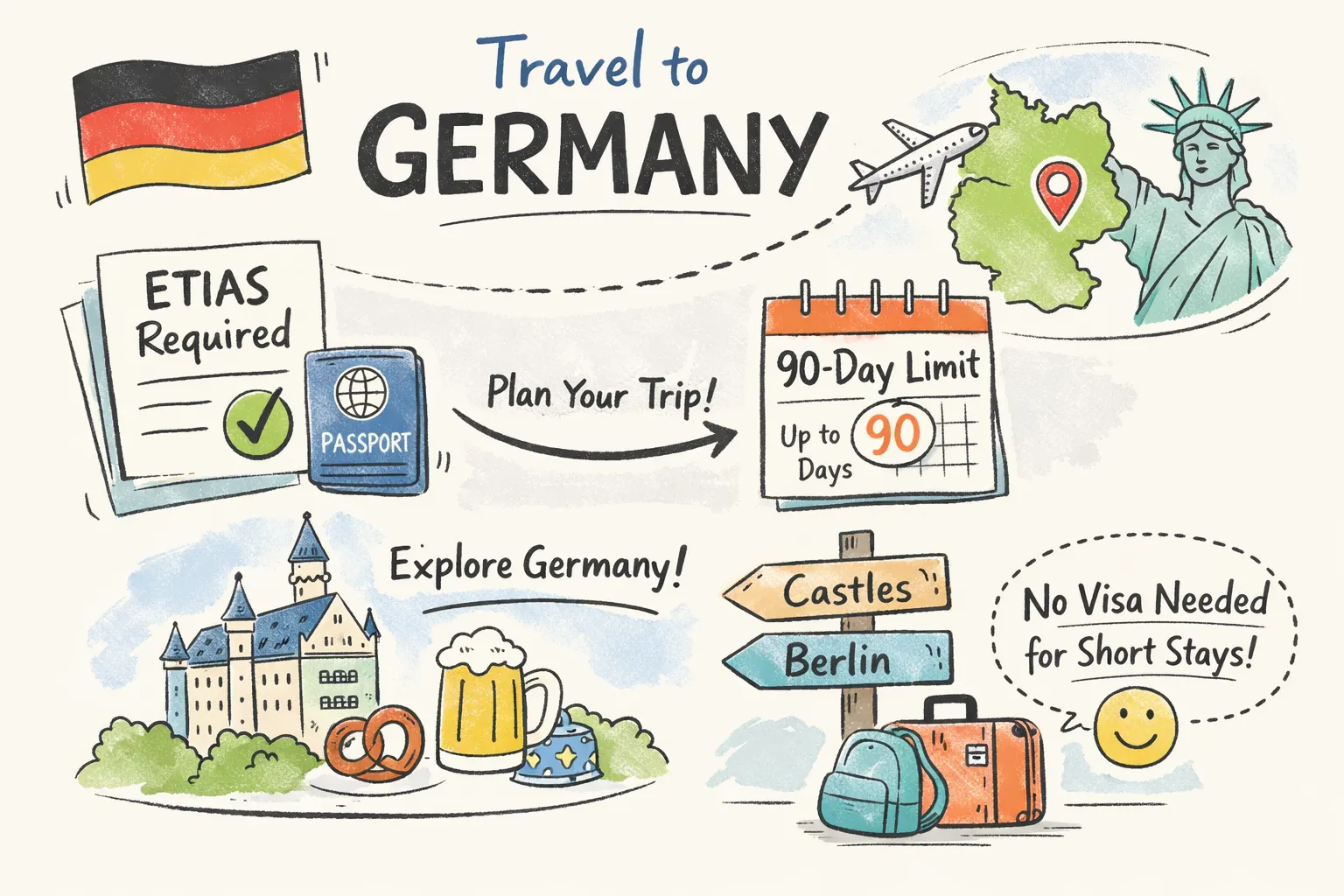
For tourism or short business trips up to 90 days in any rolling 180‑day period, U.S. citizens can enter Germany without a visa; if you plan to work, study, live with family, or stay longer than 90 days you must obtain a German national (D) visa before travel. ETIAS (the EU’s pre‑travel authorisation for visa‑exempt nationals) was not operational as of February 2026 but is expected to launch in late 2026; the Entry/Exit System (EES) is already in use for biometric registration.
At Expats World we simplify the paperwork — below you’ll find a one‑minute decision flow, clear timelines and checklists you can use today, and the exact next steps to start a D‑visa file from the U.S.
If you’re in a hurry: travel ≤ 90 days for tourism/business → visa‑free (ETIAS will be required once launched); travel > 90 days, or travel for work, study, family reunification → apply for a national (D) visa before you leave.
Quick answer: Do you need a visa or ETIAS for your trip to Germany?
Decide by two facts: purpose and length. If your visit is tourism, visiting friends, short business meetings or similar and you’ll be in the Schengen Area for 90 days or less in any 180‑day window, you don’t need a visa today. If your purpose is employment, full‑time study, family reunification, long‑term freelance work, or you plan to stay more than 90 days, you must apply for a national (D) visa in the U.S. before travelling.
Core rules you must remember: the 90/180 rule is a rolling count across the entire Schengen Area; border officers verify passport validity and entry records; previous Schengen entry refusals or deportations can change your status and may require a visa even for short stays.
Immediate checklist you can copy and paste before you travel:
- Passport: valid at least 3 months beyond your planned Schengen exit date and undamaged; keep the same passport for ETIAS/airline checks when ETIAS launches.
- Return or onward ticket and proof of accommodation or host contact.
- Evidence of basic funds (recent bank statement or credit card), and printed travel details.
When to act: for short visits you can book travel now but watch ETIAS launch announcements; for long stays or work/study applications begin your D‑visa process 3–6 weeks before travel (you may submit some D‑visa files up to 6 months early). Allow 4–8 weeks or more for processing, depending on the visa type and season.
Schengen 90/180‑day rule explained — how to count days
The technical rule is simple in text and messy in practice: at any point during your stay, count back 180 days and total how many days you spent in the Schengen Area during that window. That total may never exceed 90 days. It’s a rolling window, not “January to June” or calendar months.
Important details: both entry and exit days count as full days. Moving between Germany and other Schengen states is treated the same as staying in one country — it doesn’t reset the clock. You must be compliant every single day of your stay; overstays can trigger fines, deportation and future re‑entry bans.
Examples you can reuse
A 90‑day continuous trip: You arrive in Germany on January 1 and stay through March 31 (90 days). From April 1 you must be outside the Schengen Area until day 181 after January 1 before a new 90‑day allowance starts counting back into your window — practically this means you’ll have to wait roughly 90 days outside for a fresh 90‑day allowance.
Several short visits: You spend 15 days in Germany in January, 20 days in March, and you plan a 45‑day trip starting May 1. To check on May 1 count back 180 days (starting from that date) and add the days you were in Schengen during that period: 15 + 20 + (days already in May if your planned trip overlaps the window). If the total stays under 90 you’re fine; otherwise shorten the trip.
Using the look‑back method to avoid surprises: If you were in Schengen Feb 1–Apr 30 (90 days), then on Aug 1 you can re‑enter because those earlier days fall outside the 180‑day window counted from Aug 1. The trick is to always run the 180‑day lookback from the date you plan to be in Schengen, not from the start of the trip.
How to check: use an online Schengen calculator (enter all your entry and exit dates and it shows remaining days) or keep a simple travel log and count back 180 days manually. If using a calculator, select the date you want to check and input all Schengen stays — the tool will tell you how many days remain. For an accessible explainer of the Schengen 90/180‑day rule and worked examples, see this guide.
If you suspect an overstay: stop travelling, contact border authorities or the nearest consulate, gather proof showing you left in good faith (medical records, flight interruptions, employer letters), and consult an immigration lawyer. Quick documentation helps with requests for leniency or to contest fines.
ETIAS and EES: what U.S. travellers must know right now
Two new EU systems matter: ETIAS is a future pre‑travel authorisation for visa‑exempt nationals; EES is the electronic entry/exit system that records movements and biometric data.
Status snapshot (Feb 2026): ETIAS is not yet operational and is expected to start in late 2026. EES launched on October 12, 2025 and is progressively in use; by 2026 you should expect biometric checks at external Schengen borders (airports, some ferries and land crossings).
For the latest reporting on the timetable, read this ETIAS launch update. For official EU background on ETIAS and what travellers should expect, see the European External Action Service’s guidance on travelling to Europe with ETIAS.
When ETIAS starts it will be a short online form asking for basic personal details, passport info, your planned first entry country, and yes/no security and health questions. The fee is €7; most applicants receive approval within minutes up to 96 hours. Approvals are valid for three years or until the passport expires. Airlines will check ETIAS at boarding, so you may be denied boarding without it.
EES impact on routine travel: at the border you’ll be photographed and fingerprinted; those records, plus your entry and exit dates, are logged electronically. Expect slightly longer border wait times at busy airports; keep the passport you used to apply for ETIAS and use the same document for entry and exit to avoid mismatches.
Quick action when ETIAS launches: apply days to weeks before travel (minutes is common but give yourself a cushion), use the same passport for application and travel, and print or save the approval email until your trip is complete.
When to apply for a Germany national (D) visa — types, timelines and fees
A national (D) visa is the gateway to a German residence permit; U.S. citizens must apply in the U.S. before arrival for stays longer than 90 days. Start with choosing the visa category that matches your purpose — the wrong category is the single biggest cause of delays. For a complete relocation checklist and practical moving advice see our How to Move to Germany from the U.S. — Complete Guide.
Work visa and EU Blue Card
For employment you’ll need an employment contract, salary evidence and proof your qualifications match the job. The EU Blue Card is for highly qualified workers with a university degree and a job meeting the salary threshold (confirm the current threshold before you apply; estimates for 2026 were around €50,700 with a reduced threshold for shortage occupations). Some roles require professional recognition or licences — start qualification recognition early.
Student visa
Bring your admission letter, proof of financial means (a blocked account or confirmation of scholarship is standard), and health insurance valid from entry. After arrival you’ll convert the visa to a residence permit for study and register with your university.
Family reunification
Provide marriage or birth certificates, proof the sponsor has adequate housing and income, and translations/apostilles as required. Expect checks about housing size and finances.
Freelance, self‑employment and job‑seeker visas
Freelancers need a business plan, historic client contracts or letters of intent, and proof of funds. A job‑seeker visa gives you up to six months to find employment; you’ll need evidence of means to support yourself during that period and a convincing search plan.
Timing and fees
Apply no earlier than six months before travel and no later than a few weeks before your start date. Realistic processing time is 4–8 weeks for many D visas; student visas can be quicker (~25 days in favourable cases) while complex work or recognition processes add time. Standard consular fee is approximately €75, but confirm current rates with the German mission handling your case. For authoritative information on applying for Schengen and national visas consult the EU’s official Schengen visa application guidance. Common red flags: missing translations, absent apostilles, incomplete employer approvals, and inconsistent dates.
Step‑by‑step application workflow: from paperwork to the consulate
- Choose the correct visa category and download the mission’s checklist for your jurisdiction. Do not mix checklists between consulates.
- Gather originals and clear copies; arrange required translations and apostilles before your appointment if requested.
- Book the appointment at the correct German embassy or consulate (or the visa‑service centre they use for your state). Check multiple mission websites if you can travel between jurisdictions.
- Attend the appointment with documents organised, photos to spec, and fees in the required form. Expect to submit biometric data and answer purpose‑of‑stay questions; remain concise and factual.
- Track the application online if the mission provides tracking and respond quickly to requests for additional papers.
- When the visa is issued, verify dates, entries, and any annotation. Do not travel if the visa validity does not cover your planned dates.
- Upon arrival in Germany follow in‑country rules: register your address (Anmeldung), get health insurance enrolled, and book your Ausländerbehörde appointment to obtain the residence permit.
Practical tips at each step: label photocopies with the document name, staple but do not bind application forms, bring both the original and a neatly ordered copy set in a clear folder, and keep a digital scan of everything. If your case is urgent, ask your employer to submit a formal urgent request to the consulate — it helps but is not guaranteed.
Documents checklist (short‑stay & long‑stay) and common pitfalls
Below are the documents you will almost always need. For each visa category, consulates publish tailored checklists — use those as the authoritative list and treat the items below as a practical cross‑check.
Short stays / ETIAS readiness
Valid passport (see validity rules below), return/onward ticket, proof of accommodation or host contact, recent bank statement or card, travel itinerary. Travel medical insurance is recommended — for guidance on suitable policies see this travel medical insurance resource; once ETIAS is live you may be asked for evidence by airlines or border staff in edge cases.
Work
Original employment contract with salary and start date, employer contact details, diploma or vocational certificates (translated if required), CV, recent payslips if requested, and health insurance confirmation. For EU Blue Card: degree recognition and evidence the salary meets the Blue Card threshold.
Student
Admission letter, proof of funds (blocked account, scholarship letter), health insurance confirmation, previous diplomas/transcripts (translated if needed), and proof of accommodation.
Family reunification
Marriage or birth certificates with certified translations and apostilles where required, sponsor’s proof of income and tenancy/registration, passport copies, and photos.
Freelance / self‑employment
Business plan, client contracts or letters of intent, recent invoices, bank statements showing savings or income, and proof of health insurance.
Common pitfalls and how to fix them: passports expiring within three months — renew before applying; bank statements older than three months — request a current statement; photos not meeting ICAO standards — have a professional take compliant photos; untranslated documents — pay for certified translations; missing apostilles — obtain them from the issuing authority in the U.S. well in advance.
Sample lines consulates like to see (keep them short and factual):
Employer confirmation: “This confirms that Jane Doe has a full‑time employment contract with Company X, gross annual salary €XX,XXX, start date 01.09.2026. Contact: hr@companyx.com, +49 XX XXX.”
Host invitation: “I, Max Müller, invite John Smith to stay at my address (street) from 05.06.2026 to 20.06.2026. I will cover lodging. Contact: max@hostemail.de.”
Proof of funds line: “Account holder: John Smith; balance on 10.02.2026: $7,800 (USD). Bank: First Bank; branch: City; contact: bank@firstbank.com.”
Document presentation checklist (what to bring to the appointment):
- All originals plus one complete set of copies, organised in the same order as the mission checklist.
- Documents labelled (e.g., “Passport copy,” “Employment contract”) and placed in a clear file or folder.
Where to apply in the U.S., fees, processing times and appointment tips
Apply at the German Embassy in Washington, D.C. or the Consulates General in New York, Chicago, San Francisco, Los Angeles and Houston, depending on your state of residence and consular jurisdiction. Many missions use external service providers (BLS or VFS) for appointments and document intake — check the mission website to find the right centre.
Fees and processing: ETIAS will cost €7 when it launches. National visas typically carry a consular fee near €75 (check the mission website for exact payment methods and local service fees). Expect processing times of 4–8 weeks for typical national visas; student visas often clear faster in normal seasons (~25 days) but can lengthen during peak intake periods.
Appointment tips: book early, check multiple nearby consulates for earlier slots, monitor cancellation pages for openings, and consider priority services where offered. During peak months (summer and the start of academic terms) add an extra 2–4 weeks to any timeline you read online.
Arrival steps in Germany, common next steps and how Expats World helps
First 7–14 days checklist: register your address (Anmeldung) at the local Bürgeramt, request your tax ID (Steueridentifikationsnummer), enrol in health insurance, open a German bank account, and book an appointment with the Ausländerbehörde to convert your D‑visa into a residence permit (Aufenthaltstitel).
Bring to the Ausländerbehörde: passport with issued visa, Anmeldung proof, employment contract or enrollment confirmation, health insurance evidence, biometric photos, and financial proof. Common mistakes include missing the Anmeldung deadline or showing the wrong insurance policy — double‑check the specific documents required by your local office.
How Expats World supports you: our Germany packs include downloadable, consulate‑specific visa checklists, sample letters and a “First 7 days” city pack that tells you exactly what to bring to the Bürgeramt and Ausländerbehörde. For city‑level, practical arrival steps see our Düsseldorf Expat Guide as an example. We also provide checklists for other destinations, for example the Germasogeia Expat Guide.
For budgeting and cost comparisons, our detailed breakdowns are available in the Cost of Living in Germany: City‑by‑City Budgets and our country comparison Germany vs US 2026: Real Costs — Rent, Taxes, Take‑Home.
One‑page action plan (start now)
1) Check your passport — renew if it expires within three months of your planned Schengen exit.
2) Calculate your Schengen days with an online calculator for your planned travel dates.
3) Decide: short visit ≤90 days (no visa now; watch ETIAS), or long stay/work/study (start a D‑visa file).
4) If you need a D‑visa, download the consulate checklist, gather originals and translations, book the appointment and allow at least 4–8 weeks for processing.
5) On arrival, complete Anmeldung and book Ausländerbehörde appointment.
Want to skip the guesswork? Download Expats World’s Germany visa checklist or book a document review to have an experienced expat advisor scan your file before the consulate sees it.
Rules change — always verify with official sources (German mission websites and travel.state.gov) and start early. Key takeaways: short trips ≤ 90 days are visa‑free today; ETIAS is coming late 2026; any stay over 90 days or for work/study/family requires a D‑visa obtained in the U.S. before departure.