
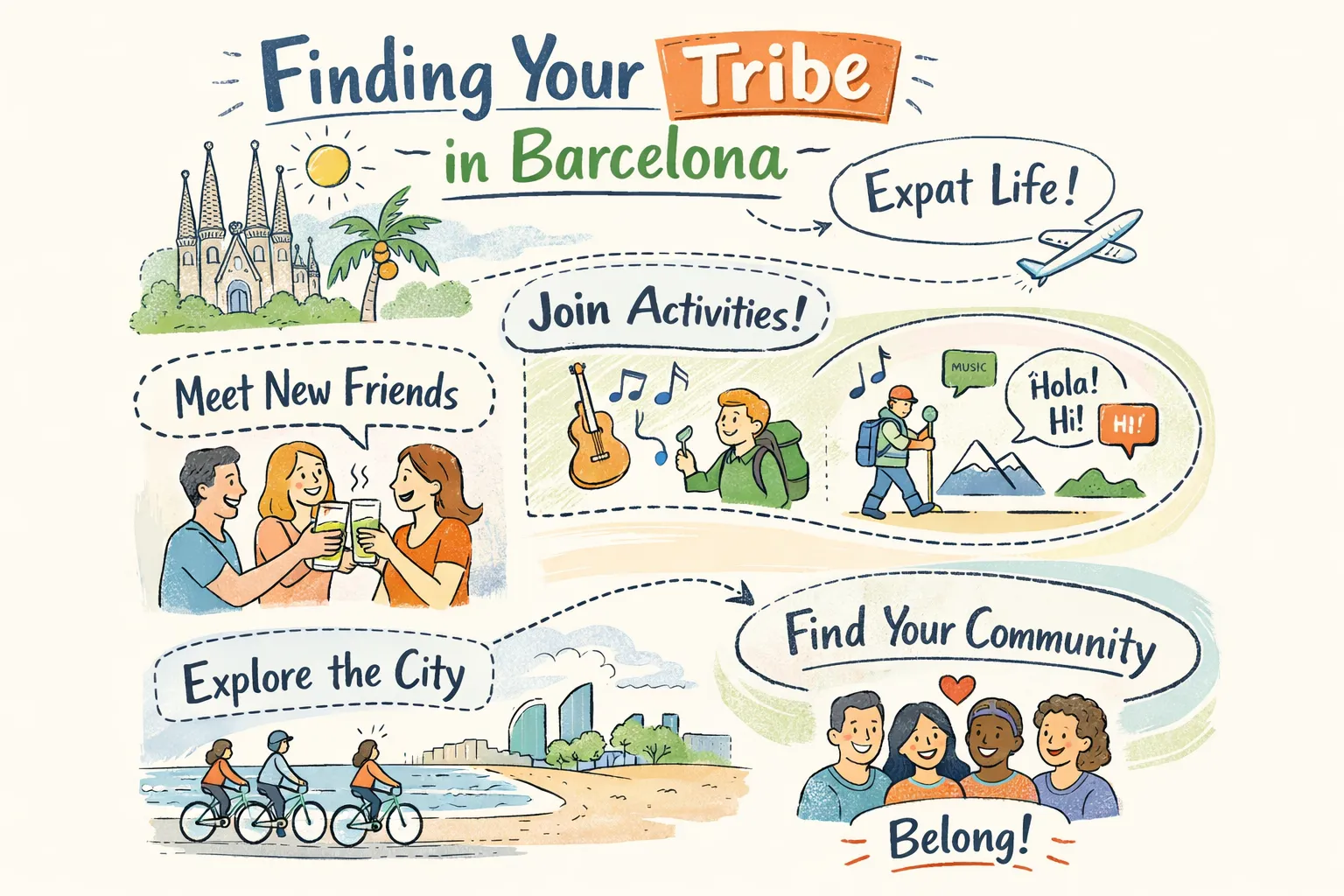
Arrive with a plan: where to start in Barcelona
Barcelona becomes manageable the moment you know where people already meet. Within the first 48 hours you can do three things that reduce waiting, speed paperwork and introduce you to the local social circuit. Do them first — they unlock the rest of your move.
- Book an empadronamiento appointment (or go in person with proof of address) — it’s the fastest document to obtain and it opens healthcare and many services.
- Join three active online groups and post a short introduction — one for housing, one for social meetups, one for your nationality or interest.
- Set up a temporary bank or fintech account (N26/Revolut) and buy a local SIM so you can RSVP to events and take bookings while you hunt for a long-term bank.
Keep this guide as your roadmap: it points to the best online hubs, the recurring meetups that actually work in 2026, neighbourhoods by lifestyle, the admin order that saves days of waiting, and a realistic 30‑day plan that turns initial contacts into friends. Expats World’s Barcelona city guide and downloadable 30‑day checklist are designed to sit alongside this article and speed up the admin and event vetting steps.
Why Barcelona’s international scene matters — and who should use this guide
Barcelona’s international scene is a patchwork. You’ll find students, families, digital nomads, corporate transferees and long-term residents sharing cafés, markets and weekend rituals. That matters because community here does practical work: locals and other internationals trade neighbourhood tips, sublets, school leads and short-term jobs — and they also help you get the small social attachments that stop newness from feeling isolating.
How to use this guide by profile:
New arrival — follow the 30‑day plan and prioritise empadronamiento, a local SIM and one recurring weekly meetup. Use the housing scripts and the vetted resource list to speed viewings.
Planning to move — bookmark the neighbourhood notes, join the online hubs now, and use the housing outreach scripts two weeks before your arrival so you can schedule viewings immediately.
Short‑term nomad — focus on digital-nomad meetups and flexible housing platforms (Spotahome, Flatio, HousingAnywhere). Aim for social routines: a weekly language exchange and one hobby class to build regular contact.
Expats World helps by curating active group directories, providing a downloadable 30‑day checklist and a short list of vetted local service partners (estate agents, translators, immigration advisers). Use these when you want tried-and-tested options rather than starting cold.
Where to meet people online — the hubs to join now
Online groups are where Barcelona’s social calendar is born. There are several useful categories: large general groups that post daily events and classifieds; nationality- or interest-based groups; housing-focused groups; language-exchange channels; and smaller WhatsApp/Telegram hangouts that drive the best real-world meetups. The city council’s Barcelona International Welcome website is also a tidy source for English-language sessions and municipal updates.
Representative names to search for in 2026 include Barcelona International Expats, Barcelona International Social, Barcelona Worldwide Friends, BCNFirst International Community and BARCELONA MEETINGS EVERY DAY. Activity and membership change fast—verify live member counts and the date of the most recent posts before relying on any group. For a quick curated list of active Facebook communities to check, see this roundup of 24 Facebook groups in Barcelona.
How to pick the right group: watch three signals over a 48‑hour window — post frequency (new posts in the last 24–48 hours), pinned rules and how moderators respond, and whether posts skew towards classifieds or social events. Moderated groups with clear rules and active admins are generally better for meetups and safety.
Vetting checklist — simple signs a group is worth your time:
- Daily or frequent posts and recent event announcements.
- Clear pinned rules and at least one admin who answers questions within a day.
- Event posts that list a venue, organiser and a way to RSVP (Meetup/WhatsApp link).
Red flags: spam-heavy feeds, repeated requests to send money before meeting, or groups with zero event history in the past month.
Two ready-to-post templates you can paste straight into a group:
General intro: Hi everyone — I’m [Name], just arrived from [country]. I work in [field] and I’ll be living in [neighbourhood]. Looking for language exchange, weekend walks, and any recommendations for good cafes with reliable wifi. Happy to meet for a coffee this week — DM me. Merci/Gràcies!
Short housing request: Hello — I’m looking for a 1‑bed or room in [Gràcia | Eixample | Poblenou] from [date]. Budget up to €[amount]. I’m [working remotely | employed by X | student], non-smoker, long-term tenant preferred. Contact [phone/email]. Thanks!
Best practice: post once, introduce yourself, ask one direct question, and follow replies with DMs. The first quality reply is usually better than a dozen weak ones.
Meet people in person — the recurring events that actually work
Face-to-face meetups are where acquaintances become friends. The types that consistently deliver are language exchanges, regular weekly social nights, hobby groups (running, board games, dance), family playgroups and professional meetups or coworking evenings. Digital-nomad meetups and co-working socials are especially useful for remote workers because they combine social time with a chance to ask practical questions about taxes, workspaces and visas.
Examples to check and verify in 2026: Barcelona International Expats runs monthly socials and fitness sessions; Barcelona International Social organises multiple weekly language exchanges and themed nights; Barcelona Worldwide Friends hosts a Saturday language exchange with pizza, and BARCELONA MEETINGS EVERY DAY publishes daily meetups and language cafés. Many of these groups also host Meetup pages — for example, check the Barcelona International Expats Meetup for upcoming events and RSVPs. Venues that appear often include Trafalgar Pizza Club, OGHAM, Pecera Pool and various bars in Gràcia and Eixample — always confirm the venue on the event page.
How to choose an event: match your goal to the format. If you want language practice, choose a language café. If you want to build local friendships, pick an event with a predictable weekly cadence so you’ll see the same faces. For professional connections, attend topic-specific meetups and follow up with people within 48 hours.
RSVP etiquette and practical arrival behaviour: RSVP early and arrive 10–15 minutes after the start time to catch ongoing conversations rather than interrupting the initial introductions. Bring one small ice-breaker question (for example: “What’s one local café you take visiting friends to?”). If you’re nervous, arrive with a short two-line intro that states where you’re from, what you do, and why you moved.
Safety and comfort: meet in clearly public venues with named organisers. Check the event page for reviews or comments from past attendees and, for the first meeting, set expectations with a friend (time, place, organiser name).
Turning a meetup contact into something real — a three-line follow-up that works:
Hi [Name], I enjoyed meeting you at [event]. Would you like to grab a coffee this Saturday afternoon? I’m free after 3pm near [metro stop].
Neighbourhoods that fit how you want to live
Picking a barrio matters more than you think: daily routines (market hours, noise, local shops), commute patterns and the kinds of people you meet are driven by neighbourhood character. When choosing, test four signals: local vibe, rent band, transport options, and proximity to the amenities you actually use (coworking, parks, schools).
Profile recommendations grounded in everyday reality:
Students & young professionals — Gràcia. Narrow streets, plazas that act as living rooms, lots of small bars and language schools. Shared flats are common and rents are generally lower than the centre. Expect lively nights and pedestrian-friendly streets.
Remote workers & creatives — Poblenou and parts of Eixample. Poblenou has coworking density, cafés with long opening hours and better value for larger flats. Eixample gives centrality and reliable transport; expect a more formal grid layout and plenty of amenities.
Families — Sarrià and Les Corts. Quieter residential streets, bigger flats, playgrounds and proximity to international schools. Rents are higher but you gain space and calmer mornings.
Beach lovers and short-term stays — Barceloneta and El Born. Great social life and quick sea access, but expect tourist traffic and higher seasonal rents.
Transport pointers: check the actual commute at rush hour. Metro and tram lines look efficient on a map but a 20‑minute daytime trip can double during peak hours. If you’ll rely on public transit daily, verify your apartment’s walking distance to a metro line that suits your routes rather than choosing purely on neighbourhood name.
Money and reality check (2026 conservative ranges): think of central one-bed flats in tiers — basic €1,000, mid €1,500, premium €2,000+. Prices change quickly; always cross-check Idealista/Fotocasa and local listings. For a broader look at where expats settle across Spain and comparative costs, see the overview of where expats live in Spain: 12 communities & costs.
Local routines and unspoken rules: grocery markets are busiest in the morning and often quiet after 2pm; many small shops close midday and on some Sundays; neighbours expect lower noise levels late at night and early morning — observe local shop hours and the rhythm of the block before hosting noisy gatherings.
For a wider perspective on recommended towns and neighbourhoods across Spain, consider reading the Best Expat Communities in Spain: 12 Top Picks 2026.
Paperwork & quick wins that save days: NIE, empadronamiento, bank and healthcare
Sequence is not arbitrary. Doing the right steps in order prevents repeat visits and missing documents. The efficient path is: get your NIE (or appointment), register on the padrón (empadronamiento), open a bank account, then register for healthcare. Each step builds the paperwork needed for the next.
- Complete the EX-15 form and pay Tax Form 790 (code 012). Keep the stamped payment receipt.
- Book your appointment at the Oficina de Extranjería or local police station for the NIE. In Barcelona, appointment slots often appear early on weekday mornings; checking Monday at 8:30am can help catch new openings.
- Gather originals and copies: passport, printed forms, proof of legal entry, employment/justification documents, photos and appointment confirmation.
- Attend the appointment, submit fingerprints if required and collect the NIE paper or instructions for the TIE card.
Empadronamiento is usually the fastest office visit — take your passport, rental contract and a completed municipal form. Many people do this during week one because the padrón is needed to register for healthcare, obtain certain permits and open a full local bank account.
Bank account choices: start with an international fintech (N26, Revolut) for immediate access and card payments; open with a local bank once you have empadronamiento and NIE if you need payroll deposits, utilities and longer-term banking features. Bring ID, NIE (or appointment confirmation), and proof of address to the bank.
Healthcare: EU citizens can access public healthcare after registration; non-EU visa holders often need private health insurance as part of their visa conditions. Once empadronado, register at your local health centre (centro de salud) to receive a health card. If you need urgent care while paperwork is pending, private clinics and international health centres are the fastest option.
Quick wins and common pitfalls: use the consulate for pre-arrival NIE if your nationality allows it; photocopies are no substitute for originals in many offices; translation may be required for some documents; book empadronamiento slots early — local registries can fill up fast. For a practical step-by-step guide to obtaining an NIE in Barcelona, this guide to obtaining an NIE in Barcelona is a useful reference.
Expats World provides a downloadable document checklist and appointment templates to copy-and-paste at the right step, plus a shortlist of vetted local agencies for urgent legal help (optional, not required). If your move is coming from the U.S., the Moving to Spain from the U.S.: The Practical Roadmap has additional pre-departure steps and timeline advice.
Finding and securing housing — platforms, scripts and what to watch for
Start online and leave time for weekend viewings. Use the big listing sites (Idealista, Fotocasa, Habitaclia) plus room-specific platforms (Badi) and verified remote view tools (Spotahome, HousingAnywhere, Flatio). CasaRadar is useful as an aggregator that pulls multiple feeds. For a curated list of the best websites to find an apartment in Barcelona, see this CasaRadar guide to apartment sites.
Fast viewing routine: shortlist 4–6 flats per weekend, schedule viewings in a single day and bring a document pack (passport, recent bank statement, employment contract or reference letter). During a viewing, ask: who is the owner (private vs agency), are utilities included, how many months’ deposit, and the notice period for leaving.
Practical outreach scripts (concise, respectful):
Message to owner/agency: Hello — I’m [Name], interested in the flat at [address]. I work as [job] and plan to rent from [date] for [duration]. I have references and can provide ID and proof of income. Is the flat still available? Thanks, [phone/email].
Facebook housing post: Looking for 1‑bed (or room) in [neighbourhoods] from [date]. Budget €[amount]. Remote worker, non‑smoker, tidy. Short-term ok. DM or WhatsApp [phone].
Contracts and payments: expect a security deposit (fianza) typically one month for rentals, an inventory and possibly an agency fee (one month + IVA in some cases). Negotiate on minor repairs, the inventory, and including fibre/internet activation if needed. Never pay a large sum before viewing or before signing a written contract.
Red flags and scam checklist:
- Requests for transfers before a viewing or before a contract is signed.
- Prices that look far below market without explanation.
- Owners who refuse a formal contract or insist on cash-only “holding fees.”
- Contacts who only communicate through private messaging and avoid video calls or verifiable IDs.
Move-in practicals: set up utilities in advance where possible — some providers activate internet in 3–7 days for fibre, mobile SIMs are instant and prepaid plans work well at first. Buy basic survival supplies for week one (cleaning, sheets, kitchen kit) so you can host quickly and build social ties.
A practical 30‑day plug‑in plan: weekly milestones to meet people and settle in
Social energy and admin both take time. This paced plan separates urgent admin from the gentle work of meeting people so you don’t burn out.
Week 1 (days 1–7) — arrival & essentials
Priority actions: empadronamiento, temporary fintech account, local SIM, join 3 online groups, attend one language café. Bring passport, rental contract and a printed checklist from Expats World to your appointments.
Week 2 (days 8–14) — neighbourhood & housing focus
Intensify the housing hunt: view flats, visit local markets and cafés in your shortlisted barrios, RSVP to two meetups and start a beginner language class or a hobby session to meet regulars.
Week 3 (days 15–21) — deepen connections
Follow up with five people you met at events with a low-effort invite. Volunteer for one community shift or offer to bring tapas to a language exchange to be useful and visible. Register for healthcare if needed.
Week 4 (days 22–30) — consolidate
Sign a lease or recalibrate the housing search. Commit to one recurring group (same night each week) and set up bill payments. Measure success: two or three contacts you can meet again in person and one recurring activity on your calendar.
Micro-scripts to use during the 30 days:
Event follow-up: Hi [Name], great chatting at [event] — are you free for a coffee this Wednesday? I know a quiet place near [metro].
Short viewing request: Hi — available to show the flat this Saturday? I can bring references and ID. Thanks!
Realistic expectations: “connected” after 30 days usually means you have a handful of people you can call for coffee, a weekly social appointment in your calendar, and the key paperwork in place. If progress feels slow, narrow your focus: fewer groups, more recurring events, and one hobby that forces repetition.
Local etiquette, safety and long‑term belonging
Small courtesies unlock warmth. Try Catalan greetings in shops — “Bon dia” (good morning), “Gràcies” (thank you), and “Si us plau” (please) — and respect late dinner rhythms (many restaurants open around 9pm). Be mindful that neighbourhoods are protective; greet your immediate neighbours and the small shop owners and they’ll reciprocate over time.
Safety pointers: keep valuables secure on public transport, avoid leaving bags open on busy metros and around La Rambla or crowded beaches. For meetups, pick public venues and check organiser profiles. Vet paid services and translators by asking for references and a business card; use the vetted lists from Expats World if you want pre-screened options.
Long-term belonging comes from showing up regularly. Volunteer with local NGOs, join a sports club or a crafts class, and apply the “show up three times” rule: people notice and remember faces after three consistent appearances. Hosting small gatherings is one of the fastest ways to reciprocate hospitality you’ve received.
Final takeaway: start by clearing the basic admin (empadronamiento, bank, SIM), then invest your energy in one recurring social routine. Quality and consistency beat trying to meet everyone at once.
Ready to go faster? Download Expats World’s Barcelona 30‑day checklist and city guide, curated group directory and appointment templates to copy into messages and forms — then pick one meetup this week and RSVP. Small, repeated steps are how cities become home. If you’re also weighing other Spanish cities, see the Valencia Expat Community: Groups, Neighborhoods & Meetups for neighbourhood and meetup ideas outside Barcelona.