
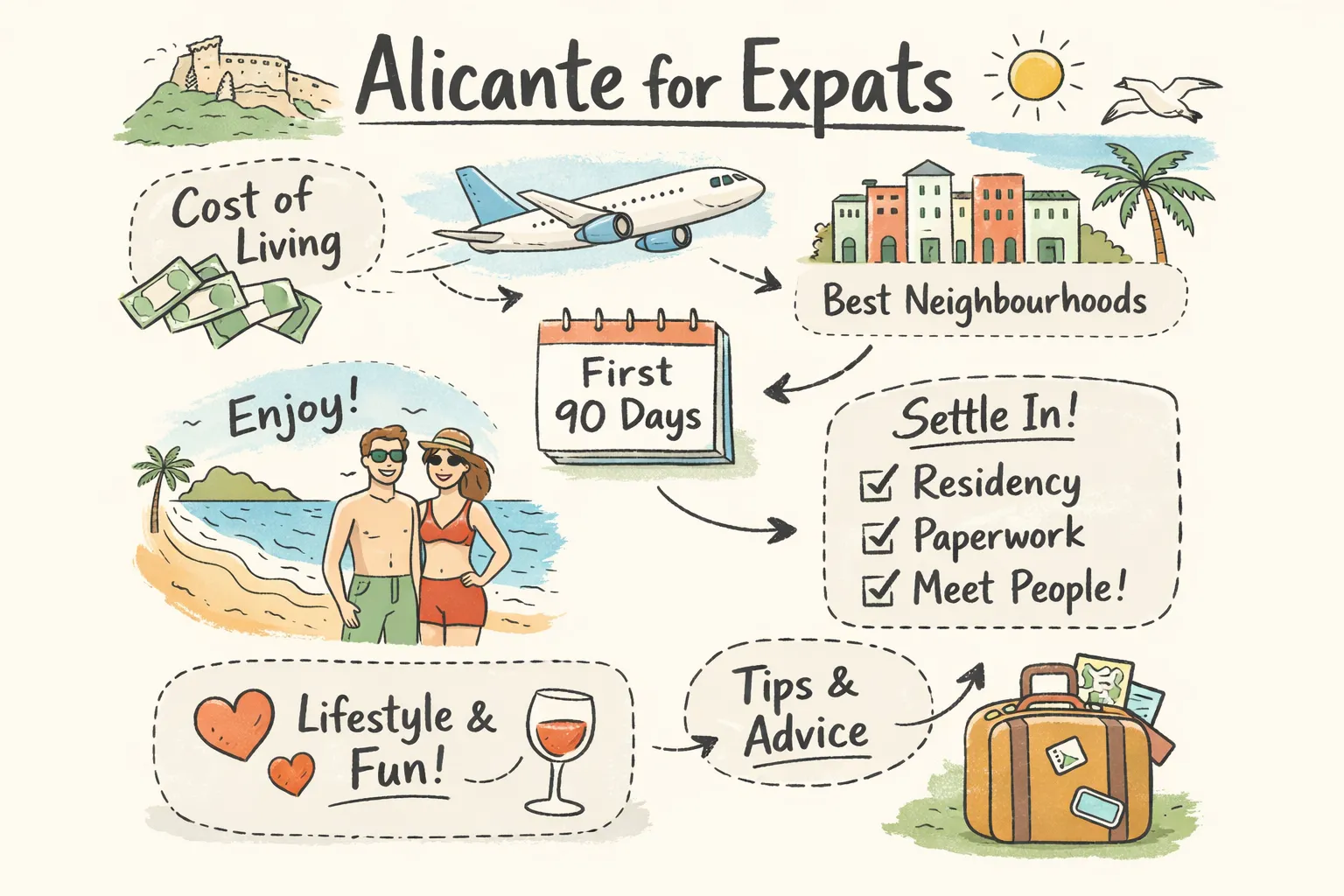
Alicante is a compact Mediterranean city: beaches within walking distance for many neighbourhoods, good walkability in the centre, a sizable international community and lower living costs than Spain’s largest cities. It’s straightforward to build a comfortable life here if your priorities are sunshine, coastal living and a relaxed pace — but it isn’t a one‑size‑fits‑all choice.
| Top‑line numbers (typical mid‑range lifestyle) | Estimate |
|---|---|
| Single (monthly) | ≈ €1,569 |
| Family of four (monthly) | ≈ €3,179 |
| 1‑bed city centre rent | €800–€1,000 |
| 1‑bed less central | €450–€600 |
| 1‑bed outside centre | €600–€900 |
Who tends to thrive: families wanting beaches and decent schools, retirees seeking a quiet coastal life, and remote workers or digital nomads who prioritise affordability and sunshine. Who should think twice: people depending on high‑end, city‑centric jobs in specialised industries, those needing immediate access to advanced tertiary hospital care, or anyone unwilling to use basic Spanish for routine bureaucracy.
How to decide in two minutes: answer these three questions — (1) Can your work/income be done remotely or through local sectors like tourism/education? (2) Do you need specific healthcare or school provision that only a large city can reliably supply? (3) Are beaches, a slower pace and smaller‑city services a priority? If you’re leaning toward “yes” for Q1 or Q3 and “no” for Q2, Alicante is worth a serious look. To compare scenarios quickly, download the Alicante neighbourhood map and budget template available in Expats World’s Alicante city guide (links at the end of the Cost and 90‑day sections below).
What living in Alicante actually costs — realistic budgets you can use
Costs in Alicante vary with neighbourhood, household size and whether you use private healthcare. Below are practical sample budgets built from local market figures — use them to test whether your income covers the lifestyle you want.
| Item | Lean single | Comfortable single | Lean family (4) | Comfortable family (4) |
|---|---|---|---|---|
| Rent | €500 (small 1BR, less central) | €900 (1BR, city centre) | €900 (2BR outside centre) | €1,600 (3BR, good area) |
| Utilities (elec/water/gas) | €90 | €140 | €140 | €200 |
| Groceries & household | €200 | €300 | €600 | €900 |
| Transport (monthly) | €40 | €50 | €80 | €120 |
| Internet & mobile | €30 | €40 | €50 | €60 |
| Entertainment & eating out | €80 | €140 | €200 | €350 |
| Private health insurance / extras | €40 | €60 | €120 | €200 |
| Childcare / school fees | — | — | €200 (part‑time / extracurricular) | €250–€800 (private/international school variable) |
| Total (approx) | €990 | €1,589 | €2,290 | €3,280 |
Notes on the numbers: the “comfortable single” approximate aligns with local midrange estimates (~€1,569). Rent is the single largest variable: beachfront, newly renovated or furnished apartments carry premiums. Utilities can spike in summer if you use air conditioning extensively and rise in winter for heating in older buildings — budget €130–€205 as a broad band. Grocery costs are reasonable; buying local produce at markets reduces the bill. A public transport monthly pass is modest; many city‑centre residents walk or cycle.
Money‑management rules of thumb: bring a buffer of two to three months’ living costs for the first move. Expect upfront housing costs — typically a first month plus a one‑month deposit (fianza) and possible agency fees (check who pays). If you qualify for public healthcare (SNS) after registering, you can reduce recurring private insurance costs; otherwise, arrange private cover early for visa compliance and peace of mind.
Practical tool note: a downloadable budget template and a printable cost snapshot are included with Expats World’s Alicante city guide — you’ll find the links at the end of this article so you can adapt these figures to your exact profile (family size, neighbourhood, healthcare choices).
Choosing a neighbourhood — where to live for families, retirees and nomads
Your neighbourhood determines daily routes, school runs, beach access and social life. Below are realistic neighbourhood fits and what living there feels like.
Family favourites
Playa de San Juan: long sandy beach, modern apartment blocks and family amenities. Expect larger flats (2–3 bedrooms), international and bilingual school options nearby, and straightforward tram access to the city. Albufereta: quieter and more residential, good for families seeking calmer mornings and seaside walks. El Pla del Bon Repós: community feel, parks and local shops — smaller streets and a strong neighbourhood vibe that supports school networks and local clinics.
Retirement choices
Playa de San Juan and Cabo de las Huertas offer safe, low‑stress living with easy beach access and good private medical options nearby. El Campello is quieter and suits retirees who prefer a small‑town rhythm with regular rail links into Alicante. For a historic, slower pace, nearby Elche Centro provides a green, culturally rich alternative within short driving distance of Alicante’s services.
Digital nomads & young professionals
Centro / Old Town is the natural pick: cafés, restaurants, historic streets and compact walkability make it easy to work from a local café or a nearby coworking space. Benalúa offers central value — lower rents within reach of the main services and evening social life. Broadband reliability in these areas is generally good; expect to find fibre in most modern buildings.
| What to check when choosing a neighbourhood | Why it matters |
|---|---|
| Proximity to Centro de Salud / hospital | Essential for children and anyone with ongoing health needs |
| Daytime noise & nightlife | Determines sleep quality and daytime comfort |
| Transport links (tram, bus) | Reduces need for a car, improves school/commute options |
| Supermarket and market options | Daily ease and grocery costs |
Expats World includes a downloadable neighbourhood map and short “one‑day” routine vignettes for these areas in the Alicante city guide — use them to visualise a morning school run, a workday commute and an evening out before you sign anything. For a national perspective on where expats settle and how costs compare across communities, see the Where Expats Live in Spain: 12 Communities & Costs.
Finding housing, signing a lease and moving in — the practical playbook
Start with the common portals (Idealista, Fotocasa, Habitaclia and local Facebook groups) and mix estate agents with private listings. Use Airbnb or a short‑term rental for the first two to six weeks while you view options in person; you’ll avoid rushed decisions and fraud.
At viewings inspect the apartment with a checklist mindset. Look for signs of damp, confirm water pressure, test sockets and lights, and ask to see the energy certificate (certificado energético). Note meter numbers and where the electric/gas meters sit; request an inventory (inventario) for furnished places and check comunidad (building) rules and fees.
- Key inspection points: damp / mould, water pressure, functioning heating / A/C, inventory list, comunidad fees and any visible safety issues.
Paperwork and typical upfront costs: Spanish rental contracts (contrato de arrendamiento) should be written and signed. Standard immediate payments include the first month’s rent and a one‑month deposit (fianza); some furnished properties may request an additional deposit. Agency fees vary — ask who pays (tenant or landlord) before committing. Bring ID (passport), NIE (if you have it) or proof you have applied, and proof of income such as employer letter, recent payslips or bank statements.
Signing tips: insist on a written inventory and signed contract, take time‑stamped photos of the full property on move‑in and ask for a recibo (receipt) for all payments. If the contract is in Spanish and you’re unsure, request an English summary or have a trusted bilingual friend check key clauses.
Utilities and connectivity: to open electricity, water and gas accounts you’ll need your rental contract and ID; some providers require an account with a bank. Broadband prices vary but expect fibre packages in the €30–€50/month band from national providers (Movistar/Telefonica, Orange, Vodafone and local groups under the MásMóvil umbrella). Mobile SIMs with decent data cost roughly €15–€25 for 10GB+ monthly.
Furnishing and moving: many rentals come either unfurnished or partially furnished. For lower upfront costs, consider second‑hand groups and local stores or short furniture rental for the first months. For larger moves, local movers and small van rentals are widely available; always get written quotes and a simple inventory for the move. For a practical example of neighbourhood‑level moving tips, see our Málaga Move‑In Guide for Expats: Neighbourhoods & Groups which applies many of the same viewings and checklist principles.
Red flags: never transfer large sums before seeing a property in person; verify the landlord’s ID matches the owner on land registry documents where possible; be wary of prices that look too good for the area — they often have hidden problems.
Visas, NIE, residency and taxes — a step‑by‑step timeline
EU/EEA/Swiss citizens move freely and should register locally to access services. Non‑EU nationals must secure the correct visa for stays longer than 90 days — apply at the Spanish consulate in your home country before travel.
Common visa routes and guidelines: non‑lucrative visas require proof of sufficient passive income (guideline often cited as ~€2,400/month or ~€28,800/year). Digital nomad visas exist for remote workers and usually expect evidence of stable remote income (thresholds vary by nationality and region). Work, student and family reunification visas each have specific requirements — check your local consulate pages early. If you want a concise pre‑arrival checklist and timeline focused on common US‑to‑Spain moves, the Moving to Spain from the U.S.: The Practical Roadmap covers many of the same steps and document requirements.
Pre‑arrival checklist: completed application forms, valid passport, passport photos, bank statements (3–6 months), travel/health insurance that meets visa rules (no deductibles where required), proof of accommodation, and certified translations and apostilles for any requested documents.
Timelines: many standard visas process in 15–21 days; non‑lucrative visas commonly take 2–3 months. After you arrive, register on the padrón (empadronamiento) at the Ayuntamiento and apply for your NIE/TIE as required. Your NIE is used for banking, signing contracts, paying taxes and more — get it early.
Tax basics: spending more than 183 days in Spain usually makes you a Spanish tax resident, with obligations on worldwide income. If you have cross‑border income, consult a tax specialist early — a bilingual gestor can save weeks of headaches on paperwork.
Practical tip: book “cita previa” (appointments) early for police and social security offices; keep originals and certified copies of all documents.
Healthcare, schools and everyday admin — how to register and what to expect
Healthcare registration follows a clear sequence: empadronamiento at the town hall → obtain or confirm your social security number (if eligible) → register at your local Centro de Salud and receive the Tarjeta Sanitaria Individual (TSI). Bring passport/ID, proof of address (rental contract), empadronamiento certificate and social security paperwork where relevant.
Public vs. private: residents eligible for the National Health System (SNS) access GP services, hospital care and specialist referrals; waiting times can be longer for non‑urgent cases. Private insurance speeds access, often includes English‑speaking practitioners and is required for some visa types. Convenio Especial is an option for people not yet eligible for SNS; regional rules and rates vary — typical monthly costs can range from roughly €60 up to €150+ depending on age and region, so check the local INSS office for current rates.
Visa insurance rules: non‑lucrative and many long‑stay visas require comprehensive private insurance with Spain‑authorised coverage and no large deductibles. Arrange cover before your consulate appointment.
Schools and childcare: public school places are assigned using catchment areas, so your neighbourhood choice matters. Private and international schools exist but places can be limited — start searches early, collect document lists and plan for application windows. Expats World’s directory within the Alicante guide lists verified schools and contact points to speed your search.
Day‑to‑day admin checklist: open a Spanish bank account (passport, NIE and empadronamiento are often required), get a local SIM and set up broadband, apply for public transport cards, consider converting your driver’s licence if you plan to drive long‑term, and register any imported vehicle if bringing a car.
For step‑by‑step instructions on how to register for Spanish healthcare, including required documents and sequence, see this practical guide: how to register for Spanish healthcare.
Work, income and making Alicante your workplace
Remote workers: confirm the visa route that suits you and check broadband availability in your chosen neighbourhood. Coworking spaces and cafés in Centro and San Juan provide a variety of setups; coworking membership costs typically range from budget day passes to monthly plans in the low hundreds of euros.
Local jobs: common expat roles are in tourism, hospitality, seasonal work and language teaching. Most local positions require Spanish; improving language skills expands your opportunities and everyday ease.
Self‑employment (autónomo): register with the tax office and Social Security, invoicing clients and paying social contributions. Costs and formalities change often — a short meeting with a local gestor will clarify expected monthly contributions, allowances and invoicing procedures.
Finding work: use local job boards (InfoJobs, local Facebook groups), contact language schools directly, and network through community meetups. For contracting or freelancing, local invoicing rules and VAT considerations make early tax advice essential to avoid surprises.
The 90‑day settling plan — exactly what to do and when
Turn the first three months into a checklist rather than a long to‑do list. Below is a practical schedule with time estimates that will keep you on track.
Day 1–7: essentials (high priority)
Finalize your housing or confirm short‑term rental. Register on the padrón at the town hall and get the empadronamiento certificate. Open a basic bank account (many banks offer accounts for newcomers). Buy a local SIM and arrange home internet. Set up electricity/water if moving into a long‑term place. If you need medical care quickly, find the nearby Centro de Salud and register.
Week 2–4: admin & setup
Apply for your NIE or TIE appointment if your visa requires it. Register for social security if you’ll be working or self‑employed. Begin school visits and enroll children if needed. Start language lessons (even a few classes helps immediately). Compare private health insurance quotes if you’re not yet eligible for SNS and decide whether to keep private cover.
Month 2–3: integration & routines
Choose a GP and dentist, establish your regular grocery and shopping routines, join a local club or volunteer group to start building friendships, and explore neighbouring towns and beaches to broaden your social map. If you’re working locally, attend meetups and networking events to find clients or jobs.
If you only do three things: (1) complete empadronamiento, (2) secure your NIE/TIE or confirm visa status, (3) register for health coverage (TSI or private insurance).
Community and support: join InterNations and targeted Facebook groups, attend one event a week for the first month, and post specific requests (“Looking for 2BR near San Juan with A/C and near a bilingual school” yields better replies than vague posts). Use meetups to ask practical questions — people happily share contractor names, doctors and school tips.
Expats World toolkit: the Alicante city guide includes a printable 90‑day checklist, a neighbourhood comparison map and a downloadable budget template — they live in the Resources section of the guide to help you run the numbers and map your first three months. See the full Alicante city guide for the toolkit and printable resources.
Final decision checklist (takeaway)
Before you commit: verify affordability with a three‑month buffer, confirm access to required healthcare and schooling, test the neighbourhood for daily routines you’ll use, and build a simple exit/backup plan. If those boxes check out, Alicante is a low‑friction, sunny place to build the life you want.
Two closing points: Alicante rewards people who plan a little and arrive ready to adapt a lot. For broader cost comparisons and national benchmarks see the Spain 2026: Real Expats’ Cost of Living — Madrid & More, and for additional national cost context consult independent cost summaries such as the cost of living figures for Spain. Use the practical tools in the Expats World Alicante city guide to test scenarios, compare neighbourhoods and turn uncertainty into a clear plan.