
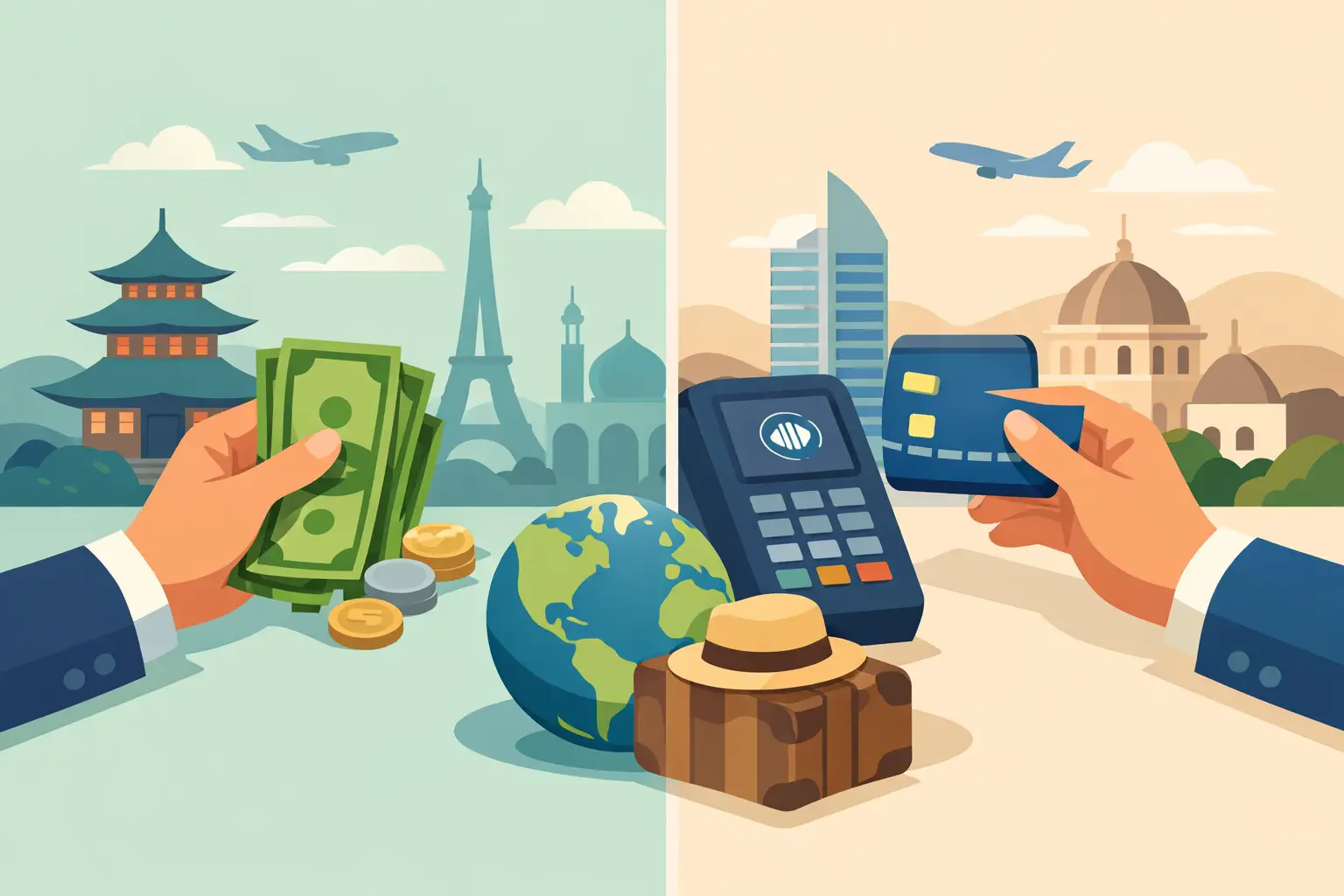
You can have a local bank account, a contactless card, and a phone loaded with payment apps, then still be unable to pay for a taxi, a repair, or your lunch. Cash versus card culture abroad is rarely just a question of technology. It reflects how local businesses operate, how people manage trust and privacy, and what counts as normal in everyday transactions.
For an expat, the practical problem is not choosing one payment method forever. It is learning when cash makes life easier, when card use is expected, and when a payment choice quietly marks you as unfamiliar with local routines.
Cash versus card culture abroad is local, not national
Country-level advice can be useful, but it often misses the reality of daily life. A capital city may be heavily card-based while smaller towns, market neighborhoods, and service trades still rely on cash. A country known for cash may have excellent contactless payments in supermarkets and transit, but require bank transfers for rent and cash for small personal services.
The reverse can also happen. In a place where cards are widely accepted, a landlord may prefer a direct bank transfer, a neighborhood restaurant may accept only a domestic payment app, and a small clinic may ask for cash at the end of an appointment. Payment habits vary by region, age group, business type, and even time of day.
Treat broad claims such as “everyone pays by card” as a starting point, not a plan. Ask people who live in your specific city how they pay for groceries, taxis, household help, school activities, medical visits, and rent. Those categories reveal much more than a generic statement about card acceptance.
What your payment method communicates
Money carries social signals. In some places, paying by card is simply efficient. In others, using cash for a small purchase is polite because it protects a small business from card-processing fees. Some merchants set minimum card amounts for this reason, whether formally or informally.
Cash can also communicate immediacy and trust. Paying a repair person or a cleaner in cash may be standard, especially when the work is arranged through personal recommendations. That does not automatically mean the arrangement is unsafe or improper. But expats should understand the line between ordinary local practice and a request designed to avoid documentation, taxes, or accountability.
Card payments can feel safer because they create a record. That record matters for expense claims, deposits, returns, and disputes. Yet some locals avoid cards due to privacy concerns, past banking instability, limited credit access, or a desire to manage spending physically. Assuming cash users are behind the times is an easy way to misread the culture around you.
The payments that catch newcomers out
Daily coffee and grocery purchases are usually the easy part. The expensive or inconvenient surprises tend to appear in less visible parts of life abroad.
Rent is a major example. Landlords may expect a local bank transfer, a standing monthly order, postdated checks, or cash. Never hand over a large cash deposit without a written receipt that states the amount, date, property address, purpose of payment, and the name of the person receiving it. If the local norm is cash, documentation becomes even more important, not less.
Tipping is another source of confusion. In card-forward countries, a terminal may present several tip options even where tipping is modest or optional. In cash-oriented settings, small notes and coins may be the practical way to tip drivers, servers, delivery workers, and hotel staff. Learn both the expected amount and the preferred method. A card terminal’s suggested percentage is not always a cultural instruction.
Small services deserve attention as well. Hairdressers, independent tradespeople, market vendors, babysitters, local tutors, and apartment building staff may prefer cash. Keep enough local currency to cover normal small payments for several days, particularly while you are still setting up banking and phone service.
Public transportation can expose a different gap. Some systems are almost entirely contactless, while others require a reloadable local transit card purchased with cash or through a specific app. Visitors often assume a foreign-issued card will work everywhere because it worked at the airport. That can be a costly assumption during a late-night commute.
Build a payment setup for real life
A good expat setup uses more than one method. Relying entirely on cash creates security and recordkeeping problems. Relying entirely on one foreign card can leave you stuck during a network outage, a fraud hold, or a merchant’s refusal to accept international cards.
Start with a modest cash reserve in local currency. The amount depends on your city and household, but it should cover transport, food, and an unplanned small expense without requiring an ATM search. Store it sensibly rather than carrying all of it with you.
Keep at least two payment cards from different providers if possible, and do not store them in the same place. Check whether your bank charges foreign transaction fees, ATM fees, or unfavorable currency conversion markups. A card that is convenient for travel may become expensive when used for every local purchase over several months.
Once eligible, open a local bank account and learn the transfer system. In many countries, bank transfers are more central to everyday life than checks or person-to-person card payments are in the United States. Ask whether transfers are instant, whether recipients need an account number or phone number, and whether there are daily limits. These details matter when you need to pay a deposit or reimburse someone quickly.
It is also worth understanding local mobile payment habits. A popular domestic app may be used for splitting restaurant bills, paying utility providers, or purchasing from small sellers. You do not need every app immediately, but knowing which one people actually use can prevent awkward workarounds.
Use cash carefully without treating it as suspicious
Cash is not inherently risky, but it requires habits that card users can overlook. Count change before leaving a counter, especially when bills and coins are unfamiliar. Learn the appearance and value of common notes before carrying a large amount. In some currencies, the difference between similar-looking bills can be significant.
Use bank-owned ATMs or machines in secure, well-lit locations whenever possible. Independent currency exchange booths and standalone ATMs may charge high fees or offer poor conversion rates. When an ATM or card terminal asks whether to charge you in U.S. dollars or local currency, choosing local currency is often better because it avoids the merchant or ATM operator setting the exchange rate. Still, check your own bank’s terms before assuming that rule applies in every case.
For significant cash payments, make the transaction traceable. Request a receipt, take a photo of it, and confirm any outstanding balance in writing. This is especially useful with deposits, school fees, repairs, and shared household costs. Clear records are not a sign of distrust. They protect both sides when expectations differ or memories fade.
Notice the hidden access issues
Cash versus card culture abroad can reveal who is fully included in a local system. New arrivals may be unable to get a local card quickly because of residency rules, proof-of-address requirements, or a lack of local credit history. Foreign cards may fail with online merchants that require a domestic billing address. A local payment app may require a national ID number or local phone number.
These barriers are frustrating, but they are common during the first months abroad. Plan for a transition period rather than expecting financial life to work exactly as it did at home. Keep a backup payment method, avoid scheduling major purchases until you understand the process, and ask employers, landlords, or local contacts what form of payment is accepted before a deadline arrives.
For families, this planning extends to dependents. Schools may collect fees through bank transfer. Teenagers may need a transit card or cash for lunch. Older relatives visiting from the United States may not be comfortable with app-only payments. A household payment plan should account for everyone who needs to function independently.
Adapt without overcorrecting
The goal is not to imitate every local habit immediately. It is to become capable of handling ordinary life without creating unnecessary friction. If cash is customary for a small vendor, use it when practical. If a large purchase or deposit needs a paper trail, prioritize a documented method. If a merchant refuses cards, do not assume bad intent. If someone insists on an undocumented cash payment for a major transaction, slow down and ask questions.
The most useful approach is observant rather than rigid. Watch what coworkers do after lunch, how neighbors pay building fees, and what form of payment local service providers request. Within a few weeks, those patterns will tell you more about your new home than any airport currency exchange ever could.
A little local cash, a reliable card, and a willingness to ask before you pay can turn an everyday uncertainty into one less thing to think about as your life abroad takes shape.