
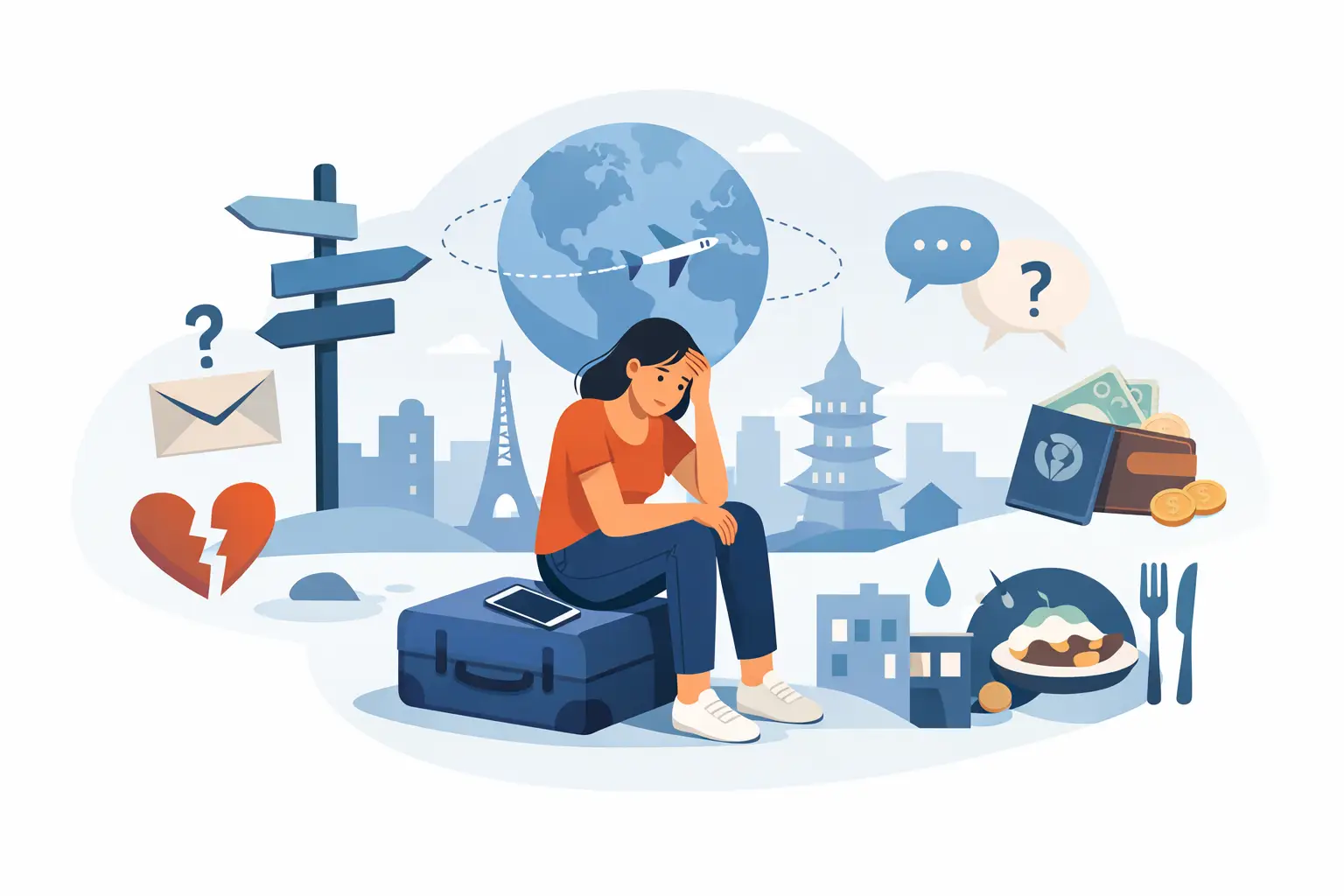
You rarely feel the strain of a move abroad in one dramatic moment. It usually shows up when your grocery trip takes an hour, your internet installer does not arrive, or a simple pharmacy question turns into an awkward guessing game. Everyday problems living abroad are often less about major crises and more about the repeated friction of doing ordinary things in an unfamiliar system.
That is why so many new expats feel caught off guard. They may have handled visas, housing deposits, and travel logistics, yet still feel unsettled once real life starts. The challenge is not just being in a different country. It is learning the hidden rules that shape daily life, from how appointments work to how neighbors communicate and how long routine admin actually takes.
Why everyday problems living abroad feel bigger than they look
Small inconveniences at home stay small because you already know the script. You know which bank branch is useful, what tone to use with customer service, when stores are busiest, and what counts as normal delay. Abroad, the same task can require new language, new timing, and new expectations.
That added effort creates decision fatigue quickly. When several minor issues stack up in the same week, they can affect your confidence more than one major problem would. Many expats start to question whether they are adapting well, when in fact they are dealing with a completely normal part of relocation.
There is also a practical side to this. Daily systems are rarely neutral. They reflect local values. A country that prizes formality may expect more paperwork and less improvisation. A place with a relaxed approach to time may frustrate someone used to strict schedules. What feels inefficient to you may simply be socially normal where you are.
The everyday problems living abroad that catch people off guard
Banking, payments, and proof of identity
Opening a bank account sounds simple until you learn that proof of address requires a utility bill, but you cannot get the utility bill in your name without a local bank account. These circular requirements are common. Even after setup, payment habits may differ. Card use may be widespread in one country and oddly limited in another. Some places still depend heavily on cash, local transfer apps, or debit systems that are unfamiliar to newcomers.
The real issue is not just access to money. It is the stress of not knowing which payment method is expected in everyday situations. That uncertainty can make ordinary errands feel higher stakes than they should.
Grocery shopping and household basics
A supermarket is one of the fastest places to realize you are no longer operating on autopilot. Product names may be confusing, familiar brands may be missing, and store layouts can reflect local cooking habits rather than yours. You may struggle to find basic items, even though the store is full.
This gets harder if you have dietary restrictions, allergies, or children. Labels may be unclear, substitutions may be imperfect, and what counts as a standard household product can vary widely. It usually improves with repetition, but the first few months often involve trial and error that feels strangely exhausting.
Customer service and problem resolution
Many expats assume frustration comes from language barriers alone. Often, it comes from mismatched expectations. In some places, customer service is warm and conversational. In others, it is strictly transactional. In one country, staff may solve exceptions creatively. In another, they may follow process so rigidly that even a small request becomes difficult.
If your internet fails, your package disappears, or your landlord misunderstands a repair issue, you are not just solving a problem. You are learning how authority, politeness, persistence, and escalation work locally. That takes time.
Healthcare and pharmacies
Even where healthcare quality is strong, access can feel confusing. You may need referrals for services you would usually arrange directly. Pharmacies may play a larger role in everyday care than you expect, or a smaller one. Prescription rules, specialist access, and appointment systems can all differ in ways that matter when you are sick and already stressed.
This is one of the clearest examples of why practical orientation matters more than broad reassurance. It is not enough to know that healthcare exists. You need to know how people actually use it.
Housing maintenance and utility issues
Renting abroad often exposes different standards around repairs, insulation, appliances, and landlord responsibility. Something that would be considered urgent in the US may be treated as minor elsewhere. Even basic instructions for trash, heating, ventilation, or mail delivery can vary building by building.
Newcomers sometimes read this as incompetence or indifference. Sometimes it is. But often it is a matter of local norms, tenant rights, and what housing stock is typically like in that market. Understanding the baseline helps you judge whether you are dealing with a real problem or a normal difference.
Social friction is part of daily life too
Not all everyday problems are logistical. Some are social, and those can be harder to name.
You may not know how friendly to be with neighbors, how direct to be with colleagues, or whether invitations are literal or polite. Small interactions can feel loaded when you do not yet understand the local rhythm. Even things like queueing, greeting shop staff, making complaints, or declining plans can carry different social meaning.
This is where many expats feel isolated without realizing why. They are functioning, but they are constantly monitoring themselves. That takes energy. It also explains why some people feel lonelier in very efficient countries and more settled in places that are administratively chaotic but socially warm. Daily comfort depends on more than systems.
What makes adjustment easier
The first useful shift is to stop treating every difficulty as a personal failure. Many everyday problems living abroad are structural. If a process is confusing, it may be confusing for locals too. If communication feels vague, that may be how people protect harmony or avoid overpromising.
The second shift is to build local pattern recognition. Instead of asking, “Why is this so hard?” ask, “How is this usually done here?” That question leads to better answers. It moves you away from comparison and toward interpretation.
It also helps to identify which problems are temporary learning issues and which ones genuinely affect your quality of life. Struggling with grocery labels for two months is annoying but solvable. Living in a neighborhood that makes routine tasks difficult may require a bigger decision. Not every problem should be normalized.
Practical ways to reduce everyday friction
Start by documenting what you learn. Keep notes on which bank branch was helpful, how to book a doctor, when local offices are least crowded, and what phrases work in service situations. This sounds basic, but it reduces the mental load of relearning the same lesson twice.
Talk to people who actually live the way you do. Advice from short-term visitors or relocation marketing materials often misses daily reality. A parent needs different guidance than a solo remote worker. A student can tolerate systems that would frustrate a full-time professional. Good expat advice is specific.
Give special attention to your weekly routines. If transportation, food shopping, laundry, school drop-off, or communication with your building are constantly draining you, those areas deserve immediate adjustment. Stability abroad usually comes from making regular life easier, not from solving one big milestone.
There is also value in accepting partial competence. You do not need to understand every custom or system at once. You need enough local knowledge to handle your life with less stress. That is a more realistic goal, especially in the first year.
When everyday problems signal a bigger issue
Sometimes daily friction is just adaptation. Sometimes it points to a mismatch between your needs and your environment.
If basic tasks remain difficult long after arrival, consider whether the problem is language access, neighborhood fit, work structure, family logistics, or legal status. For example, a city that works well for a single person may become impractical once childcare, commuting, or healthcare complexity enters the picture. Likewise, a country that feels exciting in theory may be draining if local communication styles clash with how you work and relate to people.
This is why grounded orientation matters. ExpatsWorld.net focuses on what life is actually like because that is often what determines whether a move becomes sustainable. Bureaucracy gets attention before a move. Daily function decides what happens after.
Living abroad gets easier when fewer things feel mysterious. Not perfect, not effortless, just more legible. Once you understand the habits behind the systems, ordinary life starts to feel ordinary again, and that is usually the point where a foreign place begins to feel livable.