
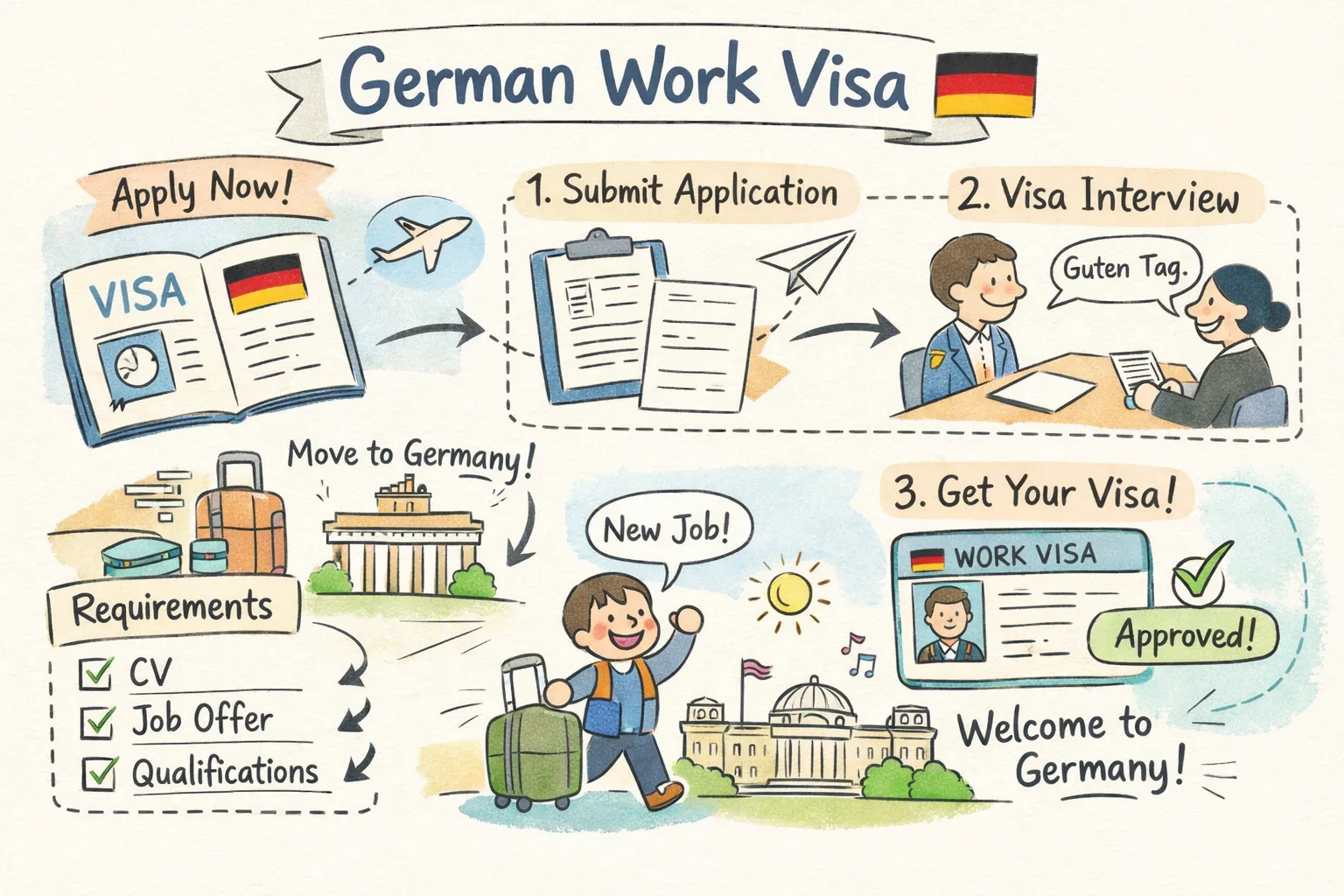
Which permit do you actually need and what should you do first? Start by answering two quick questions: do you already have a concrete job offer, and is your qualification recognised by German standards? This guide, created alongside Expats World’s printable consulate-specific checklist, gives you the immediate, practical steps: pick the right permit, collect and certify every document, file via the Consular Services Portal (VIDEX), know what to bring to your appointment, and handle the essential tasks after arrival. Read it once and you’ll have a clear action plan—plus copy‑and‑paste templates and two real timelines to follow.
Which German work permit is right for you? A quick decision guide
Decision tree, one short paragraph: If you have a firm job offer that clearly matches your training or degree → pursue a national employment/work visa or the EU Blue Card. If you have formal vocational training or a recognised degree but the salary is below Blue Card thresholds → skilled worker visa. If you need to search on arrival and meet the qualification/points criteria → Jobseeker (Chancenkarte). If you are highly qualified and meet the salary threshold → EU Blue Card for a faster route to settlement.
Quick summaries
Employment Visa (national D visa) — For non‑EU nationals with a concrete job offer for qualified employment; grants entry and residence to convert into a residence permit after arrival.
Skilled Worker Visa (Sections 18a/18b) — For recognised vocational qualifications or degrees (and recent reforms allow recognition pathways); intended to ease entry for trained professionals.
EU Blue Card — For highly qualified university graduates with a job and salary at or above the Blue Card threshold; faster path to permanent residence and family reunification.
Jobseeker Visa (Chancenkarte) — Points‑based entry to look for work in Germany for up to 12 months; no job offer required at arrival.
Quick-read decision checklist
If you already have a written job contract with salary details → start with an Employment Visa or EU Blue Card (use salary thresholds in Section 2 to decide). If you hold a recognised vocational qualification and your employer supports recognition → Skilled Worker pathways are designed for you. If you have a degree and meet the high‑salary threshold → EU Blue Card is usually best. If you have no offer but meet education/experience points → Jobseeker visa to find a role on the ground.
Special cases: regulated professions (medicine, nursing, teaching, law) require professional licences—start recognition early. Intra‑company transfers follow different intra‑company rules (check the company’s HR). If unsure, use Expats World’s quick permit planner to see which path fits your profile.
Eligibility, salary thresholds and qualification recognition—what you must prove
Every work visa revolves around the same pillars: a concrete job offer (or a points-based eligibility for Jobseekers), a qualification or recognised vocational training that matches the role, a salary that meets statutory thresholds, and proof you meet any specific professional licensing rules. Employers and the Federal Employment Agency (Bundesagentur für Arbeit, BA) are involved where the role affects the local labour market. For general background on German work and employment visas, consult a specialist overview to confirm the right national category for your case—this helps avoid choosing the wrong application route (work & employment visa overview).
2026 salary thresholds (subject to change)
| Visa Type | Key Salary Threshold (2026) | Notes |
|---|---|---|
| EU Blue Card (standard) | €50,700 | Fast-track residency; family reunification |
| EU Blue Card (shortage / recent grads) | €45,934 | Applies to shortage occupations and recent grads |
| Employment / Skilled Worker | Comparable to qualified employment level | BA involvement may set comparability |
The BA matters because it checks whether the job conditions are comparable to German standards and whether local candidates are available. Some roles—especially shortage occupations such as IT, engineering and healthcare—move faster; in those cases BA approval is typically straightforward. For high earners above a different statutory ceiling no BA approval may be necessary; check your employer’s HR guidance. Note that the EU Blue Card salary thresholds were updated for 2026—see the summary of the updated EU Blue Card salary thresholds.
Qualification recognition (Anabin / ZAB)
Before you apply, verify whether your degree or vocational training is recognised. The two main tools are Anabin (anabin.kmk.org) and ZAB (Central Office for Foreign Education). Practical steps: search your awarding institution on Anabin; if the degree is “equivalent” you’re good. If not, start a formal recognition with ZAB or the relevant German recognition authority; for regulated professions contact the relevant state authority (Landesprüfungsamt or equivalent) early because professional licences take time.
Practical checks before you apply
Confirm the gross annual salary in your written job offer and compare it to the thresholds. Ask your employer to include job title, duties, working hours and gross salary—explicit wording avoids delays. If BA approval is required, ensure the employer will submit the application and supply labour market documents. For regulated professions, begin licence recognition immediately and keep evidence of any pending approvals to include in your visa file.
Assemble every document correctly: originals, certified translations, notarisation and scans
Bring everything on the consulate checklist—organised, labelled and with the right translations. Missing or incorrectly prepared documents are the most common cause of delays and refusals. Below is the complete document set explained so you can prepare in order.
Visa application form and VIDEX — Print the completed VIDEX declaration, sign wherever required, and include the printed Declaration of Service and Visa Fees. Keep an unsigned extra page for the consulate if they request a live signature.
Passport and photos — A valid passport (issued within the last 10 years, with at least two blank pages and validity beyond three months after arrival) plus photocopies of the data page. Bring two biometric photos (35×45 mm) that meet German visa standards.
Signed job contract or offer — Must state job title, gross annual salary, working hours, start date and full employer contact details. If the contract is conditional on recognition, include a clear note and timeline.
Proof of qualifications — Degree certificates, diplomas and transcripts. If you have ZAB/Anabin recognition letters or a pending recognition file, include that documentation.
CV and work references — A concise CV and supporting reference letters or employment contracts that demonstrate relevant experience.
Declaration of Employment and BA pre‑approval — If applicable, include the employer’s BA application and any written preliminary consent (Vorabzustimmung).
Health/travel insurance — Short‑term travel/visa insurance for the appointment, showing at least the minimal coverage requested by the consulate. For national visas you’ll later present full German health insurance when registering. For details on acceptable visa insurance options, consult specialist insurers that describe minimum cover for visa appointments (visa and travel insurance guidance).
Proof of accommodation and funds — Rental contract, hotel booking or employer housing confirmation; for Jobseeker visas, bank statements or blocked account proof that you can support yourself.
Visa fee payment proof — Bring evidence of payment if paid online or the means to pay at the VAC or consulate.
Rules and practicals for originals vs copies: submit originals plus copies as the local consulate checklist requests—some expect originals plus two copies. Do not staple documents; use paper clips or separate folders. Present items in the order of the embassy checklist; add a contents sheet at the front to make the review fast and reduce requests for extra materials.
Translations, notarisation and apostilles — what to do
Default recommendation: provide German translations by a certified translator. Many consulates accept English for non‑regulated cases, but don’t assume—check the consulate’s exact checklist. If your documents require legalisation, an apostille (for Hague Convention countries) usually suffices; non‑Hague countries need consular/legalisation chains. Degrees often need recognition rather than legalisation—confirm whether the consulate wants a ZAB equivalence or an apostille.
How to get certified translations: search for “sworn translator + city/country” or use the translator directories on the consulate site. A certified translation will typically include the translator’s stamp, signature and a short certification statement. Ask the translator to include a line such as: “I certify that this translation is a true and accurate rendering of the original document.” That phrasing avoids back-and-forth.
Scanning and file naming tips for portal uploads: save each document as a single PDF (300 DPI). Use file names like Surname_Degree.pdf, Surname_Contract.pdf, Surname_ZAB.pdf. Keep file sizes within portal limits—if a file is too large, split it by page range and name parts Surname_Transcripts_1.pdf, Surname_Transcripts_2.pdf. Keep an upload log (spreadsheet or simple notes) recording what you uploaded where and when.
Folder structure recommendation for your working copies: 1) Application forms & VIDEX, 2) Passport & photos, 3) Job contract & employer letters, 4) Qualifications & recognition, 5) Insurance & funds, 6) BA documents & correspondence, 7) Travel & accommodation. This makes last‑minute retrieval simple and prevents missed items.
Sample subject line for translation orders: “Certified translation request — [Surname, Document type]” — include the original file and a clear deadline for the consulate appointment.
File online & book your appointment: step-by-step through the Consular Services Portal
- Register — Create and verify your account on the Consular Services Portal (Consular Services Portal step-by-step guide (PDF)). Save login details and use a reliable email you check daily.
- Complete VIDEX — Carefully fill the VIDEX application; download and sign the generated declaration (follow each field precisely—small errors can force a re‑submission).
- Upload documents — Use the portal checklist and the file naming tips above. Upload everything requested; the portal will usually show which items are missing during the pre‑check.
- Wait for pre‑check and invitation — The portal or VFS will pre‑screen and then send an appointment link. This can take a few days; check spam folders for notifications.
- Book and pay — Use the VFS or consulate booking tool when invited. Pay VFS service fees if applicable and keep the appointment confirmation printed or saved locally.
Note on country differences: many countries route applications through VFS or similar VACs; other missions handle booking directly. Check the local German mission page for exact steps. If the portal rejects a file, convert it to PDF, reduce DPI or split multi‑page transcripts. If you find an error in VIDEX after submission, correct it as soon as possible and re‑upload—don’t try to fix things during the appointment.
What happens at the consulate appointment — biometrics, fees and the decision path
The in‑person appointment is straightforward: present your printed appointment letter and originals, hand over the VIDEX declaration and any required original documents, have biometric data taken (photo and fingerprints), pay the visa fee, and receive a receipt. Staff will initial or stamp your documents and forward the file to the processing authority.
Fee details and payment tips: the standard national visa fee is typically €75 (paid in local currency where executed). VACs charge an additional service fee—check the VAC’s site for exact amounts. Some missions offer expedited/fast‑track options for higher fees; those are limited and not guaranteed. Always bring a backup payment method in case card terminals fail.
Processing flow behind the scenes: after the consulate confirms your submission, applications may be forwarded to the BA or the relevant Ausländerbehörde in Germany for review. That handover is why timelines vary; shortage occupation cases are usually faster. Expect a decision window of roughly 4–12 weeks but prepare for outliers. The 2025–26 digital upgrades have sped some cases, but manual checks still add time.
Passport collection and tracking: you’ll be notified by SMS or email when a decision is made. VACs often allow courier delivery for an extra fee. If asked about timelines at the appointment, rely on the receipt’s processing estimate rather than exact dates.
Interview tips: answer directly and point to your contract or employer letter when asked about salary and duties. Bring the same documents you uploaded—officers often verify originals against uploaded copies. Keep answers factual and concise.
Common pitfalls, refusal reasons and how to avoid them
Principle: most refusals are paperwork problems you can prevent. Proper organisation removes the vast majority of risk.
Missing originals or translations — Always bring originals plus the number of copies the consulate requests. Remedy: consult the consulate checklist and prepare two sets of photocopies; have certified translations ready.
Salary not meeting thresholds or unclear remuneration — If the gross salary or working hours are not explicit, BA can refuse. Remedy: ask your employer to issue a clear contract clause stating gross annual salary, hours, bonuses and benefits.
BA disapproval / labour market test — If BA finds comparable local candidates, approvals can be denied. Remedy: your employer should prepare labour‑market justification and evidence; shortage occupations have fewer hurdles.
Unrecognised qualifications — If your degree isn’t recognised, the consulate may refuse. Remedy: start recognition early, include ZAB/Anabin evidence, and explain employer support for recognition if still in progress.
Inadequate insurance or proof of funds — For Jobseeker visas especially, weak proof of funds triggers refusal. Remedy: provide a clear blocked account statement or recent bank statements and a travel insurance policy that meets minimum cover.
Poorly organised digital uploads — Wrong file formats, unreadable scans or incorrect filenames can cause automatic rejects. Remedy: follow portal specs and use Expats World’s upload checklist to verify scans before submission.
If you receive a refusal: read the refusal letter carefully and request reasons in writing if they are unclear. You may be able to reapply quickly if you can fix document issues; legal appeals are time‑bound and usually only worth it for substantive rights‑based refusals. Use the refusal reasons to prepare a corrected application and consider expert review if the case is complex.
After arrival: Anmeldung, residence permit, health insurance, taxes and starting work
Getting a visa is only the first step. The next three months establish your legal status and pay relationships in Germany. Start these tasks immediately after arrival.
Anmeldung (register your address) — Register at the Bürgeramt within 1–2 weeks of arrival. Bring your passport, rental contract and a landlord confirmation (Wohnungsgeberbestätigung). The Anmeldung is required to open a bank account, receive a tax ID, and register for many services.
Health insurance enrolment — Decide public vs private quickly because employers must register you with a statutory insurer (gesetzliche Krankenversicherung) for payroll contributions. Bring proof of existing insurance for the visa if the company requests it, and complete the employer‑requested registration documents.
Ausländerbehörde appointment for residence permit — Book the Ausländerbehörde as soon as you have an address. Bring passport, visa sticker, contract, qualifications, health insurance and recent bank statements. A national D visa is converted into a residence permit at the Ausländerbehörde; timelines vary and appointments book out fast.
Tax ID and social security — Your Steueridentifikationsnummer (tax ID) is issued automatically after Anmeldung and mailed to your registered address. Employers need the tax ID and your social security number, which the employer typically registers through payroll.
Bank account and salary payments — Open a German bank account (online or in‑branch). Banks will ask for passport, Anmeldung and employment contract. Arrange salary payment into a German account to avoid transfer delays and fees.
Workplace practicalities and unspoken rules: HR commonly asks for original documents during onboarding—bring copies plus originals. German employers expect clear start dates and fully documented proof of right to work before payroll starts. Keep digital and paper copies of all residence permit documents for HR.
Carry‑on checklist for arrival: passport with visa, printed job contract, Anmeldung confirmation, health insurance proof, bank account details, and a copy of your Ausländerbehörde appointment confirmation. City differences matter—use Expats World city guides for local appointment tips and recommended Bürgeramt offices.
Two sample timelines, printable checklist, templates and next steps
Scenario A — Apply from abroad with a firm job offer — Weeks −12 to −8: collect original qualifications, start any recognition, obtain certified translations and arrange travel insurance. Weeks −8 to −4: complete VIDEX, upload documents and wait for appointment link. Weeks −4 to 0: attend VAC/consulate appointment and submit originals; expect decision in 4–8 weeks. Arrival: register address and book Ausländerbehörde within 2 weeks.
Scenario B — Jobseeker visa then convert — Weeks −12 to −8: confirm you meet the qualifications/points and proof of funds, apply for Jobseeker visa and obtain appointment. Months 0–3: arrive and search for work; once you have a job offer, submit conversion documents to the Ausländerbehörde to switch to an Employment or Skilled Worker permit.
Printable one‑page checklist (structure)
Priority flag — Must‑have originals: passport, signed contract, qualifications, BA pre‑approval (if applicable), health insurance. Priority flag — Certified translations & apostilles: degrees, birth/marriage certificates where requested. Portal files: VIDEX PDF, scanned passport, contract PDF (named Surname_Contract.pdf). Arrival files: Anmeldung documents, bank, health insurance confirmations.
Copy-and-paste templates
Email to employer requesting BA support and clear contract wording Subject: Request: BA support documents and contract wording for German visa application Body: Dear [HR Name], thank you for the job offer. For my German visa I need a contract that specifies the gross annual salary, working hours and start date, and, if required, employer support for the Federal Employment Agency application (Vorabzustimmung). Could HR provide a signed copy mentioning these points and confirm whether you will file the BA request? Best regards, [Your Name]
Message to the consulate about translations Subject: Translation requirement query — document [type], application [VIDEX ID if known] Body: Dear Sir/Madam, I am preparing a national work visa application and would like to confirm whether English translations are accepted for [degree / transcripts / employment references] issued in [Country]. If German translations are mandatory, may I submit certified translations by a translator sworn in [your country]? Thank you, [Your Name, nationality, passport number]
Translator request template Subject: Certified translation request — [Surname], [Document Type] Body: Hello, I require a certified German translation of the attached [degree certificate/transcript/birth certificate] issued in [country]. Please confirm your fee, turnaround time and exact certification wording you will include. Deadline: [date]. Thank you, [Name, contact]
Final resources
Official references to bookmark: Make it in Germany (make-it-in-germany.com), Federal Foreign Office / Consular Services Portal (digital.diplo.de), Anabin / ZAB for recognition (anabin.kmk.org), and your local VFS site for appointment and VAC fees. For a ready‑to‑use pack, download Expats World’s Germany Work Visa Pack — it contains consulate‑specific checklists, editable templates and city settling‑in guides. If you want a second pair of eyes, use the checklist review option to confirm your documents before submission.
Conclusion
The process to secure a German employment permit is procedural: choose the right permit for your situation, assemble certified originals and translations, upload accurately to the Consular Services Portal, attend your appointment with organised originals, and complete the Anmeldung and Ausländerbehörde steps after arrival. Follow the timelines and templates here, use the printable checklist from Expats World, and treat document preparation as your single best investment in avoiding delays. When in doubt, recheck the consulate’s checklist and start recognition processes early—those two actions save the most time.