
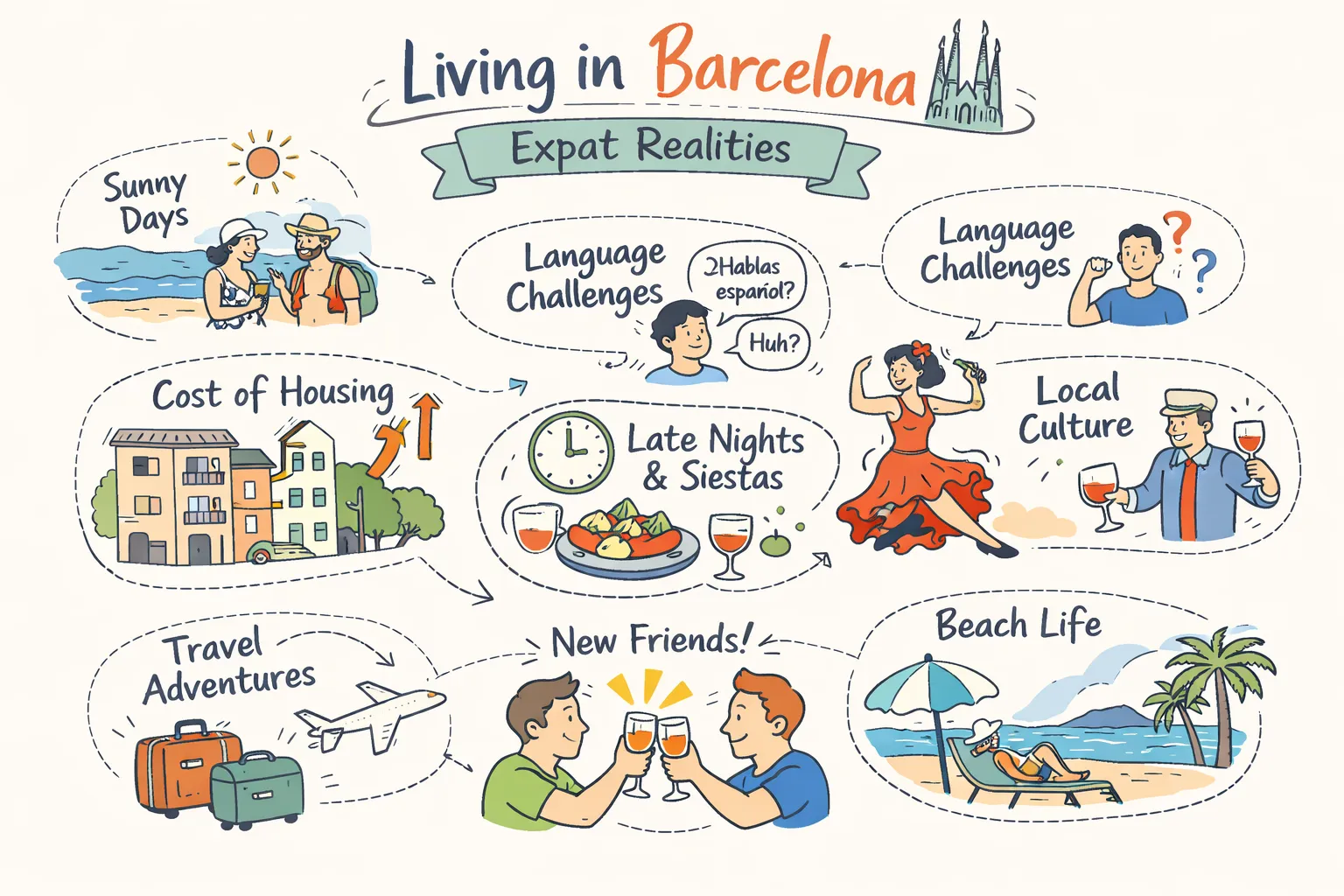
Barcelona is a sunny, cultured, urban-by-the-sea city that rewards people who want a creative, social life with good weather and a relatively affordable price compared with northern European capitals. If you prioritise cafes, neighbourhood character, walkability and a strong startup-and-service economy, Barcelona will suit you. If you need very high salaries, a quiet suburb detached from nightlife, or absolute certainty about bureaucracy timelines, pause and plan more carefully.
Quick scorecard — a snapshot you can read in 10 seconds: Cost: moderate‑to‑high (within Spain); Language: Spanish is essential, Catalan matters locally; Jobs: best in tech, sales and teaching; Family‑friendliness: good outside the busiest central areas; Nightlife: excellent; Pace of life: Mediterranean — relaxed days, lively nights.
Yes, if you want an urban, outdoor social life, strong food and culture scenes, walkable neighbourhoods and easy access to beaches and mountains. Think twice if you need very high starting salaries, absolute bureaucracy speed, or you prefer completely quiet, suburban living.
- Yes, if… you love warm winters, tapas culture, coworking and walking to errands.
- Think twice if… you require top-tier tech salaries, prefer a car-dependent lifestyle, or cannot tolerate busy summer tourist seasons.
If you want a field-tested starter set to take the next step, download Expats World’s Barcelona starter checklist (budget spreadsheet, admin templates and neighbourhood map) — a compact companion we reference through this article.
Real 2026 monthly budget: what €2,400–€2,440 actually covers
Bottom line: the realistic monthly cost for a single person in Barcelona in 2026 falls around €2,400–€2,440. Rent is the dominant line — roughly half or more of the total — followed by discretionary spending and utilities. Below is a short breakdown, then three sample budgets you can copy and modify.
Itemised ranges (typical, 2026): rent (studio / 1‑bed): ≈ €1,110–€1,700; groceries: €250–€300; utilities + internet: €150–€250; transport (monthly pass): ≈ €48; leisure & misc (dining out, gym, small trips): ≈ €350. These are city averages: your choices of neighbourhood, eating habits and social life change the totals fast.
| Category | Tight (economy studio) | Typical single (realistic) | Comfortable |
|---|---|---|---|
| Rent | €1,110 | €1,350 | €1,700 |
| Groceries | €250 | €275 | €300 |
| Utilities + Internet | €150 | €200 | €250 |
| Transport (monthly) | €48 | €48 | €48 |
| Leisure & Misc | €200 | €550 | €700 |
| Total | €1,758 | €2,423 | €2,998 |
Line‑by‑line math is simple: add fixed essentials (rent, utilities, transport) and then assign a discretionary bucket for food, social life and surprises. The “typical single” above matches the €2,400–€2,440 research range — this is the baseline to plan from. For broader comparisons and detailed region-by-region figures see the ThinkSpain cost of living guide.
Practical cost levers: flatshares reduce rent dramatically; choose less central neighbourhoods to save €150–€400; sign leases outside tourist high season (late summer) for better deals; buy at the market and cook — local produce cuts grocery bills by 20–30%; bulk transport cards and monthly passes reduce per-ride costs by 30–40%.
How to build your personal monthly estimate: list fixed recurring costs (rent + utilities + transport), forecast variable monthly spend (groceries + leisure), add 10–15% contingency for unexpected bills, and test the plan against three months of actual spending. For instant help, use the downloadable budget spreadsheet in Expats World’s Barcelona Expat Guide — it comes pre-filled with the numbers above so you can tweak by neighbourhood.
Where to live: neighbourhoods mapped to lifestyles and rents
Choose a neighbourhood by weighing commute, schools, nightlife exposure and noise sensitivity. Prioritise two or three target areas for viewings: it keeps search time focused and lets you compare apples-to-apples when offers arrive. For additional context on where expats typically settle across Spain, see Where Expats Live in Spain: 12 Communities & Costs.
Gràcia
Vibe: bohemian, village streets, plazas full of locals. Typical resident: young professionals, couples and families who value community. Pros: quieter evenings, characterful cafes, relatively affordable. Cons: limited big supermarkets, smaller flats. Approx one‑bed rent band: €1,000–€1,400 (estimate).
El Born
Vibe: indie, historic, central. Typical resident: creatives and those who want walk-to-everything city life. Pros: restaurants, culture and nightlife at your doorstep. Cons: higher rent and tourist footfall nearby. Approx one‑bed: €1,400–€1,800 (estimate).
Eixample
Vibe: the grid — modern amenities, long avenues. Typical resident: professionals, digital nomads and design lovers. Pros: excellent transport, shops, cafes; good coworking options. Cons: can be impersonal in parts. Approx one‑bed: €1,200–€1,700 (estimate).
Barceloneta
Vibe: beach-first. Typical resident: beach-lovers and short-term renters. Pros: sand and sea a short walk away. Cons: noisy in summer, tourist prices. Approx one‑bed: €1,200–€1,700 (estimate; seasonal spikes).
Les Corts
Vibe: residential and upmarket. Typical resident: families and professionals working near business districts. Pros: quieter, modern blocks. Cons: less nightlife. Approx one‑bed: €1,300–€1,800 (estimate).
Sant Andreu
Vibe: suburb-within-the-city. Typical resident: families and long-term residents. Pros: value for money, schools and community feel. Cons: longer commute to central nightlife. Approx one‑bed: €850–€1,200 (estimate).
El Clot
Vibe: emerging, local. Typical resident: budget-conscious professionals and families. Pros: improving amenities and good transport links. Cons: fewer expat-focused services. Approx one‑bed: €900–€1,250 (estimate).
Sants‑Montjuïc
Vibe: green, sporty and mixed-use. Typical resident: active city-dwellers who prioritise parks and facilities. Pros: large green areas, good transport. Cons: patchy nightlife. Approx one‑bed: €950–€1,400 (estimate).
Neighbourhood match at a glance: digital nomads → Eixample / Gràcia; families → Les Corts / Sant Andreu; students → El Born / Gràcia; beach‑lovers → Barceloneta; budget seekers → El Clot / Sant Andreu. For curated community picks and long‑term trends see Best Expat Communities in Spain: 12 Top Picks 2026.
Micro‑checks on viewings: check the nearest market, a laundromat and transport link; listen for night noise and check elevator/stair access; ask about sunlight and storage. Mini‑map idea: when you view, draw a 15‑minute walking radius showing the nearest metro stop, primary market, GP/clinic and grocery store — it reveals daily life in a glance.
Visa routes and residency: which option fits your plan
Spain provides several routes for non‑EU nationals who want to stay in Barcelona longer than a tourist visit. Below are the practical options, the people they suit, and the main documents you should gather now.
Digital Nomad Visa (DNV)
Purpose: legal residency for remote workers employed by foreign companies or freelancers working mostly with international clients. Suits: remote professionals who want to live in Spain without local employment. Key eligibility: employment ≥3 months with employer ≥1 year OR freelance with most clients outside Spain; clean criminal record; health insurance; proof of income (typical guidance points to around €2,700–€3,024/month but consulates vary). Work permission: yes (remote work for foreign clients). Typical duration: 1–3 years depending on application route. For a complete walkthrough of the visa requirements and application steps see the complete guide to Spain’s Digital Nomad Visa.
Non‑Lucrative Visa (NLV)
Purpose: residency for those with passive income or savings who do not plan to work in Spain. Suits: retirees or people living off investments. Key eligibility: proof of sufficient funds (research guidance ≈ €2,400/month or €28,800/year for main applicant), private health insurance, clean criminal record. Work permission: no. Typical duration: 1 year, renewable.
Student Visa
Purpose: full‑time studies. Suits: degree students, exchange students, language immersion. Key requirements: enrollment proof, funds, insurance. Work permission: limited part‑time work allowed under conditions — check the consulate for exact hour caps and rules.
Self‑Employed Visa
Purpose: start a business or freelance from Spain. Suits: entrepreneurs with business plans and viability. Key requirements: business plan, qualifications, proof of funds and clients. Work permission: yes. Timelines and documentation vary by region.
Golden Visa (note)
Purpose: residency by significant investment (real estate or capital). Suitability: high net‑worth individuals. Note: rules and availability change — check the latest consular guidance if you consider investment routes.
Extraordinary regularization (2026 window)
Purpose: a temporary route for those already in Spain before specific cutoff dates — check eligibility carefully. In 2026 there were specific application windows for long‑standing residents; confirm deadlines and document requirements with a lawyer or the consulate.
Key documents to gather before you apply: valid passport (with required remaining validity), apostilled criminal record certificates (from countries lived in the last 5 years), private health insurance, proof of funds (bank statements), employment contract or degree proof (for DNV), authenticated translations where required, passport photos and proof of accommodation. Timelines are typically 15+ working days; many applicants start at their local consulate but some apply from inside Spain depending on the visa. Expats World’s pre‑application dossier template includes a cover letter sample and a document checklist to speed the process.
Final visa note: national rules update quickly. Treat the numbers here as guidance, confirm with the Spanish consulate and use the Starter Pack checklist before you submit.
First 30–60 days admin checklist: NIE, empadronamiento, healthcare, bank
Triage your first two months by priority: Day 0–7 find accommodation and book your empadronamiento; Week 2–4 apply for NIE or TIE and begin other paperwork; Month 1–2 open a bank account and register for Catalonia’s CatSalut public healthcare if eligible. If you’re relocating from the U.S., pair this checklist with our Moving to Spain from the U.S.: The Practical Roadmap for US-specific timelines and tips.
Empadronamiento (registering your address): book an appointment with your district’s Ajuntament. Bring passport, rental contract or a signed owner‑declaration if you rent a room, and the completed registration form. If you’re renting a room, the owner’s signed statement plus a copy of their ID works as a legal workaround. Keep your certificate: it’s used for bank accounts, NIE/TIE and healthcare. For a practical how‑to and step‑by‑step checklist see how to register (empadronamiento).
NIE/TIE: apply at the Oficina de Extranjeros or Policía Nacional. The empadronamiento certificate is often required to secure an appointment. Avoid common paper traps: submit apostilled documents where needed, use correct passport photo specs, and don’t send screenshots of bank statements — consulates require originals or certified copies.
Healthcare: as a newcomer bridge with private insurance for immediate needs; then register with CatSalut via your local CAP after you have an NIE or proof of residence. Expect longer waits for specialists on public schedules — for fast access use a private clinic initially and transfer records to your CAP GP when registered.
Banking: Spanish banks typically ask for passport, NIE/empadronamiento and proof of income. If you don’t yet have the full dossier, open an account with a digital bank (they accept fewer documents) to receive salary and get an IBAN. Local high‑street banks (Santander, BBVA, Caixa) are useful for mortgage or long-term services, but require more paperwork and sometimes an appointment — debit cards usually arrive within days when opening in branch.
Take a printable “appointment survival kit” to every office: originals and copies, a pen, a translator app, the appointment confirmation and the exact Spanish form names. Expats World’s downloadable appointment templates include sample emails for booking and a checklist you can print for each visit.
Finding housing and signing a fair lease
Search strategy that works: choose 2–3 neighbourhoods, block 48 hours for consecutive viewings so you can compare, and always bring a complete dossier. Use the major portals (Idealista, Fotocasa, Spotahome, and Nestpick) plus local estate agents and expat groups on social media — the combination finds the best options fast.
Your renter’s dossier should include passport, recent bank statements (3 months), references (previous landlords or employer), a contract offer letter and any guarantor documentation. If you lack Spanish payroll, be ready to offer a guarantor, larger deposit, or several months’ rent in advance.
What to read carefully in the lease: the exact contract length and renewal mechanics; who pays comunidad (building fees) and utilities; an inventory clause listing furnishings and their condition; subletting restrictions and whether short‑term rentals are allowed; and the deposit clause — residential contracts commonly ask for a one‑month legal deposit plus any additional guarantees agreed in writing. Never sign without clear rules for repairs and maintenance responsibility.
Negotiation scripts you can use: “If I sign today, will you accept a six‑month lease and one month’s deposit instead of two?” or “Would the landlord consider a utilities‑included option for an additional €50/month?” Common concessions include small maintenance fixes, flexible move‑in dates, or a rent freeze in exchange for a longer contract.
Fraud red flags: no in‑person viewing, pressure to pay via non‑traced methods, the landlord refusing to show ID or a property title, or contracts with vague payment instructions. At move‑in: record meter readings, take photos of damage, and sign an inventory — these protect your deposit. If you want help, Expats World’s rental negotiation checklist includes scripts and a move‑in PDF you can use on viewings.
Working in Barcelona: where English works and what to expect
Strong sectors for English speakers: tech and AI (22@ district), sales & business development for international markets, English teaching and international schools, hospitality & tourism, and multilingual customer service centres. Barcelona is a major startup hub; English is often the working language in tech teams and international companies.
Salary reality check: Barcelona salaries are typically lower than in Northern Europe. Rough 2026 ranges: tech roles (mid to senior) ≈ €45,000–€85,000+; sales/B2B roles ≈ €35,000–€55,000 including OTE; teaching roles ≈ €23,000–€42,000 depending on experience and institution. Startups may pay less but offer equity or other perks.
Practical job‑hunt plan: optimise LinkedIn (Spanish and English summaries), reach out to specialised recruiters, attend meetups and co‑working events, monitor local job boards and register for job fairs (e.g., the May 20, 2026 Time Out Market jobs fair). For freelancers, the Digital Nomad Visa makes long stays legal — set up invoicing, check VAT rules, and seek local tax advice early. Some experienced relocators benefit from the Beckham Law tax options; check eligibility.
Networking and outreach: send short messages that mention why you’re a good fit and ask for 15 minutes to learn. Example: “Hi María — I’m a product marketer relocating to Barcelona in June and building contacts in SaaS — could we meet for 15 minutes for advice on the local market?” Follow a 30‑day interview plan: week 1 build/optimise profile and reach out to 20 contacts, week 2 attend events and apply to openings, week 3 follow up and schedule interviews, week 4 refine pitches and close offers.
Settling in and thriving: daily life hacks, healthcare, language and long‑term planning
Everyday hacks: shop markets (Mercat de la Llibertat, Mercat de Sant Antoni) for fresher and cheaper produce; supermarkets have good deals mid‑week; many shops close Sunday afternoons — plan weekend errands accordingly. Eating out is affordable if you choose daily menus (menu del día) at lunchtime. Tipping is polite but modest — rounding up or 5–10% for good service is normal.
Health & safety: register with CatSalut for a local GP (CAP) once you have residency. For faster appointments, book a private GP and keep medical records digital. Be vigilant against pickpockets in tourist hotspots — use a zippered bag and avoid distracted phone use on La Rambla and crowded metros. On the beach, don’t leave valuables unattended.
Language strategy: learn functional Spanish fast; it opens day‑to‑day life and most service jobs. Catalan matters in schools, some public services and for deeper local integration — a few Catalan phrases are appreciated. Fastest gains: intensive weekly classes, language exchanges, and daily conversation practice with locals. Use apps for vocabulary and join local conversation meetups to accelerate progress.
Building belonging: join a language exchange, a sports club, volunteer group, or a co‑working community. Vet service providers via local expat groups and community reviews, and ask for references. Small rituals (regular tapas with neighbours, market days) create routines and local friendships faster than large one‑off events. For practical community-building ideas see Finding Your People in Barcelona: Expat Community Guide.
Long‑term admin reminders: track visa renewal dates, keep empadronamiento up to date after moves, and set calendar reminders for tax year and social security filings. After several years of legal residence you may qualify for long‑term residency or other status — plan with a specialist if this is your goal.
Five‑minute action list: save the typical monthly budget to your phone; book an empadronamiento slot for the week after you arrive; assemble your rental dossier (passport + bank statements); apply for private insurance to bridge healthcare; and join one local meetup this week. These small actions reduce friction in your first month.
Barcelona rewards those who prepare: plan your finances around rent, choose neighbourhoods that fit daily life, and prioritise the empadronamiento + NIE steps in your first 30 days. If you’re ready to go further, download Expats World’s Barcelona starter pack — it includes the budget spreadsheet, admin checklist, rental scripts and a neighbourhood map to save you weeks of work and avoid common mistakes.