
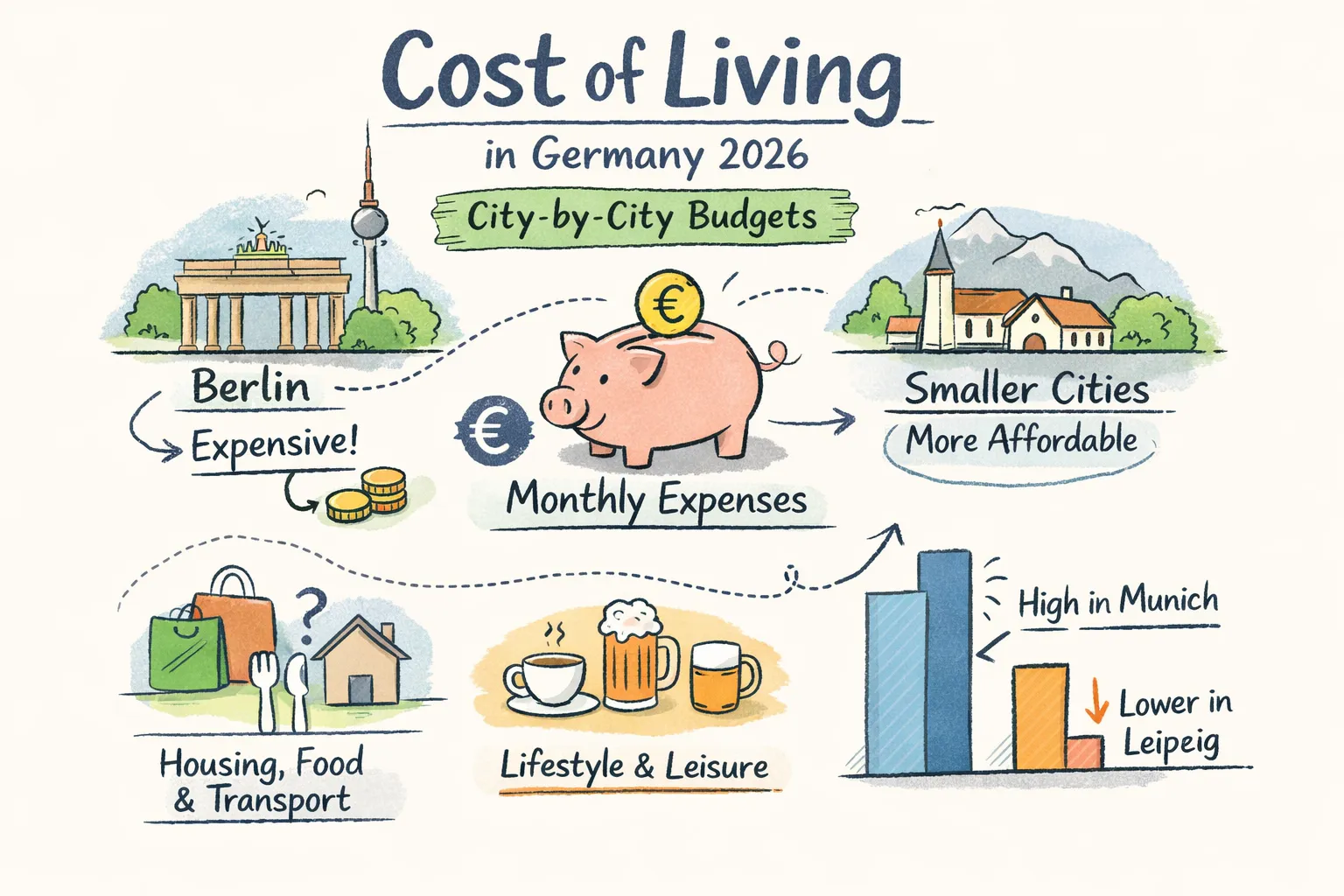
Can you live in Munich on €2,500? Berlin on €1,500?
Short answer: maybe — and only if your rent, commute and childcare needs line up. This guide gives you city-by-city monthly budgets for 2026, practical assumptions so you can adapt the numbers, and a downloadable spreadsheet from Expats World to run the exact scenario for your life.
Expats World’s city guides and budget calculator informed these figures — use them to tailor the examples below to your salary, family size and moving plan. (See the Expats Guide for Germany for an overview of workflows and resources.)
What you’ll get in 5 seconds
| Representative single monthly total (1BR) | Berlin | Munich | Hamburg | Frankfurt | Cologne |
|---|---|---|---|---|---|
| Typical 2026 range (net) | €1,500–2,400 | €2,200–3,200 | €1,700–2,700 | €2,000–3,000 | €1,650–2,500 |
Snapshot: typical monthly budgets for students, singles and families
| Persona | Berlin | Munich | Hamburg | Frankfurt | Cologne |
|---|---|---|---|---|---|
| Student (shared room / dorm) | €750–1,150 | €900–1,600 | €800–1,300 | €800–1,300 | €800–1,250 |
| Single professional (1BR) | €1,500–2,400 | €2,200–3,200 | €1,700–2,700 | €2,000–3,000 | €1,650–2,500 |
| Family of four (3BR) | €3,000–4,300 | €3,700–4,800 | €3,200–4,400 | €3,300–4,600 | €3,100–4,200 |
How to read the ranges: each cell bundles typical rent + utilities + groceries + transport + insurance + modest extras. Ranges exist because a) city centre vs perimeter makes the largest difference, and b) furnished short-term lets can be 10–30% pricier. If you want an instant, personalised number, plug your expected rent and salary into Expats World’s budget calculator (download: expatsworld.com/budget-calculator).
Headline takeaways: students in major German cities commonly manage on roughly €800–1,400/month; single professionals generally fall between €1,500–3,000; families usually see €3,000–4,800. Always verify live rents for each city and neighbourhood.
How to read these numbers: assumptions, methodology and sources
These budgets are net monthly totals (what you pay out of pocket). They combine representative rent ranges with realistic allowances for utilities, transport and daily life. Key assumptions:
Persona definitions
Student — shared room or student dormitory, use of Mensa, minimal discretionary spending. Single — one-bedroom apartment, routine groceries, public transport (Deutschlandticket). Family of four — three-bedroom apartment, two children, childcare or school fees included where typical.
Housing — 1BR and 3BR rent ranges reflect unfurnished market listings (cold rent). Deposit (Mietkaution) typically equals up to three months’ cold rent. Brokerage (Makler) commission varies by state and listing; recent practice often leaves the landlord paying in many cities, but verify per listing.
Utilities & services — cold rent excludes Nebenkosten (incidental costs). Typical bundled utilities (heating, water, garbage, building services) range €120–€350/month depending on size and consumption. Broadband is commonly €15–€50; mobile plans €5–€80 depending on data.
Transport — standard urban commuter assumption is the Deutschlandticket at €63/month (2026). Car ownership is modelled separately when relevant; public transport is usually the cheaper in-city baseline.
Income & taxes — we report costs in net euros. When we reference salaries, net take-home is estimated from common gross→net conversion ranges (roughly 60–70% net depending on tax class and deductions). Use local brutto-netto calculators to convert your offer.
Sources & method — ranges are built from recent market listings and official statistics: Statistisches Bundesamt (Destatis), ImmobilienScout24 and Immowelt supply rent signals; local Verkehrsverbünde (VBB, MVV, HVV) inform transport; Auswärtiges Amt and DAAD guide visa and student funding rules; consumer price indices and salary surveys provide wage context. For broader cost-of-living context see resources such as Expatica’s cost of living guide and student-focused summaries like Studying-in-Germany’s living costs page. Where 2026 point-estimates are missing, I used conservative ranges grounded in 2025–early-2026 listings and flagged uncertainty.
How to adjust for your case — a simple formula: Your monthly budget = (expected rent + utilities + transport + groceries + insurance + extras) × 1.1 (10% buffer for irregulars). Rent is the dominant lever; small shifts there change totals by hundreds of euros.
City-by-city budgets: Berlin, Munich, Hamburg, Frankfurt, Cologne
City context matters. Job markets, neighbourhood supply and transport links change both price and lifestyle. Below are compact profiles with example budgets for each persona. Check live listings (Immowelt, ImmobilienScout24) before you sign anything.
Berlin
Snapshot: the capital mixes startups, creatives and public sector jobs. Rental demand remains high but outer districts still offer savings; popular zones for newcomers include Neukölln, Friedrichshain and Kreuzberg.
Rent snapshot (2026): small 1BR averages around €1,050 unfurnished (center higher, periphery lower); 3BR family flats commonly range €1,600–2,800 depending on district and quality.
Student in Berlin ≈ €750–1,150 — rent €350–600 (shared room/dorm), groceries €200–300, Deutschlandticket €63, utilities & internet €50–80 (if split), health/other €80–150.
Single professional in Berlin ≈ €1,500–2,400 — 1BR rent €1,050–1,400, utilities €120–200, groceries €250–320, transport €63, insurance/phone €100–200, extras €100–300.
Family of four in Berlin ≈ €3,000–4,300 — 3BR rent €1,600–2,400, utilities €300, groceries €550–700, transport €150–250 (children discounts or regional passes), childcare €200–700 depending on type, insurance €200–300, extras €200–400.
Biggest cost drivers: rent and deposit practices; demand for well-located, furnished short-lets keeps prices high for newcomers.
Practical tips: prioritize WG-Gesucht and Studentenwerk for student rooms; have Anmeldung-ready documents when applying; consider outer districts like Lichtenberg or Marzahn for lower rent and S-Bahn commutes. For a deeper neighbourhood and logistics overview, see the Berlin Expat Guide.
Neighbourhood trade-off: cheaper/commutable — Lichtenberg, Spandau; central/expensive — Mitte, Prenzlauer Berg.
Munich
Snapshot: Bavaria’s economic engine (automotive, engineering, tech) pays well and costs more. Good salaries reduce stress for many, but housing is the main squeeze.
Rent snapshot (2026): typical 1BR rentals commonly fall €1,300–1,900; 3BR family apartments frequently range €2,000–3,500, with central districts commanding strong premiums.
Student in Munich ≈ €900–1,600 — shared accommodation or Studentenwerk halls €400–800, groceries €250–300, transport €63 (Deutschlandticket) or student discount, utilities/internet €70–120, student insurance €80–200.
Single professional in Munich ≈ €2,200–3,200 — 1BR rent €1,500–2,000, utilities €200–300, groceries €300, transport €63, insurance/phone €120–250, leisure €150–300.
Family of four in Munich ≈ €3,700–4,800 — 3BR rent €2,200–3,200, utilities €330, groceries €600–800, childcare €400–900 (public vs private), transport €150–250, insurance €250–350.
Biggest cost drivers: rent and childcare; space is scarce inside the S-Bahn ring and central neighbourhoods (Maxvorstadt, Altstadt) are expensive.
Practical tips: check suburbs with fast S-Bahn links (Pasing, Moosach, Neuperlach) for value; prepare proof of income and references — competition moves fast. For neighbourhood-specific moving tips and checklists, consult the Munich Expat Guide.
Neighbourhood trade-off: cheaper/commutable — Pasing, Neuperlach; central/expensive — Maxvorstadt, Altstadt-Lehel.
Hamburg
Snapshot: port and media hub with diverse neighbourhoods. Waterfront and HafenCity come at a premium; inland boroughs offer better value and good transit.
Rent snapshot (2026): 1BR €1,100–1,700; 3BR €1,800–3,000 depending on district and renovation level.
Student in Hamburg ≈ €800–1,300 — dorm or WG €350–700, groceries €200–300, transport €63, utilities & internet €60–120, student insurance/fees €80–150.
Single professional in Hamburg ≈ €1,700–2,700 — rent €1,100–1,600, utilities €150–250, groceries €250–320, transport €63, insurance €100–200, extras €100–300.
Family of four in Hamburg ≈ €3,200–4,300 — rent €1,800–2,700, utilities €300, groceries €550–700, childcare €200–700, transport €120–220, insurance €200–300.
Biggest cost drivers: central and waterfront rents, and building efficiency — older stock can mean higher heating bills in winter.
Practical tips: search in Altona, Wandsbek or Barmbek for better value; verify Energieausweis (energy certificate) to estimate heating costs.
Neighbourhood trade-off: cheaper/commutable — Harburg, Barmbek; central/expensive — HafenCity, Neustadt.
Frankfurt
Snapshot: banking and finance centre with strong salaries and comparatively high service costs. Short commutes and international firms attract many expats.
Rent snapshot (2026): 1BR €1,100–1,800; 3BR €1,900–3,500 depending on proximity to city centre and quality.
Student in Frankfurt ≈ €800–1,300 — share housing €350–700, groceries €200–300, transport €63 (or student discount), utilities €60–120, insurance €80–150.
Single professional in Frankfurt ≈ €2,000–3,000 — 1BR rent €1,200–1,700, utilities €150–250, groceries €250–320, transport €63, insurance €120–220, extras €150–300.
Family of four in Frankfurt ≈ €3,300–4,600 — 3BR rent €2,000–3,000, utilities €320, groceries €600–800, childcare €300–800, transport €150–250, insurance €250–350.
Biggest cost drivers: rent and childcare; while salaries are strong, childcare availability and costs can significantly change family budgets.
Practical tips: consider Bornheim or Sachsenhausen for family-friendly housing; leverage employer benefits where possible (childcare subsidies, relocation support). More local tips and logistics are in the Frankfurt Expat Guide.
Neighbourhood trade-off: cheaper/commutable — Höchst, Fechenheim; central/expensive — Westend, Innenstadt.
Cologne
Snapshot: a Rhine city with media, creative industries and a lively cultural scene. Costs sit under Munich and Frankfurt but above many mid-sized German cities.
Rent snapshot (2026): 1BR €900–1,400; 3BR €1,600–2,800 with variation by district.
Student in Cologne ≈ €800–1,250 — WG/dorm €350–650, groceries €200–300, transport €63 or student pass, utilities €60–120, insurance €80–150.
Single professional in Cologne ≈ €1,650–2,500 — rent €900–1,300, utilities €140–240, groceries €250–320, transport €63, insurance €120–220, extras €100–300.
Family of four in Cologne ≈ €3,100–4,200 — 3BR rent €1,600–2,400, utilities €300, groceries €550–700, childcare €200–700, transport €120–220, insurance €200–300.
Biggest cost drivers: rent in popular districts (Altstadt, Südstadt) and seasonal energy bills in older housing stock.
Practical tips: look to Ehrenfeld or Nippes for balanced rents; use local Facebook groups and Stadtteilmarkt for second-hand furniture and bargains.
Neighbourhood trade-off: cheaper/commutable — Porz, Mülheim; central/expensive — Altstadt, Südstadt.
What really drives your monthly costs (and how to think about trade‑offs)
Five levers change totals most dramatically: housing, taxes & social insurance, childcare/education, transport (car vs public) and discretionary lifestyle. Every budget is a combination of these choices: a cheaper flat increases commute time; a car reduces transit stress but adds fixed annual costs.
Housing is king. Rent should be the first line of defense in budgeting. If rent consumes over 40% of your expected net income, reassess location or living arrangement. Deposits are typically up to three months’ cold rent, and moving costs (first month + deposit + basic furniture) are a one-time hit many forget.
Health insurance. Public (gesetzliche Krankenversicherung) is income‑based and broadly predictable; private insurance can be cheaper for some high earners or self-employed people but brings long-term commitments and different cost profiles for families. For families and high earners, this choice materially shifts monthly outgoings.
Energy & utilities. Heating bills have been volatile. Consumption matters more than unit price: insulating behaviour, thermostat settings and window airing reduce bills. Expect winter heating spikes; budget an extra €50–150/month in colder months for older flats.
Car vs public transport. Train and tram use with the Deutschlandticket (€63/month) is hard to beat for inner-city commuting. Owning a car introduces insurance, fuel, VAT, maintenance and parking; in many cities, public transport plus occasional car rental is cheaper than full ownership.
If you must cut roughly €300/month, housing adjustments (move to a peripheral district or a smaller apartment) tend to achieve the largest, fastest effect. Switching from a private car to public transport or trimming discretionary spending (dining out, subscriptions) are the next simplest levers.
Students & visas: budgeting for study and proof-of-funds
International students typically live on shared housing or student halls to keep costs low. Mensa cafeterias reduce food spend and student transport discounts exist in many regions.
Blocked account for visa (Sperrkonto): as of 2026 the standard amount used for student visa proof is €11,904 (≈ €992/month withdrawable once in Germany). Confirm the current required sum with the German mission where you apply—rules can change and embassies may accept scholarships or parental guarantees instead of a blocked account.
Part-time work: student visa holders can usually work limited hours under residence regulations; check the current rules with the Ausländerbehörde and your student visa conditions. Realistically, many students supplement income with part-time jobs that add roughly €200–€600/month depending on hours and local wages.
- Student checklist on arrival: open a blocked account (or secure alternative proof), estimate tuition + at least 3 months living buffer, register with Studentenwerk for housing support and Mensa access, and arrange student health insurance or a student tariff.
Student money-savers include Mensa meals, second-hand furniture markets, and student discount cards for transport and museums.
Wages, affordability and how to test a job offer against local costs
Always convert gross to net before you commit. Use an online Brutto‑Netto calculator for an accurate net take-home. As a rule of thumb, net pay tends to be 60–70% of gross for many full-time employees in tax class I.
Example scenarios (illustrative): a mid-level IT role in Munich might pay a gross of €65,000/year (≈ €5,416/month gross), translating to an estimated net of ~€3,300–€3,900 depending on tax class and social contributions. If a 1BR near your workplace costs €1,600, rent is roughly 41–48% of take-home — high pressure on savings. A Berlin startup role at €48,000/year (≈ €4,000/month gross) may net ~€2,400–€2,700; a typical 1BR at €1,050 then represents about 39–44% of net.
Affordability rule-of-thumb: aim for rent under 30–40% of net income when possible, and target saving 10–20% of net income after fixed costs.
Quick calculation in plain steps: estimate monthly net income → subtract fixed costs (utilities, transport, insurance, childcare) → the remainder is your discretionary & saving pool → set a max rent so savings target remains feasible. Add a relocation buffer for deposit, initial setup and potential bridging costs.
Quick savings, rent-finding hacks and first-30-day checklist
Small habits add up: shop at discounters (Aldi/Lidl), cook at home, use flea markets and second‑hand groups for furniture, and compare mobile plans after arrival. Energy-saving behaviours — lowering thermostats, using LED bulbs, and avoiding long hot showers — reduce winter spikes.
Housing tactics that work in Germany: be application-ready with Anmeldung, Schufa (if available), proof of income or guarantor, and references; search mid‑month when listings get relisted; use WG‑Gesucht for shared flats and Studentenwerk for student rooms.
First 30-day checklist (practical, actionable)
- Secure temporary accommodation for arrival (short-term flat, youth hostel or serviced apartment).
- Register your address (Anmeldung) at the local Bürgeramt — needed for almost everything that follows.
- Open a German bank account and apply for a tax ID if starting work.
- Set up health insurance (public or private) and confirm coverage start date.
- Get the Deutschlandticket or local transit pass to simplify commuting (students may have discounted rates) — check the latest price details before purchase atthe Deutschlandticket information site.
- Start searching long-term housing with completed documents ready to send immediately.
- Order internet access and set up utilities where needed (some landlords include Nebenkosten; confirm).
- Join local expat or neighbourhood groups for real-time tips and second‑hand finds.
How to use these budgets to plan — tools, next steps and where Expats World helps
Turn these ranges into your plan with a simple sequence: download Expats World’s editable monthly budget spreadsheet, plug in your expected rent and salary, then run the affordability check. The template separates fixed vs variable costs and calculates rent-to-net ratios and a relocation buffer automatically.
Use Expats World’s city guides for neighbourhood deep dives and routine checklists (Anmeldung workflow, schooling options, local commuting maps). Share your draft budget in the Expats World community to compare with recent arrivals — real numbers from people on the ground are the best sanity check. For more background on national-level cost trends you can also consult broader cost-of-living summaries such as Studying-in-Germany’s cost overview and regional summaries like the one on Expatica.
Suggested next reads: “How to find a flat in [City]” (practical listing alerts and application scripts), “Student finance checklist for Germany” (blocked accounts, scholarships), and “Opening a bank account & insurance basics”.
7/30/90 day plan highlight: within 7 days complete Anmeldung and banking; within 30 days secure long-term housing and insurance; within 90 days finalize school/childcare arrangements and build a three-month emergency fund.
Soft CTA: download the budget template at expatsworld.com/budget-calculator and compare your numbers with recent posts in the community to refine estimates.
Short conclusion
Rent, childcare and health insurance are the three levers that will most change your 2026 monthly totals in Germany. Use the ranges here as a starting point, plug your exact rent and salary into a spreadsheet, and update the plan once you have a firm offer and a rental quote. If you’d like, share your intended city and rent in the comments — the community and I can help you fine-tune the numbers.
FAQ prompts to expand later
Where do I find up‑to‑date rent figures for a specific neighbourhood? (Check ImmobilienScout24, Immowelt and local Facebook groups.)
How do I calculate the exact blocked account requirement for my visa? (Confirm with the German mission/consulate handling your application.)
How should I adapt the budget if I plan to own a car? (Estimate annual insurance, fuel, tax and maintenance and divide by 12 to add to monthly costs.)